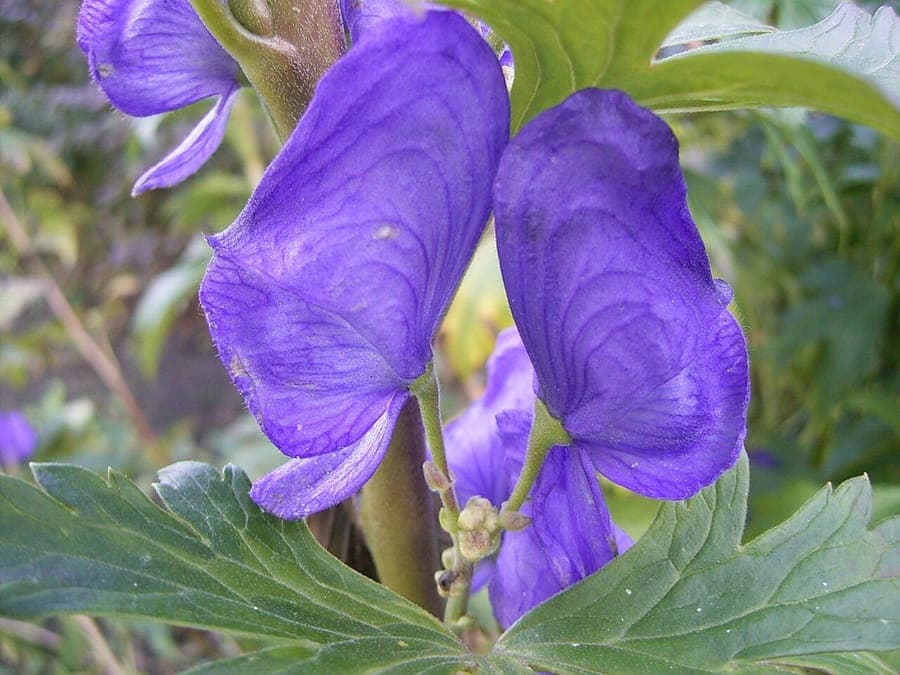
No machine-readable author provided. TeunSpaans assumed (based on copyright claims). / CC BY 2.5, via Wikimedia Commons
Chinese Aconite (Aconitum carmichaelii): complete guide
Aconitum carmichaelii
Want to see Chinese Aconite (Aconitum carmichaelii): complete guide in your garden?
Full design in HD: €7.99
Look after your Chinese Aconite with the GardenWorld app
Identify plants with your camera and get a care calendar with reminders for this plant.


Overview
Chinese aconite (Aconitum carmichaelii), also called Carmichael's monkshood, is one of the very last perennials to bring real colour to the border. Just as most summer flowers are fading, it sends up sturdy spires of deep violet-blue blooms in September and October. Each flower is shaped like a monk's hood or a helmet, which explains the family of common names shared by all aconites. Its late season sets it apart from the familiar common monkshood (Aconitum napellus), which flowers in high summer.
The species is native to central and western China, where it grows along woodland edges, in damp mountain meadows and among scrub. In gardens the best-known selection is 'Arendsii', raised by the German nurseryman Georg Arends. It reaches 100 to 150 cm, has strong stems that rarely flop, and carries intensely blue flowers. The Wilsonii Group, including 'Kelmscott' and 'Barker's Variety', grows taller still and can top 180 cm.
A word of warning before anything else: Aconitum carmichaelii is among the most poisonous plants grown in European gardens, so this guide gives its toxicity a section of its own. Treated with respect, it will reward you for many years. If you would like to know where it would sit best in your own plot, on gardenworld.app you can have a garden design made in which late performers such as monkshood get a proper place, safely away from play areas and the vegetable patch.
Toxicity and safety
Every part of the plant is highly toxic: the tuberous roots, stems, leaves, flowers and seeds. It contains aconitine and related alkaloids, which disrupt the heart rhythm and the nervous system. Even a small amount can cause serious poisoning in people. Early symptoms include tingling and numbness in the mouth and face, followed by nausea, vomiting and an irregular heartbeat. If you suspect someone has eaten any part of it, contact a doctor, NHS 111 or the emergency services straight away.
The toxin can also be absorbed in small amounts through the skin, and especially through cuts and grazes. Always wear sturdy gardening gloves when planting, dividing, cutting back or arranging the flowers, and wash your hands afterwards. Avoid touching your eyes or mouth while you work, and do not leave clippings where animals can reach them.
Pets and livestock are just as much at risk. Dogs, cats, rabbits, horses and poultry can become gravely ill or die after eating it. So do not plant it where young children play unsupervised, next to a chicken run or paddock, and never in or beside the vegetable garden. The roots can be mistaken for edible roots or horseradish when digging, and seeds or leaves can end up among crops unnoticed. A spot towards the back of an ornamental border, where you only go to admire the flowers, is the sensible choice.
Appearance and bloom cycle
Aconitum carmichaelii forms an upright clump of glossy, dark green, rather leathery leaves, deeply cut into three to five lobes. By May and June the clump makes a handsome green mass that serves as a backdrop for summer flowers.
From late August the flower stems shoot up. The blooms are packed into dense racemes at the top and on side branches. Each flower has a prominent hood about 2 to 3 cm tall that shields the nectar. Only long-tongued bumblebees can reach it easily, which makes the plant a valuable late source of food for them. The colour ranges from deep violet-blue in 'Arendsii' to soft lavender-blue in the Wilsonii Group. Flowering runs from September into October, and in mild years until the first frost.
Ideal location
Chinese aconite does best in partial shade, or in sun with some protection from the fiercest afternoon heat. In the wild it grows at the edges of woodland, and its preferences reflect that: morning sun and light shade later in the day suit it perfectly. Full sun is fine as long as the soil never dries out. In a hot, dry spot the leaf edges scorch and flowering is disappointing.
Because of its height it belongs at the back or in the middle of a border. It also looks good at the edge of a shrub border or in a lightly shaded woodland planting. Allow 40 to 50 cm between plants. A sheltered position stops the tall Wilsonii varieties being knocked over by autumn gales.
Free preview
Want to see Chinese Aconite (Aconitum carmichaelii): complete guide in your garden? Make a free preview of your design.
Soil requirements
This plant likes a fertile, humus-rich soil that stays moist without becoming waterlogged. A good loam, or heavier garden soil improved with compost, is ideal. On light, sandy ground, dig plenty of compost or leaf mould into the top 30 cm at planting time to help the soil hold moisture. It tolerates both slightly acid and chalky conditions; a pH between 5.5 and 7.5 is fine.
What the tubers will not tolerate is standing water in winter. On heavy clay that becomes saturated, coarse grit or a slightly raised bed helps. A spring mulch of compost or bark keeps the root run cool and moist.
Watering
During the first year after planting, give a good can of water once a week in dry weather so the roots establish well. After that the plant is fairly self-sufficient in a typical British summer, especially in partial shade. During long dry spells in July and August you will need to water, though, because that is when the flower buds form. Drought at that stage means fewer, shorter flower spikes and sometimes powdery mildew on the leaves.
Pruning
Pruning is simple. After flowering, in November, cut the brown stems down to just above ground level. Alternatively, leave them until spring; the old stems add a little winter structure and give the crowns some protection from hard frost. Wear gloves every time and clear away the debris at once.
There is no point deadheading for a second flush, because this late species will not produce one. You can, however, remove spent spikes to stop seed forming, so that no poisonous seedlings turn up in unexpected places. The tall Wilsonii Group needs support in an open site: put a plant support or a few sturdy canes around the clump in May. 'Arendsii' usually stands up on its own.
Every three to four years an overcrowded clump can be divided, in October or March. Lift it, split the tubers with a spade and replant the pieces immediately. Gloves are essential here too.
Maintenance calendar
March–April: Cut away old stems if you left them standing. Scatter a handful of organic fertiliser or compost around the clump. Dividing and moving can be done now.
May: Put supports in place for tall varieties. Apply a mulch to keep the soil moist.
June–August: Water during dry spells. Watch for powdery mildew and for slugs on young shoots.
September–October: Peak flowering. Enjoy the bumblebees. Cut stems for a vase only with gloves on, and keep the vase out of reach of children and pets.
November: Cut back the stems or leave them as a winter silhouette. Plant new tubers or pot-grown plants now.
December–February: Dormant period. No work needed.
To keep these jobs in mind, the plant calendar on gardenworld.app shows what needs doing in the garden each month, late bloomers like monkshood included.
Winter hardiness
Aconitum carmichaelii is exceptionally hardy. The RHS rates it H7, meaning it survives temperatures well below -20 °C, roughly USDA zones 3 to 8. Anywhere in Britain and the rest of north-western Europe it needs no winter protection in the open ground.
The real winter risk is wet soil rather than cold. Tubers sitting in water for months will rot, so good drainage matters.
Companion plants
Chinese aconite is a star of the autumn border and pairs well with other late performers. A classic partner is New England aster (Symphyotrichum novae-angliae), whose pinks and purples blend beautifully with the deep blue. Sneezeweed (Helenium autumnale) and black-eyed Susan (Rudbeckia fulgida) are strong companions too: their warm orange and yellow make the blue really glow.
For a more natural feel, combine it with great burnet (Sanguisorba officinalis) and grasses such as Miscanthus. In partial shade, hostas (Hosta sieboldiana) work well at its feet, where their broad leaves hide the bare lower stems. Avoid placing it in the same bed as edible herbs or vegetables.
Final thoughts
Aconitum carmichaelii gives you an autumn colour few other plants can match: a deep, clear blue on sturdy stems, busy with bumblebees. It needs little maintenance, is extremely hardy and will stay in the same place for years.
The other side of the coin is its severe toxicity. Always handle it with gloves, plant it away from children, pets and the vegetable patch, and tell everyone in the household what it is. With those precautions in place, Chinese aconite is a safe and spectacular addition to any border that needs to keep flowering late into the year.
Frequently asked questions about Chinese Aconite
Is Chinese Aconite winter hardy?
Aconitum carmichaelii is exceptionally hardy. The RHS rates it H7, meaning it survives temperatures well below -20 °C, roughly USDA zones 3 to 8.
When and how do you prune Chinese Aconite?
Pruning is simple. After flowering, in November, cut the brown stems down to just above ground level.
How much water does Chinese Aconite need?
During the first year after planting, give a good can of water once a week in dry weather so the roots establish well. After that the plant is fairly self-sufficient in a typical British summer, especially in partial shade.
Where does Chinese Aconite grow best?
Chinese aconite does best in partial shade, or in sun with some protection from the fiercest afternoon heat. In the wild it grows at the edges of woodland, and its preferences reflect that: morning sun and light shade later in the day suit it perfectly.
What soil does Chinese Aconite need?
This plant likes a fertile, humus-rich soil that stays moist without becoming waterlogged. A good loam, or heavier garden soil improved with compost, is ideal.

See it in your garden
See Chinese Aconite in your garden
One photo of your garden and a few questions. You see the result in about a minute.
Try it with a photoIdentify this plant in your own garden. Identify a plant
Similar plants
New England aster: complete guide
Symphyotrichum novae-angliae
Learn all about New England aster (Symphyotrichum novae-angliae), a stunning fall-blooming perennial.
Fall Sneezeweed (Helenium autumnale): complete guide
Helenium autumnale L.
Discover Fall Sneezeweed, a stunning late-season bloomer with red, yellow, and copper flowers. Hardy perennial for borders and late-season color.
Sanguisorba: complete guide
Sanguisorba officinalis
Discover everything about Sanguisorba officinalis. Learn about its elegant appearance, ideal growing conditions, care and maintenance comprehensively.
