
Wikimedia Commons / CC BY-SA 3.0, via Wikimedia Commons
Fern-leaf yarrow: complete guide
Achillea filipendulina
Want to see Fern-leaf yarrow: complete guide in your garden?
1 minute, no credit card
Overview
Fern-leaf yarrow, or Achillea filipendulina, is a robust herbaceous perennial that brings bold texture and long-lasting colour to sunny borders. Native to the mountainous regions of Central Asia – including Iran, Afghanistan, and the Caucasus – it thrives in hot, dry conditions. In temperate gardens across zones 4 to 9, it stands tall with fern-like foliage and large, flat-topped clusters of golden-yellow flowers from early summer through late August.
This plant forms upright clumps, reaching heights of 90 to 120 cm, and spreads slowly via creeping rhizomes. It's not invasive, but it does steadily fill in its space over a few seasons. As a member of the Asteraceae family, it shares traits with daisies and coneflowers – particularly in its flower structure and appeal to pollinators. Once established, it asks for very little, making it a solid choice for low-maintenance gardens.
On gardenworld.app, you can design a pollinator-friendly garden layout that features Fern-leaf yarrow as a structural backbone among drought-tolerant perennials.
Appearance & bloom cycle
The foliage of Achillea filipendulina is its first standout feature. Finely divided, feathery leaves in a soft, medium green create a delicate cloud-like base. When brushed, they release a faint, spicy scent – slightly camphorous, sometimes compared to chrysanthemums. This aromatic quality may help deter deer and rabbits.
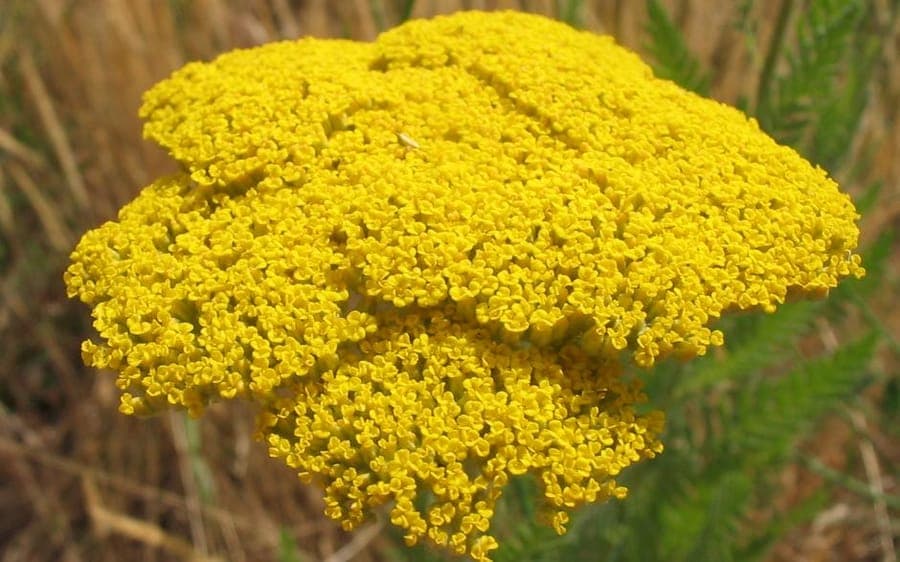
From June to late August, sturdy, hairy stems rise above the foliage, topped with 10–15 cm wide flower heads. These are composed of hundreds of tiny, densely packed yellow florets forming flat umbels. The golden hue is rich and warm, standing out even in bright midday sun. Deadheading can encourage a lighter rebloom in early autumn, though it's not guaranteed.
Ideal location
Full sun is non-negotiable. Aim for 8 hours of direct sunlight daily – this plant scores an 8 on the light scale for good reason. In shade, it becomes leggy, flops over, and produces far fewer flowers. Plant it at the back or middle of a sunny border where it won't be shaded by taller neighbours.
Air circulation is key. Crowded conditions or poor airflow invite powdery mildew, especially in humid climates. Avoid planting under dense tree canopies or in damp corners of the garden. On gardenworld.app, you can simulate sun exposure in your garden and test whether your site meets the light needs of Fern-leaf yarrow.
Soil requirements
Well-drained soil is essential. This yarrow tolerates poor, rocky, or sandy soils but struggles in heavy clay or waterlogged conditions. The ideal pH range is alkaline: 7.5 to 8.0. If your soil is acidic, consider amending with lime or planting in a raised bed with gravelly mix.
It doesn't demand rich soil – in fact, too much fertility leads to floppy growth and fewer blooms. A light top-dressing of compost in spring is sufficient. Avoid high-nitrogen fertilisers at all costs.
Free design
Want to see Fern-leaf yarrow: complete guide in your garden? Make a free design now.
Watering
Once established, Fern-leaf yarrow is remarkably drought-tolerant. Water deeply but infrequently during the first growing season to help roots settle. After that, it survives on rainfall alone in most climates. Only during extended droughts (3+ weeks without rain) should you supplement with watering.
When you do water, aim at the base to prevent wet foliage, which promotes fungal diseases. Early morning is the best time to irrigate. Drip systems or soaker hoses work better than overhead sprinklers.
Pruning
Pruning keeps the plant tidy and healthy. After the main bloom flush in August, cut the flower stems back by about one-third. This may trigger a second, lighter bloom in September. More importantly, it prevents self-seeding and maintains a neat shape.
In early spring (March to April), remove all dead foliage before new growth emerges. Cut back to 10–15 cm above ground. Use sharp, clean shears to avoid spreading disease. Leave the old stems over winter in colder zones – they help insulate the crown.
Maintenance calendar
- Jan: Minimal care. Check crown for rot in wet winters.
- Feb: Wait. No action unless unusually mild.
- Mar: Cut back old growth. Add light compost.
- Apr: New shoots appear. No extra water needed.
- May: Rapid growth. Stop fertilising.
- Jun: Blooms begin. Watch for aphids.
- Jul: Peak bloom. Avoid overhead watering.
- Aug: Deadhead and trim. Check for mildew.
- Sep: Possible rebloom. Leave seed heads for birds.
- Oct: Stop cutting. Let foliage die back naturally.
- Nov: Mulch lightly if soil is heavy.
- Dec: Dormant. No maintenance.
Winter hardiness
Fern-leaf yarrow is hardy in USDA zones 4 to 9. In zone 4, mulching may help protect the crown during harsh winters, especially if the soil stays wet. The real enemy is winter wetness, not cold. In areas with heavy snow and poor drainage, consider planting in a raised bed or slope.
Don't cut back in fall – leave the old stems standing. They catch snow, which acts as natural insulation, and provide visual interest in the winter garden.
Companion plants
Pair Fern-leaf yarrow with other sun-loving, drought-tolerant perennials. Excellent companions include Echinacea purpurea, Salvia nemorosa, Russian sage (Perovskia), and ornamental grasses like Panicum virgatum. The golden flowers contrast beautifully with deep purples and blues.
Avoid moisture-loving plants like astilbe or hostas – their needs clash completely. Stick to companions with similar cultural requirements for a harmonious border.
Closing
Fern-leaf yarrow earns its place in any sunny garden. With structural foliage, long bloom time, and minimal care, it's a dependable performer. It's perfect for cottage gardens, gravel beds, or modern xeriscapes.
You'll find Achillea filipendulina at garden centres across the UK and US, especially in summer. Look for named cultivars like 'Gold Plate' for larger blooms. And remember, gardenworld.app lets you preview how this plant fits into your garden design before you buy.
Want to see Fern-leaf yarrow: complete guide in your garden? Make a free design now.
Upload a photo, pick a style, and get a photorealistic design with plant list in under a minute.
No credit card required


Similar plants
Calendula stellata: complete guide
Calendula stellata
Complete guide to Calendula stellata, the star-flowered marigold from Sicily: location, soil, watering and companion planting tips.
Korean chrysanthemum: complete guide
Chrysanthemum x rubellum
Chrysanthemum x rubellum is a hardy autumn perennial with single pink to copper flowers from August to November. Care and combinations.
Helianthus divaricatus: complete guide
Helianthus divaricatus
Helianthus divaricatus is a North American woodland sunflower with yellow summer blooms, ideal for naturalistic borders and shady edges.