
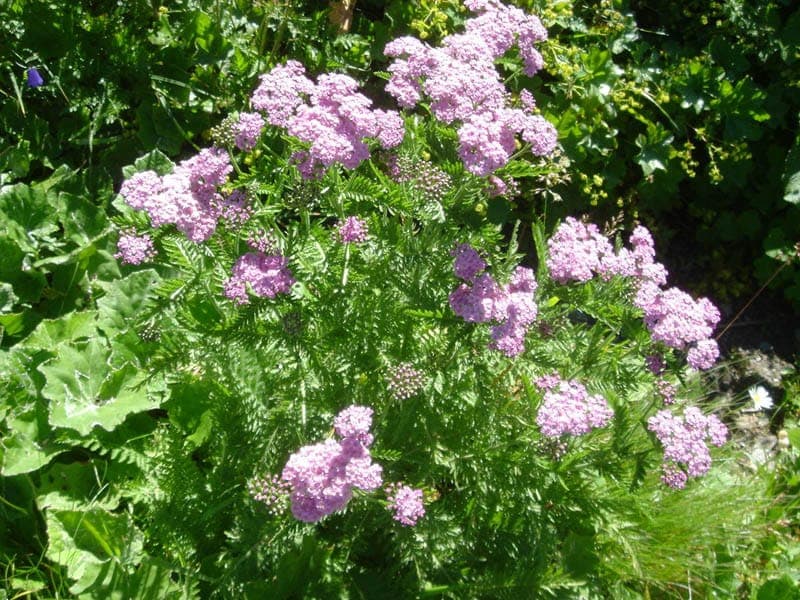
Ghislain118 http://www.fleurs-des-montagnes.net / CC BY-SA 3.0, via Wikimedia Commons
Tansyleaf milfoil: complete guide
Achillea distans
Want to see Tansyleaf milfoil: complete guide in your garden?
1 minute, no credit card
Overview
Achillea distans, commonly known as Tansyleaf milfoil, is a graceful herbaceous perennial that brings delicate texture and airy charm to the garden. A member of the Asteraceae family, it's native to southern and eastern Europe, including regions of Albania, Austria, Greece, and France. In temperate climates like those in the UK and northern Europe, it thrives in sunny, dry conditions, making it a top choice for gravel gardens, rockeries, or the front of a mixed border. It reaches a height of 30–50 cm and spreads about 40 cm, forming a compact clump that doesn't dominate but adds consistent visual interest.
On gardenworld.app, you can design a drought-resistant border that highlights the fine foliage and soft blooms of Achillea distans, especially when paired with silver-leaved companions.
Appearance & bloom cycle
The foliage of Achillea distans is finely divided, resembling tansy or yarrow, with a soft grey-green hue. It forms a neat, fern-like mound that stays attractive all season. From July through September, slender stems rise above the foliage, bearing flat-topped clusters of small, white to pale pink flowers. These feathery inflorescences sway gently in the breeze, attracting bees, hoverflies, and butterflies. The bloom period is extended, especially if you deadhead regularly. Its airy presence works well as a filler between bolder plants or as a softening element along pathways.
Ideal location
This plant loves sun. Aim for a spot with a light rating of 7 or higher - that's at least 6 hours of direct sunlight daily. In the UK and similar zones, south- or southwest-facing borders are ideal. It performs best in open, well-drained areas with little competition from tree roots or dense ground cover. Avoid shady corners or damp, crowded spots. It also does well in crevices of dry stone walls or between paving stones where drainage is excellent.
Use gardenworld.app to map your garden's sun exposure and pinpoint the best location for Tansyleaf milfoil based on your garden's microclimate.
Soil requirements
Achillea distans prefers light, sandy, or loamy soil with a pH between 5.5 and 6.5. It thrives in well-drained conditions and dislikes heavy clay or waterlogged soils. If your soil is dense, amend it with coarse grit or horticultural sand to improve drainage. While it tolerates poor soils, a light addition of compost at planting time can help establish roots. Avoid rich, overly fertile soils - they encourage weak, floppy growth and reduce flowering.
Free design
Want to see Tansyleaf milfoil: complete guide in your garden? Make a free design now.
Watering
Once established, Achillea distans is highly drought-tolerant. During the first growing season, water weekly during dry spells to help roots settle. After that, it rarely needs supplemental watering unless facing extreme drought. When you do water, soak the base deeply rather than spraying the foliage, which can encourage fungal issues. Let the soil dry out between waterings.
Pruning
Pruning is minimal. Leave the stems standing over winter to provide shelter for beneficial insects and add winter structure. In early spring, cut back old growth to about 10–15 cm above the ground before new shoots emerge. This encourages bushy, upright growth. Deadhead spent flowers during summer to prolong blooming and prevent excessive self-seeding.
Maintenance calendar
- Jan: No action; observe plant structure
- Feb: Check for signs of new growth
- Mar: Cut back old stems; apply light compost mulch
- Apr: Monitor for pests; water if unusually dry
- May: Watch for aphids; ensure good air circulation
- Jun: Plant may begin flowering; check for staking needs
- Jul: Deadhead regularly; enjoy peak bloom
- Aug: Continue deadheading; observe pollinators
- Sep: Allow final blooms to set seed for birds
- Oct: Leave plant intact for winter interest
- Nov: No maintenance
- Dec: Protect from prolonged wetness
Winter hardiness
Achillea distans is hardy in USDA zones 5 to 9. In the UK (zone 8), it survives winter with ease as long as the soil drains well. The main threat is winter wetness, which can lead to crown rot. Leaving the old stems intact helps insulate the crown and supports overwintering insects.
Companion plants
Pair Tansyleaf milfoil with drought-tolerant perennials like Echinacea, Salvia officinalis, or Sedum 'Matrona'. Its fine texture contrasts beautifully with bold-leaved plants like Alchemilla mollis or the upright form of Stachys byzantina. It also blends well with ornamental grasses such as Deschampsia cespitosa. Avoid overly vigorous spreaders like mint or aggressive ground covers that may smother it.
Closing
Achillea distans is a reliable, low-fuss perennial that rewards with months of blooms and year-round structure. It's perfect for gardeners seeking sustainable, wildlife-friendly planting. You can find this plant at garden centres across the UK in spring, often labeled under its Latin name. With the right spot and minimal care, it will thrive for years. For design inspiration, check out gardenworld.app's curated planting schemes featuring Achillea distans in naturalistic settings.
Want to see Tansyleaf milfoil: complete guide in your garden? Make a free design now.
Upload a photo, pick a style, and get a photorealistic design with plant list in under a minute.
No credit card required


Similar plants
Calendula stellata: complete guide
Calendula stellata
Complete guide to Calendula stellata, the star-flowered marigold from Sicily: location, soil, watering and companion planting tips.
Korean chrysanthemum: complete guide
Chrysanthemum x rubellum
Chrysanthemum x rubellum is a hardy autumn perennial with single pink to copper flowers from August to November. Care and combinations.
Helianthus divaricatus: complete guide
Helianthus divaricatus
Helianthus divaricatus is a North American woodland sunflower with yellow summer blooms, ideal for naturalistic borders and shady edges.