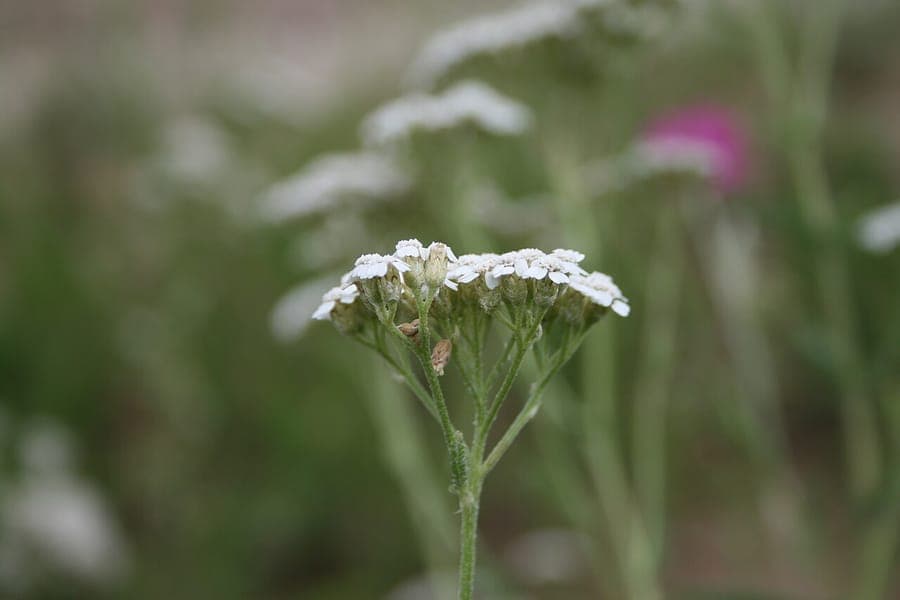
Oceancetaceen - Alice Chodura / CC BY-SA 3.0, via Wikimedia Commons
Hill yarrow (Achillea collina): complete guide
Achillea collina
Want to see Hill yarrow (Achillea collina): complete guide in your garden?
Full design in HD: €7.99
Look after your Hill yarrow with the GardenWorld app
Identify plants with your camera and get a care calendar with reminders for this plant.


Achillea collina, commonly known as hill yarrow or hügel-schafgarbe, is a versatile perennial from Central Europe. Native to grasslands, hillsides, and semi-dry habitats in Poland, Hungary, and eastern Switzerland, it thrives under modest conditions. For gardens, it offers a robust, low-maintenance option with rich flower colours throughout summer months.
Overview
Achillea collina forms a well-branched, compact perennial mound, typically 30-50 centimetres tall. Growth is rapid but orderly, producing continuous floral displays from May through September. Colour ranges from pink to purple-pink, sometimes warm orange-pink tones depending on cultivar selection. This is a plant for those seeking colour without constant fussing.
Appearance & bloom
Foliage is finely divided, feathery, grey-green. Not as refined as some relatives, but ornamental nonetheless. Flower clusters are flat, compound umbels, typically pink to purple tones, sometimes warmer orange-pink. Blooming can extend two months with regular removal of spent flowers. Yellow stamens add visual interest. Fresh flowers emerge continuously if deadheaded.
Ideal location
Full sun is essential; minimum 6 hours direct daily sunlight. Light shade is tolerated but flower production diminishes. This is a plant that dislikes deep shade.
Free preview
Want to see Hill yarrow (Achillea collina): complete guide in your garden? Make a free preview of your design.
Soil
Achillea collina grows in virtually any well-draining soil. Heavy clay should be lightly amended with sand. Fertility is not critical; poor, lean soils are well tolerated. Water drainage is important; waterlogging invites fungal disease.
Watering
After planting, water regularly to establish roots. Established plants tolerate drought well and need little supplemental watering. In extremely dry years, occasional irrigation boosts flower production.
Pruning
Regularly remove spent flowers (weekly during bloom season) to stimulate continuous flowering. Cut back in autumn to 15-20 centimetres to promote compact growth in spring.
Maintenance calendar
- Spring: Clean plant, remove old stems.
- Summer: Deadhead continuously, water during drought.
- Autumn: Cut back to 15-20cm, prepare for winter.
- Winter: No maintenance; plant fully hardy.
Winter hardiness
Achillea collina is hardy in USDA zones 3-8, surviving -30 degrees Celsius or lower. Winter hardiness is not a concern in Northern Europe.
Companion plants
Pairs well with: Salvia x sylvestris, Delphinium species, Lupinus hybrida, Campanula persicifolia. Also: Coreopsis, Echinacea, lavender species.
Closing
Hill yarrow is a reliable perennial for sunny borders. Less refined than some relatives but more robust. Readily available at garden centres. GardenWorld recommends this plant for those seeking durable colour and proven frost hardiness without constant coddling.
Frequently asked questions about Hill yarrow
Is Hill yarrow winter hardy?
Achillea collina is hardy in USDA zones 3-8, surviving -30 degrees Celsius or lower. Winter hardiness is not a concern in Northern Europe.
When and how do you prune Hill yarrow?
Regularly remove spent flowers (weekly during bloom season) to stimulate continuous flowering. Cut back in autumn to 15-20 centimetres to promote compact growth in spring.
How much water does Hill yarrow need?
After planting, water regularly to establish roots. Established plants tolerate drought well and need little supplemental watering.
Where does Hill yarrow grow best?
Full sun is essential; minimum 6 hours direct daily sunlight. Light shade is tolerated but flower production diminishes.
What soil does Hill yarrow need?
Achillea collina grows in virtually any well-draining soil. Heavy clay should be lightly amended with sand.

See it in your garden
See Hill yarrow in your garden
One photo of your garden and a few questions. You see the result in about a minute.
Try it with a photoIdentify this plant in your own garden. Identify a plant
Similar plants
Frikart's aster (Aster × frikartii): complete guide
Aster × frikartii
Everything about Frikart's aster (Aster × frikartii): position, soil, pruning and hardiness of the aster that flowers lavender-blue from July to October.
False aster (Boltonia asteroides): complete guide
Boltonia asteroides
False aster (Boltonia asteroides) covers itself in white daisies from late August to October. How to plant, cut back and combine this tough, tall perennial.
Daisy bush (Brachyglottis greyi): care guide
Brachyglottis greyi
Brachyglottis greyi, formerly Senecio greyi, pairs silver felted leaves with yellow summer daisies. Advice on position, soil, pruning, hardiness and companions.
