
Le.Loup.Gris / CC BY-SA 3.0, via Wikimedia Commons
Tartar maple: complete guide
Acer tataricum
Want to see Tartar maple: complete guide in your garden?
1 minute, no credit card
Overview
The Tartar maple (Acer tataricum) is a compact, upright-growing deciduous tree that brings quiet elegance to gardens without demanding space or attention. Native to regions stretching from Austria to central China, it thrives in temperate climates and adapts well to urban conditions. Typically reaching 6 to 8 meters in height with a spread of 4 to 5 meters, it's ideal for small to medium-sized gardens, courtyards, and even container growing in its youth.
Unlike some maples that require acidic soil or constant moisture, the Tartar maple is forgiving and steady. It's not flashy, but its reliability and seasonal rhythm make it a smart addition to any thoughtful garden design. On gardenworld.app, you can visualize how this tree fits into your space, especially when planning for year-round interest and layered planting.
Appearance & bloom cycle
This maple has a naturally rounded to oval crown with smooth grey bark that becomes slightly fissured with age. The leaves are simple, opposite, and typically 5- to 7-lobed, though less deeply cut than many other maples. They emerge a soft green in spring, deepen in summer, and transform in autumn into rich shades of golden yellow, orange-brown, and sometimes hints of red - a display that lasts well into November.
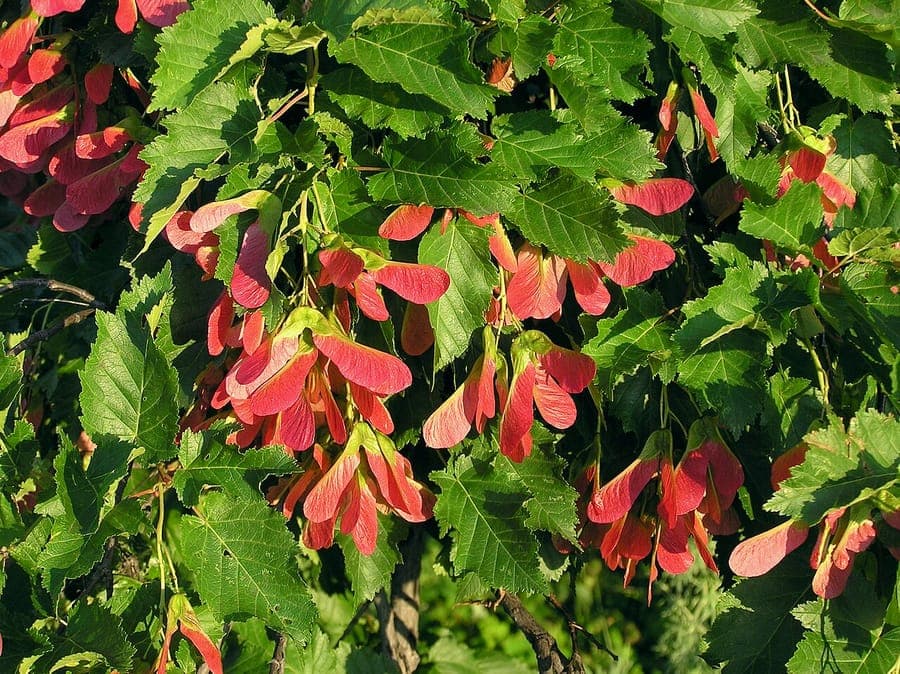
Flowering occurs in late spring (May to early June), producing small, greenish-white flowers in drooping clusters. While not showy, they attract bees and other pollinators. By late summer, these develop into paired samaras - the classic 'helicopter seeds' - that start green, then turn a striking red before maturing to brown. These persist into winter, adding interest after leaf drop.
Ideal location
The Tartar maple grows best in full sun to partial shade. In southern exposures or hot climates, afternoon shade helps prevent leaf scorch during dry spells. It performs well in USDA hardiness zones 4 to 7, tolerating winter lows down to -34°C. A spot with good air circulation prevents fungal issues, especially in humid areas.
Avoid cramped spaces - give it at least 3.5 to 4.5 meters of clearance from buildings or other large plants. It works well as a standalone specimen, in small groups, or as part of a mixed woodland edge. It also adapts to urban settings, handling compaction and pollution better than many ornamental trees.
Soil requirements
It prefers moist, well-drained loam but tolerates a wide range, from sandy to clay-loam, as long as drainage is adequate. The ideal pH is between 5.5 and 7.5. Heavy clay soils should be amended with compost or leaf mould to improve structure. Poorly drained sites lead to root rot, especially in winter.
When planting, dig a hole twice as wide as the root ball but no deeper. Backfill with native soil mixed with organic matter. Water thoroughly after planting and mulch with 5–8 cm of wood chips to retain moisture and suppress weeds.
Free design
Want to see Tartar maple: complete guide in your garden? Make a free design now.
Watering
During the first two growing seasons, water deeply once a week during dry periods - about 10–15 liters per tree. After establishment, it becomes moderately drought-tolerant but appreciates supplemental water during extended dry spells, especially in zones with hot summers.
Avoid overhead watering to reduce the risk of foliar diseases. Instead, use soaker hoses or water at the base. Overwatering, particularly in winter, can suffocate roots, so ensure the soil isn't constantly soggy.
Pruning
Minimal pruning is needed. The natural form is attractive and symmetrical. If shaping is desired, prune in late winter or early spring before sap flow begins. Remove dead, damaged, or crossing branches with clean, sharp tools. Avoid summer pruning, as maples bleed sap heavily when cut during active growth.
Never top the tree or over-prune - this disrupts its structure and invites disease. Focus on maintaining a single leader and balanced canopy. For hedges or formal plantings, light trimming is acceptable in December, but this species is best left to grow naturally.
Maintenance calendar
- January: Inspect for storm damage, remove dead wood if conditions are dry
- February: Final pruning window, check for signs of pests
- March: Apply balanced organic fertilizer, top up mulch
- April: New growth emerges, watch for aphids or scale
- May: Flowers appear, increase watering if rainfall is low
- June: Monitor for leaf scorch in hot, dry weather
- July: Deep water during droughts, avoid fertilizing
- August: Continue monitoring moisture, especially in young trees
- September: Fruit turns red, minimal care needed
- October: Leaves begin to fall, collect or leave as mulch
- November: Reduce watering, protect young trunks from rodents
- December: Winter check, avoid pruning unless essential
Winter hardiness
Extremely cold-hardy, surviving in USDA zones 4 to 7. It handles snow load well and rarely suffers winter injury once established. Young trees may need protection from frost cracks on the south-facing trunk - use tree wrap if necessary. The exfoliating bark and persistent fruit add texture and interest in the dormant season.
Companion plants
Underplant with shade-tolerant perennials like Epimedium, Polygonatum, or Hepatica nobilis. Ferns such as Dryopteris erythrosora add texture, while early bulbs like Crocus tommasinianus or Scilla siberica bring spring color before the canopy fills in.
For structure, pair with small shrubs like Fothergilla gardenii, Cornus alternifolia, or Viburnum lantana. Ornamental grasses like Panicum virgatum 'Shenandoah' complement the upright form. On gardenworld.app, you can design a planting scheme that balances root competition and light availability, ensuring your companions thrive alongside the Tartar maple.
Closing
The Tartar maple is a quiet achiever - unspectacular at first glance, but dependable, attractive, and easy to care for. It earns its place in the garden through consistency, not drama. With its modest size, clean habit, and long seasonal interest, it's a smart choice for modern landscapes.
You can find Acer tataricum at local garden centres, especially those specializing in ornamental trees. Look for healthy specimens with even branching and no signs of canker or dieback. With proper planting and a little attention early on, this maple will serve you well for decades.
Want to see Tartar maple: complete guide in your garden? Make a free design now.
Upload a photo, pick a style, and get a photorealistic design with plant list in under a minute.
No credit card required


Similar plants
Acer pycnanthum: complete guide
Acer pycnanthum
Acer pycnanthum, the Japanese swamp maple, is a fast-growing tree with early red flowers and brilliant autumn color, ideal for damp garden settings.
Freeman maple: complete guide
Acer × freemanii
Everything about the Freeman maple (Acer x freemanii): a fast-growing shade tree with spectacular autumn colour for large gardens.
Wild ackee: complete guide
Cupania americana
A comprehensive guide to Cupania americana, a tropical tree from the Sapindaceae family with conspicuous white flowers and brown fruits, native to tropical America.