
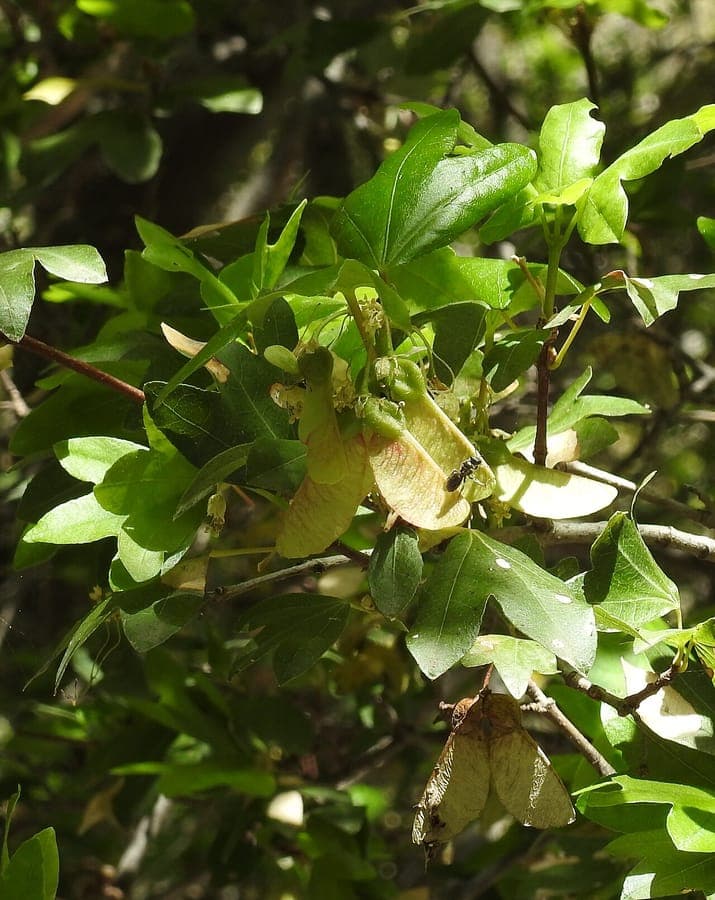
Robert Flogaus-Faust / CC BY 4.0, via Wikimedia Commons
Cretan maple: complete guide
Acer sempervirens
Want to see Cretan maple: complete guide in your garden?
1 minute, no credit card
Overview
Acer sempervirens, commonly known as the Cretan maple, is a compact, elegant tree native to rocky slopes in Greece, Turkey, and the eastern Aegean islands. Despite its species name meaning 'evergreen', it often behaves as semi-deciduous in cooler climates, dropping some or all of its leaves in harsh winters. Still, in milder regions it retains a graceful presence year-round, making it a compelling choice for gardens aiming for a soft Mediterranean character. In the UK and northern Europe, it's gaining attention for its adaptability and ornamental charm when given the right start.
On gardenworld.app, you can create a garden layout that highlights the Cretan maple as a focal point among drought-tolerant shrubs or beside sun-baked stone walls.
Appearance & bloom cycle
Mature Cretan maples reach 3–5 m in height with a spread of 2.5–4 m. The growth habit is open and finely branched, with a loose, airy canopy. Leaves are palmate, typically with five narrow, pointed lobes, emerging in spring as fresh light green and developing a subtle sheen in summer. Autumn colour is modest-usually soft yellow to pale copper-but adds quiet warmth to the late-season garden.
From April to June, small greenish-white to pale yellow flowers hang in loose panicles. Though not showy, they attract pollinators like bees and hoverflies. After flowering, paired samaras ('keys') form and mature by late autumn, ready to disperse or be collected for propagation.
Ideal location
This maple thrives in full sun to partial shade. In the UK, a south- or southeast-facing spot with protection from cold, drying winds is ideal. A position against a warm wall or among rocks helps retain heat and mimics its natural habitat. Avoid deep shade, which leads to leggy growth and poor flowering. Wind protection is essential-its slender branches are prone to breakage.
Consider planting it as a specimen in a gravel garden, raised bed, or large container. It pairs beautifully with architectural plants and is perfect for patios with a Mediterranean theme. For visual inspiration, gardenworld.app offers curated designs featuring the Cretan maple in modern, low-water landscapes.
Soil requirements
The Cretan maple isn't fussy about soil richness but demands excellent drainage. It prefers sandy loam or stony soil with added organic matter. A pH range of 6.0–7.5 is optimal. Heavy clay soils must be improved-raise the planting area by 20–30 cm and mix in grit and compost to prevent waterlogging.
In containers, use a free-draining mix with perlite or pumice. Refresh the top 5–10 cm of soil each spring to replenish nutrients.
Free design
Want to see Cretan maple: complete guide in your garden? Make a free design now.
Watering
Water regularly during the first growing season-about once a week, deeply soaking the root zone. From year two, it becomes drought-tolerant but benefits from occasional deep watering during dry spells, especially when young. Water early morning or evening, avoiding foliage wetting to reduce fungal risk.
Potted specimens need more frequent watering, particularly in heatwaves. Check moisture at 10 cm depth-soil should feel slightly damp, never soggy.
Pruning
Pruning is rarely necessary. Remove only dead, damaged, or crossing branches in late winter or early spring, before bud break. Avoid summer pruning-maples bleed sap heavily if cut outside dormancy. Light shaping is acceptable for container-grown trees, but avoid hard pruning.
Always use clean, sharp tools. Sterilise between cuts if disease is suspected.
Maintenance calendar
- Jan: inspect for winter damage, remove broken twigs
- Feb: final pruning window
- Mar: check soil moisture, apply slow-release organic fertiliser if needed
- Apr: monitor leaf emergence, protect from late frosts
- May: inspect for aphids or scale insects
- Jun: flowering phase, avoid disturbance
- Jul: supplemental watering in prolonged drought
- Aug: no feeding; reduce watering if rain is adequate
- Sep: last deep watering before dormancy
- Oct: leaves may drop; collect for mulch
- Nov: insulate container plants, move to sheltered spot
- Dec: observe, minimal intervention
Winter hardiness
Hardy to USDA zones 7b (–15°C) to 9. In the UK (zone 8), it survives most winters, but young trees and container plants need protection. Wrap trunks with hessian or use fleece during cold snaps. Elevate pots on feet to prevent frozen bases. Root damage from repeated freeze-thaw cycles is a bigger risk than top dieback.
Even if top growth is damaged, established trees usually resprout vigorously in spring.
Companion plants
Pair with drought-tolerant, sun-loving plants: Cistus, Phlomis, Euphorbia characias, and Stachys byzantina. Low evergreens like Daphne or Rhamnus alaternus provide structure. Grasses such as Festuca glauca or Carex testacea add movement and contrast.
Avoid invasive root competitors like bamboo or dense groundcovers that smother surface roots.
Closing
The Cretan maple isn't common in UK garden centres, but it's worth seeking out. Its delicate form and resilience in dry, sunny spots make it a standout. Buy from reputable suppliers-look for healthy, well-branched specimens at garden centres like those stocking Mediterranean plants.
For design ideas and planting schemes, visit gardenworld.app. Their visual tools help you plan a garden where the Cretan maple thrives alongside compatible companions.
Want to see Cretan maple: complete guide in your garden? Make a free design now.
Upload a photo, pick a style, and get a photorealistic design with plant list in under a minute.
No credit card required


Similar plants
Acer pycnanthum: complete guide
Acer pycnanthum
Acer pycnanthum, the Japanese swamp maple, is a fast-growing tree with early red flowers and brilliant autumn color, ideal for damp garden settings.
Freeman maple: complete guide
Acer × freemanii
Everything about the Freeman maple (Acer x freemanii): a fast-growing shade tree with spectacular autumn colour for large gardens.
Wild ackee: complete guide
Cupania americana
A comprehensive guide to Cupania americana, a tropical tree from the Sapindaceae family with conspicuous white flowers and brown fruits, native to tropical America.