
Willow / CC BY 2.5, via Wikimedia Commons
Sycamore maple: complete guide
Acer pseudoplatanus
Want to see Sycamore maple: complete guide in your garden?
1 minute, no credit card
Overview
The Sycamore maple (Acer pseudoplatanus) is a tough, long-lived tree that brings structure and shade to larger gardens across Europe. Native to mountainous regions of southern Europe, it's now naturalised in many temperate zones, including the UK and parts of northern Europe. It's not related to the true sycamore (Platanus), despite the name, but gets its common name from the superficial resemblance in leaf shape.
If you're planning a spacious, woodland-style garden, the Sycamore maple fits perfectly. On gardenworld.app, you can visualise how this tree interacts with your existing layout, especially if you're working with slopes or larger open areas.
Appearance & bloom cycle
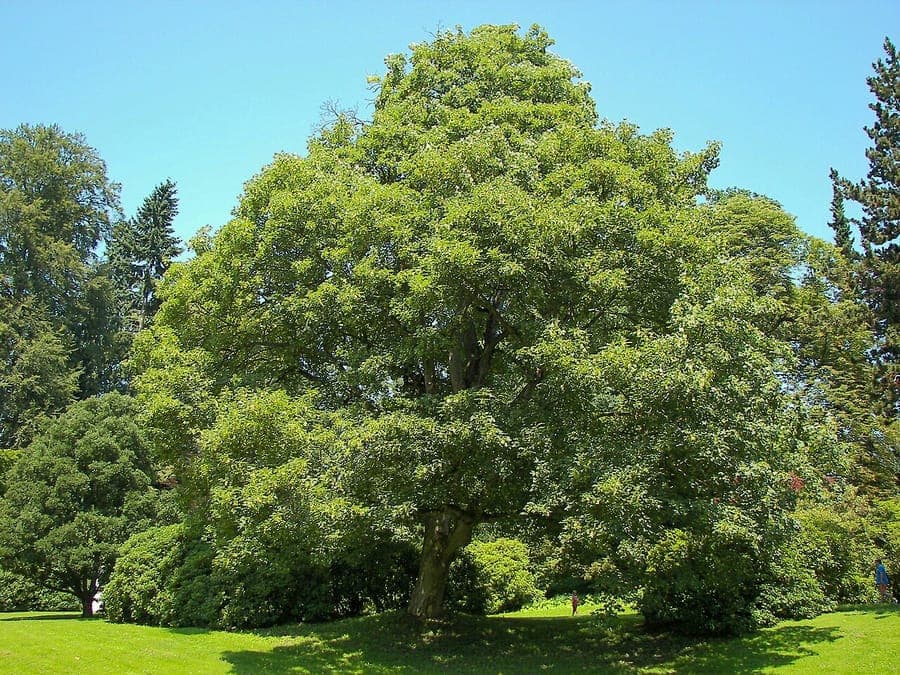
This tree matures at 20–30 meters tall with a spread of 12–15 meters, giving it a broad, domed crown. The bark starts smooth and grey-green, becoming furrowed with age. The leaves are palmate, five-lobed, and measure 10–20 cm across. They're dark green on top, paler underneath, and turn buttery yellow in autumn - not as fiery as Japanese maples, but reliable and graceful.
Flowering occurs from April to early May. The small, greenish-yellow flowers hang in long, drooping panicles (10–20 cm), attracting early pollinators like hoverflies and bees. After pollination, the winged samaras form and start spinning to the ground from late summer through autumn - a fun feature for kids and a sign of the tree's vigorous self-seeding.
Ideal location
A mature Sycamore maple needs space - think at least 8 meters from buildings, drives, or drainage systems. Its roots are strong and can lift paving or infiltrate pipes. Plant in full sun to light shade (rate 7/10 on the light scale). It tolerates urban pollution and coastal exposure, making it a good choice for larger suburban gardens.
It's happiest in open, grassy areas or as a standalone specimen. Avoid planting near patios or small borders. Use gardenworld.app to simulate its mature size and shadow footprint before committing.
Soil requirements
This maple adapts to a range of soils but thrives in moist, well-drained loam or sandy loam with a pH between 5.8 and 7.0. It tolerates clay if drainage is adequate, but avoid waterlogged sites - especially in winter, when root rot can set in.
When planting, mix in compost or well-rotted manure into the backfill. A 5 cm mulch layer (bark chips or leaf mould) helps retain moisture and suppresses weeds. Replenish annually in spring.
Free design
Want to see Sycamore maple: complete guide in your garden? Make a free design now.
Watering
Young trees need consistent watering in their first 2–3 years. Provide 20 litres per week during dry spells, ideally twice a week to encourage deep rooting. Mature trees are drought-tolerant but benefit from deep soaking every few weeks in prolonged dry periods.
Avoid overhead watering, which can promote fungal issues. Instead, water at the base. Mulching reduces evaporation and stabilises soil temperature.
Pruning
Pruning is minimal for Sycamore maple. Focus on removing dead, damaged, or crossing branches in late winter (February). Avoid summer pruning - maples 'bleed' sap heavily if cut when active, which weakens the tree.
If shaping is needed, prune while dormant and limit cuts to branches under 10 cm diameter. Use sharp, sterilised tools. For large trees, hire a certified arborist - safety first.
Maintenance calendar
- January: Inspect for storm damage. Check branch attachments.
- February: Prune if needed. Avoid cutting in frost.
- March: Apply balanced fertiliser if soil is poor. Check mulch levels.
- April: Flowers appear. Monitor for aphids.
- May: Seed panicles form. Water young trees in dry weather.
- June–August: Deep water young trees weekly during droughts.
- September: Stop feeding. Prepare for leaf fall.
- October–December: Rake leaves - compost them or use as mulch elsewhere. Don't pile around the trunk.
Winter hardiness
The Sycamore maple is hardy in USDA zones 5–8. It withstands temperatures down to -25°C. Young trees may show minor leaf scorch in harsh winters but recover fully in spring. No winter protection is needed, though mulch helps insulate roots.
Companion plants
Due to dense shade and aggressive roots, planting under a mature Sycamore maple is challenging. Choose shallow-rooted, shade-tolerant species:
- Helleborus orientalis (Lenten rose)
- Pachysandra terminalis
- Carex elata 'Aurea'
- Tellima grandiflora
Avoid moisture-hungry plants - they'll lose the competition. On gardenworld.app, explore shaded planting schemes that work beneath large trees.
Closing
The Sycamore maple isn't flashy, but it's dependable. It grows fast, lives long (100+ years), and provides excellent shade and seasonal interest. It's best suited for larger gardens where its size won't be an issue.
You can find it at garden centres across the UK and Europe. In the UK, check larger independents; in mainland Europe, OBI and Hornbach (DE), Truffaut and Jardiland (FR), or Gamma and Intratuin (NL) often carry it. Choose a young tree with a straight trunk and even branching. With proper placement, it'll become a garden landmark for generations.
Want to see Sycamore maple: complete guide in your garden? Make a free design now.
Upload a photo, pick a style, and get a photorealistic design with plant list in under a minute.
No credit card required


Similar plants
Acer pycnanthum: complete guide
Acer pycnanthum
Acer pycnanthum, the Japanese swamp maple, is a fast-growing tree with early red flowers and brilliant autumn color, ideal for damp garden settings.
Freeman maple: complete guide
Acer × freemanii
Everything about the Freeman maple (Acer x freemanii): a fast-growing shade tree with spectacular autumn colour for large gardens.
Wild ackee: complete guide
Cupania americana
A comprehensive guide to Cupania americana, a tropical tree from the Sapindaceae family with conspicuous white flowers and brown fruits, native to tropical America.