
Angilbas at English Wikipedia / Public domain, via Wikimedia Commons
Pacific maple: complete guide
Acer macrophyllum
Want to see Pacific maple: complete guide in your garden?
1 minute, no credit card
Overview
Acer macrophyllum, commonly known as Pacific maple, is a striking deciduous tree native to the Pacific Northwest, spanning from Alaska down through British Columbia, Washington, Oregon, and into northern California. It thrives in moist, forested environments and stream banks, where it can reach heights of 15 to 25 meters. In garden settings, it demands space - ideally at least 6 meters in all directions - to develop its broad, rounded crown.
This isn't a tree for cramped urban yards. But if you've got a woodland edge, a damp corner, or a large garden looking for a natural focal point, the Pacific maple delivers. On gardenworld.app, you can model how this tree will grow over time, helping you plan sightlines, shade zones, and root spread.
Appearance & bloom cycle
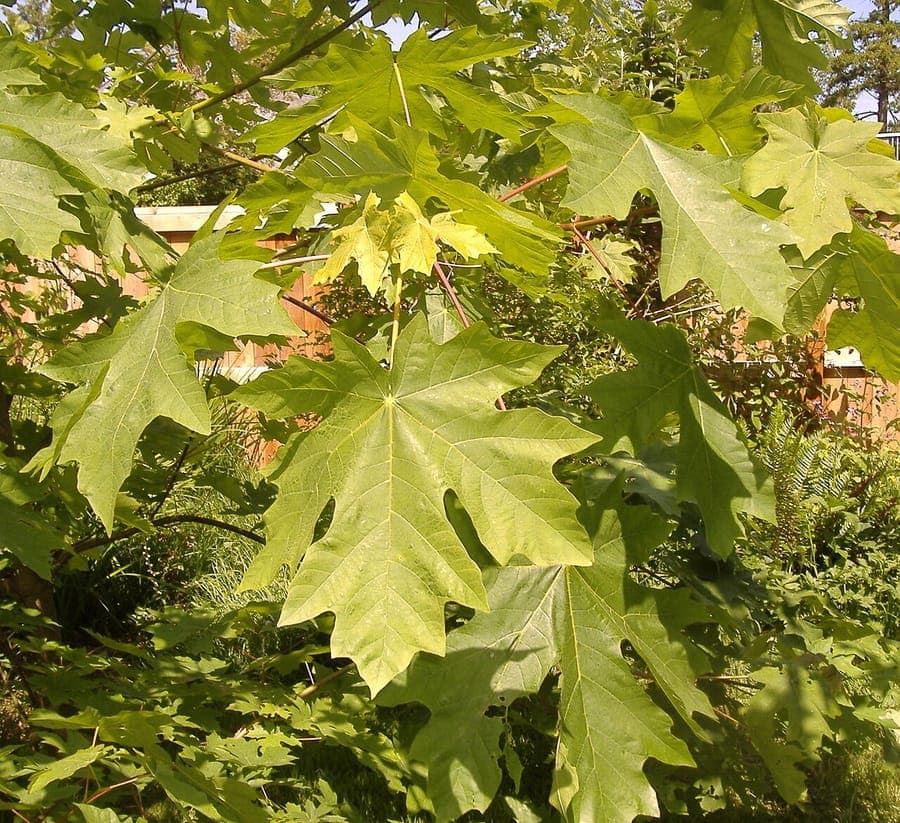
The standout feature of the Pacific maple is its enormous leaves - among the largest of any maple species. They can reach 15 to 30 cm in diameter, deeply lobed with five to seven pointed segments, and emerge bright green in spring, maturing to a darker, glossy green by summer. The undersides are paler and slightly fuzzy.
In late spring, typically May to June, clusters of small, greenish-yellow flowers dangle from long stalks. They're not showy but attract pollinators. By late summer, winged samaras (seeds) form and turn brown, ready to spin away on the wind from September onward.
Autumn is when this tree truly shines. Leaves turn vibrant shades of golden yellow, sometimes deep orange or russet, creating a warm, luminous canopy. The bark on mature trees becomes deeply furrowed and dark gray, adding winter interest.
Ideal location
Pacific maple prefers partial to full shade, especially in warmer climates. In zones 8 and 9, full sun can lead to leaf scorch unless the soil stays consistently moist. A north- or east-facing slope is ideal. It also benefits from shelter from strong winds, which can tear the large leaves.
Avoid planting near paved areas or compacted soil - this tree has shallow, spreading roots that need room to breathe. In suburban or rural gardens, it fits beautifully beneath open canopies or along natural water features. Use gardenworld.app to simulate how shade evolves throughout the day and season, ensuring your site matches the tree's needs.
Soil requirements
This maple grows best in rich, loamy, well-drained but moisture-retentive soil. The pH range is broad - from 4.8 to 7.2 - meaning it tolerates slightly acidic to neutral conditions. Clay soils are acceptable if not waterlogged, while sandy soils need organic matter like compost or leaf mold to retain moisture.
Avoid dry, alkaline, or compacted sites. The root zone should never dry out completely, especially in the first three years.
Free design
Want to see Pacific maple: complete guide in your garden? Make a free design now.
Watering
Young trees need consistent watering - deep soakings once a week during dry spells from May to September. Use a soaker hose or drip irrigation to deliver water slowly to the root zone. Mulch with 5–8 cm of wood chips to reduce evaporation and suppress weeds.
Mature trees are more drought-tolerant but still perform best with regular moisture. During prolonged droughts, even established trees benefit from occasional deep watering.
Pruning
Pruning is rarely needed. Only remove dead, broken, or crossing branches, and do so in late winter or early spring before bud break. Avoid pruning in early spring when sap is flowing - this can cause excessive bleeding, though it's not usually fatal.
Never top this tree or heavily prune the crown. Its natural shape is elegant and upright-pyramidal when young, becoming more rounded with age.
Maintenance calendar
- January: Inspect for storm damage. Remove any broken limbs.
- February: Apply a layer of compost around the base, keeping it away from the trunk.
- March: Final pruning window before growth resumes.
- April: Monitor for emerging pests or fungal spots.
- May: Begin regular watering if rainfall is below 2.5 cm per week.
- June–August: Maintain mulch. Watch for signs of drought stress.
- September: Seeds mature and disperse. Watch for seedlings in borders.
- October: Peak fall color. Rake leaves if needed, but consider leaving some as natural mulch.
- November–December: Reduce watering. Protect young trees from deer or rodents with tree guards.
Winter hardiness
Pacific maple is hardy in USDA zones 6 to 9 (-23°C to -7°C). In zone 6, young trees may need winter mulch (10 cm deep) to protect shallow roots. Once established, it handles cold well but dislikes wet, frozen soil.
Avoid de-icing salts near the root zone - they can damage the tree over time.
Companion plants
Underplant with shade-loving species like Heuchera, Tellima grandiflora, Carex varieties, and Polystichum munitum (Western sword fern). Early spring ephemerals such as Trillium or Erythronium thrive in the dappled light before the canopy fills in.
Avoid aggressive groundcovers like ivy or periwinkle, which can choke out seedlings and compete for moisture. Keep lawn mowers and string trimmers away from the trunk - the bark is thin and easily damaged.
Closing
The Pacific maple isn't a common garden tree, but it's a rewarding one for the right setting. Its dramatic foliage, fall color, and ecological value make it a standout. While not suited for small yards, it's perfect for naturalistic designs, riparian zones, or large properties. Look for young trees at local garden centres, and use gardenworld.app to visualize your planting plan, ensuring harmony with existing structures and plants.
Want to see Pacific maple: complete guide in your garden? Make a free design now.
Upload a photo, pick a style, and get a photorealistic design with plant list in under a minute.
No credit card required


Similar plants
Acer pycnanthum: complete guide
Acer pycnanthum
Acer pycnanthum, the Japanese swamp maple, is a fast-growing tree with early red flowers and brilliant autumn color, ideal for damp garden settings.
Freeman maple: complete guide
Acer × freemanii
Everything about the Freeman maple (Acer x freemanii): a fast-growing shade tree with spectacular autumn colour for large gardens.
Wild ackee: complete guide
Cupania americana
A comprehensive guide to Cupania americana, a tropical tree from the Sapindaceae family with conspicuous white flowers and brown fruits, native to tropical America.