
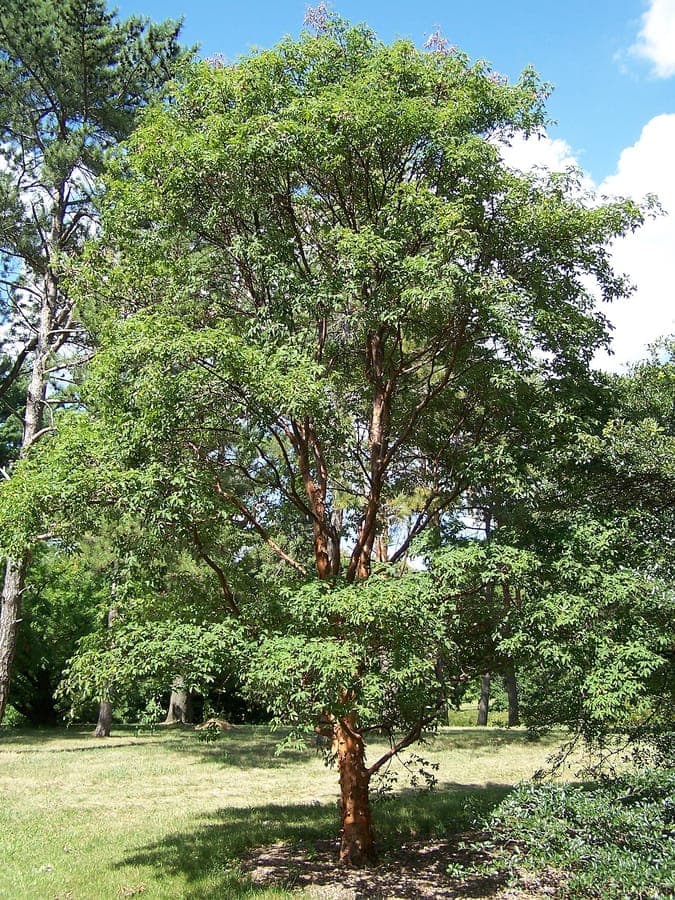
Bruce Marlin / CC BY-SA 2.5, via Wikimedia Commons
Paperbark maple: complete guide
Acer griseum
Want to see Paperbark maple: complete guide in your garden?
1 minute, no credit card
Overview
Acer griseum, commonly called paperbark maple, isn't the kind of tree you'll see in every suburban garden - and that's part of its charm. Native to central and southeastern China, this understated yet striking tree grows slowly, reaching 6 to 8 meters in height with a spread of around 5 meters over 20 to 30 years. Its real appeal lies not in flowers or fruit but in its unique, peeling bark and reliable autumn colour. It's a tree for those who appreciate texture, seasonal change, and quiet elegance. If you're designing a new garden layout, gardenworld.app lets you visualise how an Acer griseum fits into your space, considering height, spread, and light conditions.
Appearance & bloom cycle
The standout feature of this maple is its bark. Starting around year 5, the cinnamon-brown outer layers begin to peel in thin, papery curls, revealing fresh layers beneath. This exfoliation continues every year, creating a rich, textured trunk that's especially eye-catching in winter. The leaves are trifoliate - each leaf has three pointed leaflets - with a deep green upper surface and a paler, sometimes silvery underside. In late September through November, they turn a deep coppery-red, holding colour longer than many other maples. Flowers are inconspicuous - small, greenish, and appearing in spring - but they're followed by paired samaras that twirl down in autumn. There's no strong scent or dramatic floral display, but the overall presence is deeply satisfying.
Ideal location
Plant your paperbark maple where it gets morning sun and afternoon shade, or dappled light under taller trees. Full afternoon sun, especially in hot climates, can scorch the leaves. A north-east or east-facing spot works best. Give it at least 3 meters of clearance from buildings or other trees to allow its natural, upright-rounded form to develop. It makes a superb focal point in a lawn, near a patio, or at the edge of a woodland garden. On gardenworld.app, you can overlay mature tree sizes onto your garden plan to avoid future crowding.
Soil requirements
This maple prefers fertile, well-drained soil that's slightly acidic to neutral (pH 5.5–7.0). Heavy clay soils need amending with compost or leaf mould to improve drainage. Avoid pure sand without organic matter - it dries out too fast. A layer of organic mulch in spring helps retain moisture and keeps the root zone cool. Never plant in waterlogged areas - Acer griseum hates wet feet and will develop root rot if left in saturated soil.
Free design
Want to see Paperbark maple: complete guide in your garden? Make a free design now.
Watering
Water deeply once a week during the first growing season, especially in dry spells. Aim for 10–15 litres per tree. After the first year, it becomes moderately drought-tolerant but still benefits from supplemental watering during prolonged dry periods, particularly in June through August. Use rainwater when possible, as the tree is sensitive to lime and chlorine in tap water. Always water at the base - avoid wetting the foliage to reduce fungal risk.
Pruning
Pruning is rarely needed. The tree develops a graceful, naturally balanced shape on its own. If required, remove dead, damaged, or crossing branches in late winter (February), before sap flow begins. Avoid pruning in spring - maples 'bleed' sap heavily if cut during active growth. Use clean, sharp tools to prevent disease. Never top or hard-prune - it ruins the tree's elegant form and weakens its structure.
Maintenance calendar
- January: Check for storm damage and loose branches.
- February: Light pruning if necessary.
- March: Apply a fresh layer of compost or mulch.
- April: Monitor for aphids or powdery mildew.
- May: No action needed unless drought hits.
- June: Water during dry weeks.
- July: Watch for leaf scorch in hot, sunny locations.
- August: No pruning - tree is actively growing.
- September: Autumn colour begins - avoid fertilising.
- October: Rake fallen leaves to reduce disease risk.
- November: Final inspection, leave mulch in place.
- December: Dormant period - no care required.
Winter hardiness
Acer griseum is hardy in USDA zones 5 to 8 (-20°C to -12°C). It handles cold winters well, and the exfoliating bark adds year-round interest when other trees are bare. Young trees benefit from a thick mulch ring around the base to protect roots in harsh winters. No anti-desiccant sprays or wrap needed - the bark is naturally resilient. Snow cover actually helps insulate the roots.
Companion plants
Pair with shade-tolerant, moisture-loving plants that won't compete aggressively for roots. Good companions include hostas, epimediums, hellebores, and ferns like Dryopteris. Underplant with spring bulbs like daffodils or snowdrops for early-season colour. Avoid invasive groundcovers or plants with dense root systems like bamboo. A slow-growing shrub like Fothergilla or Viburnum opulus 'Nanum' works well nearby.
Closing
The paperbark maple isn't flashy, but it's deeply rewarding. It grows slowly, asking for little once established, and repays patience with decades of beauty. Its bark evolves with age, becoming more intricate each year. You'll find young specimens at garden centres like B&Q, Wyevale, or specialist nurseries in spring. Start with a healthy 60–80 cm sapling, plant it right, and it'll become a treasured feature of your garden. And when you're planning your layout, gardenworld.app helps you place it perfectly - so you won't regret its position in 20 years.
Want to see Paperbark maple: complete guide in your garden? Make a free design now.
Upload a photo, pick a style, and get a photorealistic design with plant list in under a minute.
No credit card required


Similar plants
Acer pycnanthum: complete guide
Acer pycnanthum
Acer pycnanthum, the Japanese swamp maple, is a fast-growing tree with early red flowers and brilliant autumn color, ideal for damp garden settings.
Freeman maple: complete guide
Acer × freemanii
Everything about the Freeman maple (Acer x freemanii): a fast-growing shade tree with spectacular autumn colour for large gardens.
Wild ackee: complete guide
Cupania americana
A comprehensive guide to Cupania americana, a tropical tree from the Sapindaceae family with conspicuous white flowers and brown fruits, native to tropical America.