
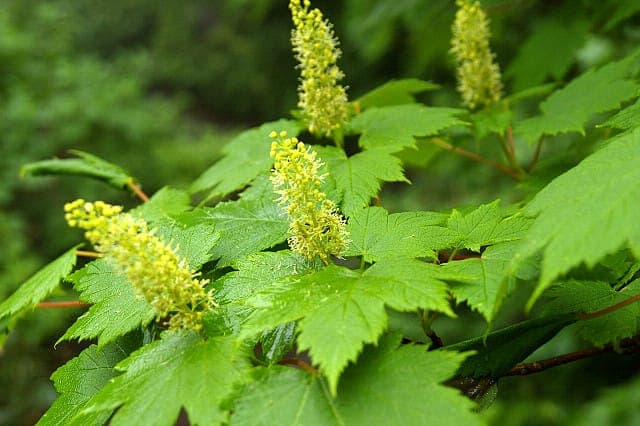
E-190 / CC BY-SA 3.0, via Wikimedia Commons
Tail-leaf Maple: complete guide
Acer caudatum
Want to see Tail-leaf Maple: complete guide in your garden?
1 minute, no credit card
Overview
Tail-leaf Maple (Acer caudatum) is an elegant tree from the Himalayan region, occurring from Nepal to northern China and Myanmar. This maple is renowned for its distinctive leaves featuring long, slender points resembling tails - hence the botanical name caudatum (tail-bearing). The tree is mid-sized, moderate-growing, and offers year-round interest with red spring flowers and fine yellow to red autumn foliage.
What makes this species special is its refinement. It doesn't grow too rapidly or too large - ideal for average-sized gardens. The fine leaves with their striking tails give the tree character throughout the growing season. This is a maple for those appreciating sophisticated botanical beauty.
Appearance and Bloom
Tail-leaf Maple develops into a shrub or small tree, typically 5 to 10 meters tall, sometimes taller under optimal conditions. The crown is compact, rounded, well-branched. The growth habit is elegant and fine.
The leaves are opposite, 5 to 10 centimeters long, deeply three-lobed with long slender points (caudate). The foliage is dark green in summer, shifting to bright yellow or deep red in autumn - depending on variety and location. The veins are red-tinted.
Flowers appear April through May, before full leaf development. They are small, approximately 0.5 centimeters, bright red to crimson, in pendant clusters. They are highly decorative despite their modest size. The fruit is a winged seed pair (samara), green to reddish.
Ideal Location
Tail-leaf Maple performs best in dappled shade to full sun. Position it where it receives three to six hours of direct sunlight daily, but sheltered from intense midday sun. In very hot regions, partial afternoon shade is actually beneficial.
The tree tolerates some wind, though sheltered locations are preferable. Never position in full drafty exposure. It also grows well on gentle slopes and in small valleys where air circulation is slightly moister.
Soil
Tail-leaf Maple thrives in well-draining, nutrient-rich soil abundant in organic matter. The pH should range between 6 and 7 (slightly acidic to neutral). It tolerates poorly extremely alkaline soils.
Incorporate compost or humus at planting. The soil must be nutrient-rich yet drain excellently. Heavy clay without amendment is unsuitable. On clay soils, build raised beds or improve soil substantially.
Free design
Want to see Tail-leaf Maple: complete guide in your garden? Make a free design now.
Watering
Tail-leaf Maple is reasonably moisture-loving. During the first year after planting, water regularly to encourage deep root development. After establishment, consistent moisture is preferable, especially during dry periods.
During very dry summers, occasional supplemental watering helps. The tree tolerates extended drought poorly. Regular moisture results in healthier, more attractive growth.
Pruning
Pruning is rarely necessary. The tree grows naturally compact and attractive. Only damaged branches warrant careful removal. The tree tolerates pruning well, so formative pruning after winter leaf-drop is possible.
Avoid large wounds. Dead or diseased wood can always be removed.
Maintenance Calendar
March-April: Flowering. The red blooms are striking against emerging leaves.
May-September: Growth and summer greenery. Regular watering. Enjoy the refined canopy.
October-November: Autumn color. Yellow to red foliage. Leaf drop.
December-February: Winter dormancy. Minimal activity. Pruning can occur.
Winter Hardiness
Tail-leaf Maple is moderately cold hardy. It tolerates temperatures to approximately -10 to -12 degrees Celsius. In USDA zones 5 through 8, it thrives. Young plant material is more tender than mature specimens.
In very cold regions (zone 4 and colder), it may suffer during extreme winters, especially if warm spring weather is followed by late frosts.
Companion Plants
Tail-leaf Maple works well with other Asian trees. Birches, ashes, magnolias, and other maples create beautiful combinations. On larger scales, establish an Asian woodland.
Understory planting is challenging because the tree casts shade, but shade-tolerant groundcovers can establish beneath it.
Closing
Tail-leaf Maple is an excellent choice for those seeking elegant, medium-sized trees. With its distinctive tail-like leaves, red spring flowers, and magnificent autumn color, it offers year-round interest. Source young trees from nurseries or online suppliers. Visit gardenworld.app for garden design inspiration. Plant in dappled shade and enjoy this refined Himalayan maple for decades.
Want to see Tail-leaf Maple: complete guide in your garden? Make a free design now.
Upload a photo, pick a style, and get a photorealistic design with plant list in under a minute.
No credit card required


Similar plants
Acer pycnanthum: complete guide
Acer pycnanthum
Acer pycnanthum, the Japanese swamp maple, is a fast-growing tree with early red flowers and brilliant autumn color, ideal for damp garden settings.
Freeman maple: complete guide
Acer × freemanii
Everything about the Freeman maple (Acer x freemanii): a fast-growing shade tree with spectacular autumn colour for large gardens.
Wild ackee: complete guide
Cupania americana
A comprehensive guide to Cupania americana, a tropical tree from the Sapindaceae family with conspicuous white flowers and brown fruits, native to tropical America.