
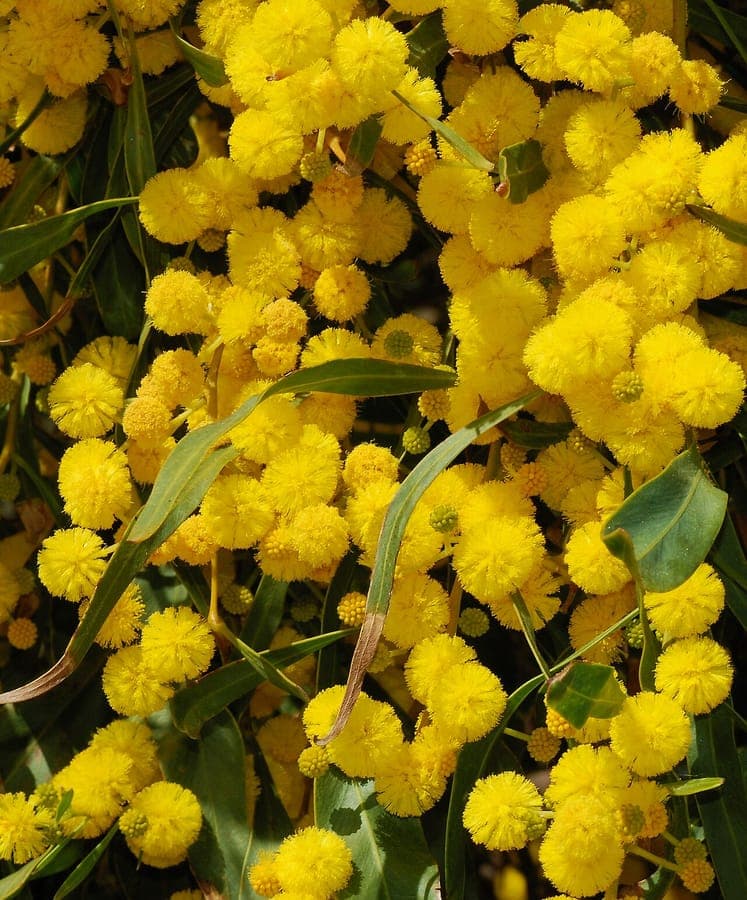
Alvesgaspar / CC BY-SA 3.0, via Wikimedia Commons
Acacia saligna: complete guide
Acacia saligna
Want to see Acacia saligna: complete guide in your garden?
1 minute, no credit card
Overview
Acacia saligna, known as Orange wattle or Willow-leaf acacia, is an elegant, fast-growing tree from Western Australia. This plant stands out for its very fine, willow-like foliage and bright yellow flowers in full bloom. With a natural height of 5-7 meters and rapid growth, it is an excellent choice for hedges, screens, and Mediterranean gardens.
The species is valued for its ability to quickly create maximum visual impact. It is also appreciated for its potential to rapidly establish sight barriers.
Appearance and bloom
The Orange wattle grows as an elegant, slender tree with fine, willow-like leaves that sway gently in the wind. The foliage is blue-green in color and gives the tree a very distinctive character.
Flowers appear from March to May in yellow, fluffy balls (pompoms) that cluster along the branches. The blooming period typically lasts two to three weeks and creates a golden glow in the landscape.
Ideal location
Plant the Willow-leaf acacia in a spot receiving full sun. At least 6 hours of direct sunlight daily is essential for good growth and abundant flowering. The tree can also benefit from light partial shade, but this may reduce blooming.
The plant tolerates wind excellently and is suitable for open, windswept locations, including coastal gardens.
Soil
Acacia saligna grows well in well-draining soil and tolerates heavy, sandy, and even somewhat poor soils. The plant has no need for rich feeding, making it a low-maintenance choice.
Ensure water drains well. Heavy clay soils can be improved by adding sand and grit.
Free design
Want to see Acacia saligna: complete guide in your garden? Make a free design now.
Watering
Ensure the newly planted tree is watered regularly until it is deeply rooted. This takes approximately two seasons.
Once established, the Willow-leaf acacia shows remarkable drought resistance. Watering is normally needed only during prolonged drought periods.
Pruning
This tree requires minimal maintenance pruning. Dead or damaged branches can be removed when needed. To maintain a specific shape or size, prune shortly after flowering.
Avoid heavy interventions, as this can hinder growth or cause damage.
Maintenance calendar
January-February: Check winter condition, minimal pruning. March-May: Enjoy golden blooming, regular weed control. June-August: Maintenance pruning, water during dry spells. September-October: Winter preparation, health checks. November-December: Minimal maintenance, frost protection in harsh winters.
Winter hardiness
The Orange wattle is frost-sensitive and is most suitable for zones 9-11. In cooler regions, winters can cause damage.
Temperatures below -5 degrees Celsius can be problematic. Consider container growing in cold climates.
Companion plants
The Willow-leaf acacia combines well with other Mediterranean plants such as cistus, lavender, and rosemary. This mix creates a cohesive, drought-stable design.
Also use for living walls and hedges, as rapid growth makes it ideal for screens.
Closing
Acacia saligna offers rapid growth, elegant forms, and golden spring blooms, making it ideal for Mediterranean gardens. With minimal care, it can add value for decades. Visit gardenworld.app/en for more ideas and garden concepts. Find quality material at Intratuin or Gamma.
Want to see Acacia saligna: complete guide in your garden? Make a free design now.
Upload a photo, pick a style, and get a photorealistic design with plant list in under a minute.
No credit card required


Similar plants
Tall Silky Lupine: complete guide
Lupinus elatus
Tall silky lupine is a fast-growing Californian perennial with silvery foliage and blue-purple flower spikes, ideal for a prairie-style garden.
Garfield Lupine: complete guide
Lupinus garfieldensis
The Garfield lupine is a rare, fast-growing American perennial for alkaline, dry grassland gardens, with striking blue flower spikes.
Lupinus elegans: complete guide
Lupinus elegans
Lupinus elegans, the elegant lupine, is a spectacular blooming plant from Mexico with blue flower spikes. Care, cultivation and garden use.