
Kurt Stüber [1] / CC BY-SA 3.0, via Wikimedia Commons
Swamp wattle: complete guide
Acacia retinodes
Want to see Swamp wattle: complete guide in your garden?
1 minute, no credit card
Overview
Acacia retinodes, commonly known as swamp wattle, is a tough and adaptable shrub native to coastal South Australia. Don't let the name fool you – despite 'swamp' in its common name, this plant thrives in well-drained soils and actually dislikes waterlogged roots. It's a popular choice in gardens across mild European climates thanks to its near-continuous flowering and minimal care needs. Reaching 2 to 4 metres in height, it forms a dense, upright structure that works well as a focal point or screen.
On gardenworld.app you can visualise how Acacia retinodes fits into your garden layout, helping you plan spacing and companion planting.
Appearance & bloom cycle
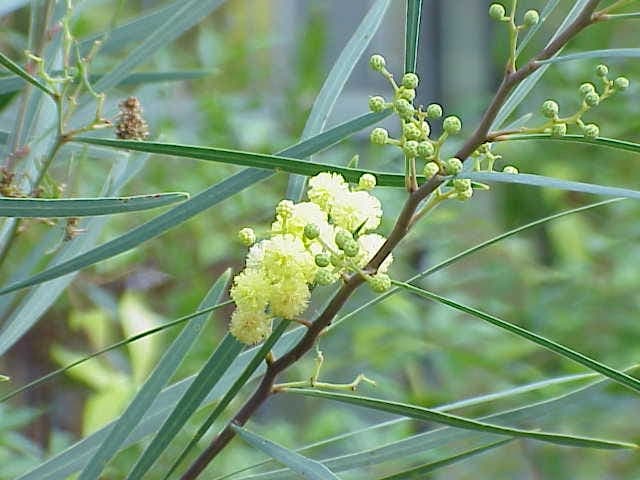
Swamp wattle features smooth, greyish bark and long, slender phyllodes – modified leaf stalks that function as leaves. These are bright green, up to 15 cm long, and arranged alternately along the stems. The real showstopper is the flower: dense, spherical clusters of golden-yellow blooms that appear from late autumn through winter and into spring (November to May). Each flower head is about 1 cm in diameter and emits a light, sweet fragrance that attracts bees and other pollinators.
The extended bloom period makes this plant a standout in gardens when few others are flowering.
Ideal location
Full sun is essential. Acacia retinodes needs at least 6 hours of direct sunlight daily to flower well. A south- or west-facing position works best. In cooler regions like the UK or northern Europe, plant near a warm wall or paved area to benefit from radiant heat. Avoid shady spots under trees or on north-facing slopes.
This shrub tolerates coastal exposure and light winds but should be sheltered from harsh, cold gusts. Use it as a specimen plant in a lawn, in mixed borders, or as part of a windbreak. On gardenworld.app, you can test different planting zones and see how sunlight plays across your garden throughout the year.
Soil requirements
Swamp wattle is not picky about soil type. It grows well in sandy, loamy, or clay soils as long as drainage is good. Avoid heavy, compacted clay without amendments. If your soil retains water, mix in coarse sand or gravel to improve drainage.
The ideal pH range is between 5.5 and 7.5. No fertiliser is needed – in fact, too much nitrogen can reduce flowering and weaken stems. As a member of the Fabaceae family, Acacia retinodes fixes its own nitrogen through root nodules, making it self-sufficient in nutrient-poor conditions.
Watering
Water regularly during the first 12 months after planting. Deep, weekly soakings encourage strong root development. Once established, swamp wattle is highly drought-tolerant and rarely needs supplemental watering, even in dry summers.
Avoid frequent light watering – it promotes shallow roots. In prolonged dry spells, give a deep drink every 2–3 weeks. Use rainwater if possible, as this plant can be sensitive to high lime content in tap water over time.
Free design
Want to see Swamp wattle: complete guide in your garden? Make a free design now.
Pruning
Prune after the main flowering flush, typically in late spring (May or early June). This timing allows new growth to harden off before winter. Remove dead, damaged, or crossing branches to improve airflow and shape. Light tip-pruning encourages bushiness.
Avoid heavy pruning – cutting back too far into old wood may result in poor regrowth. Use sharp, clean secateurs and wear gloves; some young stems have small spines.
Maintenance calendar
- January: Check for frost damage. Remove any dead wood.
- February: Minimal care. Water only if winter is unusually dry.
- March: Monitor for new growth. Keep base clear of weeds.
- April: Peak flowering. Watch for aphids on new shoots.
- May: Prune after flowering. Avoid heavy cuts.
- June: Mulch lightly to retain moisture and suppress weeds.
- July: Drought tolerance kicks in. Water only in extreme heat.
- August: No active care needed.
- September: Inspect for fungal spots or pests.
- October: Begin observing flower buds forming.
- November: Flowers appear. Protect young plants from early frosts.
- December: Enjoy winter blooms. Avoid disturbing nesting birds.
Winter hardiness
Acacia retinodes is hardy in USDA zones 9–11. In cooler areas like the UK (zone 8b), it can survive with protection. Young plants are more vulnerable – wrap the trunk with hessian or fleece during cold snaps. Mature specimens tolerate brief dips to -8°C, especially in sheltered, well-drained spots.
Avoid wet soil in winter – this is the main cause of winter dieback. If the ground freezes during dry cold spells, water lightly on a mild, sunny day.
Companion plants
Pair swamp wattle with other drought-tolerant, sun-loving plants like lavender, rosemary, Cistus, or Euryops. The golden blooms contrast beautifully with silver foliage or purple flowers. For a naturalistic look, combine with grasses like Stipa gigantea or perennials such as echinacea and rudbeckia.
Avoid invasive groundcovers that might crowd the base. Keep a 30 cm radius around the trunk free of mulch and competing plants to prevent rot.
Closing
Acacia retinodes is a reliable, low-maintenance shrub that brings vibrant colour to gardens during the cooler months. With full sun, good drainage, and minimal pruning, it rewards you with years of cheerful blooms.
Available at garden centres across the UK, often in 3–5 litre containers. Look for plants with healthy green phyllodes and no signs of dieback. With proper placement and care, swamp wattle becomes a long-term asset in your garden.
Want to see Swamp wattle: complete guide in your garden? Make a free design now.
Upload a photo, pick a style, and get a photorealistic design with plant list in under a minute.
No credit card required


Similar plants
Tall Silky Lupine: complete guide
Lupinus elatus
Tall silky lupine is a fast-growing Californian perennial with silvery foliage and blue-purple flower spikes, ideal for a prairie-style garden.
Garfield Lupine: complete guide
Lupinus garfieldensis
The Garfield lupine is a rare, fast-growing American perennial for alkaline, dry grassland gardens, with striking blue flower spikes.
Lupinus elegans: complete guide
Lupinus elegans
Lupinus elegans, the elegant lupine, is a spectacular blooming plant from Mexico with blue flower spikes. Care, cultivation and garden use.