
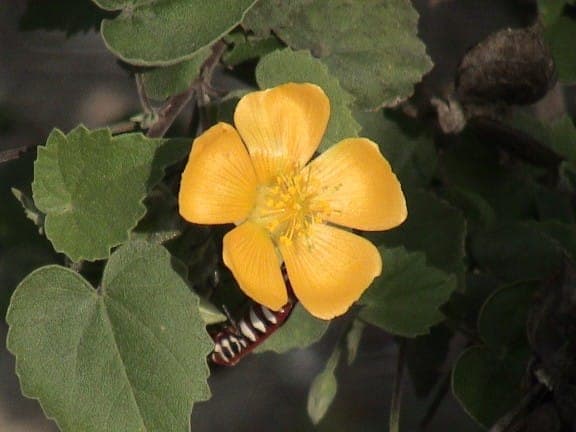
Bō-á-tún ê hoe / CC BY-SA 3.0, via Wikimedia Commons
Indian Abutilon: complete guide
Abutilon indicum
Want to see Indian Abutilon: complete guide in your garden?
1 minute, no credit card
Overview
The Indian Abutilon (Abutilon indicum) is a robust, fast-growing shrub native to tropical Asia (India, Sri Lanka to Australia). This plant is renowned for its cheerful yellow, bell-shaped flowers and its surprising hardiness. In warm climates (Mediterranean, warm continental), it grows outdoors; in cooler zones, it thrives as a conservatory plant.
This Abutilon is easier than many other species: faster-growing, more frost-tolerant (to -5 degrees Celsius briefly), and flowering prolifically. For Gardenworld.app users in warm regions, or with a heated conservatory, this is an excellent choice.
Appearance & bloom
The shrub reaches 1-2 metres tall with an upright, bushy growth habit. The leaves are small to medium, approximately 3-7 cm wide, heart-shaped, with irregular fine serrations.
The flowers are the star: bright yellow, bell-shaped (campanulate), approximately 2-3 cm wide, with red or brown veining. They appear continuously from April to October under favourable conditions.
The fruits are distinctive, compound capsular fruits with radially projecting segments, unique among Malvaceae.
Ideal location
The Indian Abutilon grows best in:
- Warm, sunny locations (minimum 6 hours direct sunlight)
- Sheltered spots (away from strong winds)
- Containers on south or east-facing terraces
- Conservatories with good ventilation
In warm climates (Mediterranean), it can overwinter outdoors. In northern Europe, it prefers a sheltered sunny spot or conservatory.
Soil
Use well-draining potting compost (peat-free compost 60% + perlite 40%). pH: neutral to slightly acidic (6-7). This plant tolerates poor soil well - feeding is not critical.
The plant performs better on slightly drier soil than very moist; drainage is crucial.
Free design
Want to see Indian Abutilon: complete guide in your garden? Make a free design now.
Watering
During the growing period (April-October), water regularly so the compost remains moist but not waterlogged. During winter dormancy (November-March), reduce watering to approximately every 2 weeks.
Once established, the plant tolerates short dry spells well. Water in the morning rather than evening to prevent leaf rot.
Feeding
Feed with standard houseplant fertiliser every 3 weeks during the growing period. Half-strength is adequate. Excessive feeding produces more foliage, fewer flowers.
Pruning
In March/April, cut back to 50 cm height for a dense, bushy form. Regular pinching (removing shoot tips) of young growth promotes branching.
Remove dead wood throughout the year.
Maintenance calendar
- January-February: minimal care, reduce watering, no feeding (conservatory below 10 degrees)
- March-April: prune back, resume feeding
- May-September: regular watering and feeding, deadhead spent flowers
- October: outdoors: provide frost protection; conservatory: maintain temperatures
- November-December: bring indoors, minimal care
Winter hardiness
In warm climates (USDA zones 9-10), it can overwinter outdoors. In temperate zones, very frost-tender: bring into conservatory if temperatures fall to -5 degrees Celsius. Leaves drop in cold, but the plant can recover.
Pests & diseases
- Spider mite: increase humidity
- Aphids: spray with warm soapy water
- Botrytis (grey mould): improve ventilation, avoid wetting foliage
Traditional use
In Indian and traditional Asian medicine, used for:
- Cough and bronchitis (leaf tea)
- Skin conditions (poultice)
- Diarrhoea (seeds)
Gardenworld.app advises medical use only under professional guidance.
Companion plants
Pairs well in conservatory/warm area with:
- Lantana camera
- Passiflora edulis
- Solanum seaforthianum
- Jasminum sambac (Arabian jasmine)
- Bougainvillea
Closing
The Indian Abutilon is an excellent, low-maintenance shrub for those who love exotic flowering without fuss. With regular feeding and pruning, it flowers continuously. Perfect for warm gardens or conservatory use.
Want to see Indian Abutilon: complete guide in your garden? Make a free design now.
Upload a photo, pick a style, and get a photorealistic design with plant list in under a minute.
No credit card required


Similar plants
Crimean linden: complete guide
Tilia × euchlora
Crimean linden is an elegant, fast-growing shade tree ideal for large gardens. Discover cultivars, spacing, maintenance tips and winter hardiness.
California flannelbush: complete guide
Fremontodendron californicum
Everything about California flannelbush (Fremontodendron californicum): sunny placement, drainage, pruning and care for this spectacular yellow-flowering shrub.
Hairy rose mallow: complete guide
Hibiscus moscheutos subsp. lasiocarpos
Full growing guide for hairy rose mallow (Hibiscus moscheutos subsp. lasiocarpos): location, soil, watering, winter hardiness and garden design tips.