
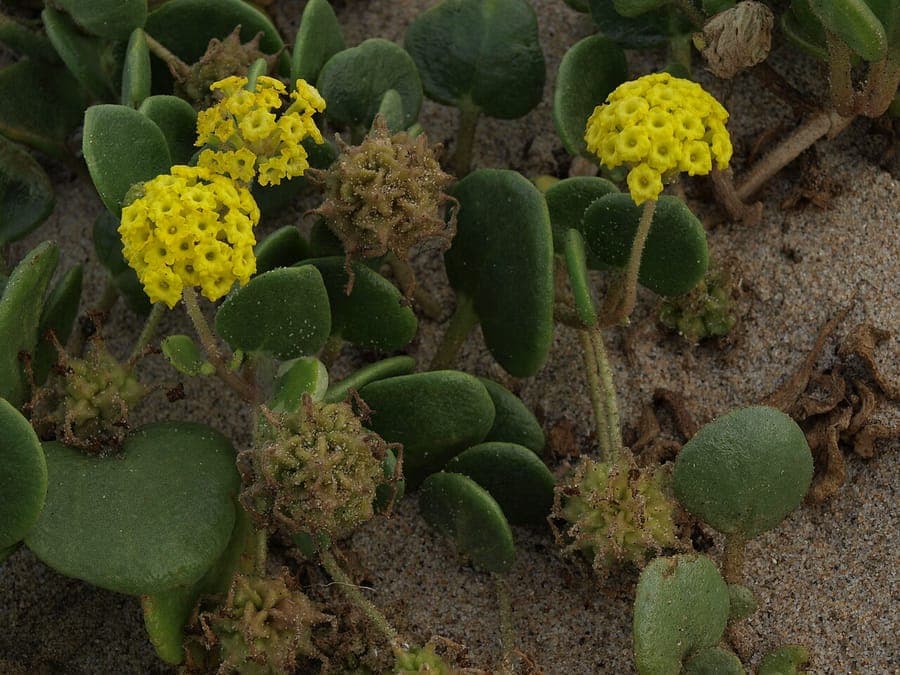
Jim Morefield from Nevada, USA / CC BY-SA 2.0, via Wikimedia Commons
Abronia latifolia: complete guide
Abronia latifolia
Want to see Abronia latifolia: complete guide in your garden?
1 minute, no credit card
Overview
The Yellow Sand-Verbena, Abronia latifolia, is one of the most recognisable coastal wildflowers of western North America. Belonging to the Nyctaginaceae family (the four-o'clock family), this robust trailing perennial thrives along the entire Pacific coastline from British Columbia in Canada to Baja California in Mexico. With fleshy succulent leaves, thick trailing stems and radiant yellow flower clusters, it has evolved to flourish in conditions that would defeat most garden plants: pure sand, relentless wind, salt spray and summer drought.
For gardeners worldwide, Abronia latifolia offers exciting possibilities. Coastal gardens from Cornwall to Cape Town, Mediterranean terraces, Australian beachside plantings and Pacific Island landscapes can all benefit from this tough, ornamental ground cover. At gardenworld.app you can create a garden design tailored to salt-tolerant and coastal species like this one. Hardy to USDA zones 7 through 10, the plant suits a broad range of mild to warm climates, though it draws the line at prolonged hard frosts.
Appearance & bloom cycle
Abronia latifolia is instantly recognisable thanks to its succulent foliage and showy yellow flowers. The plant grows 15 to 30 centimetres tall and spreads to a metre or more via thick, fleshy trailing stems that root at the nodes when they contact moist sand. The stems are covered in glandular hairs that trap sand grains, a clever adaptation that reduces water loss from wind exposure.
The leaves are the most distinctive vegetative feature. Broad, kidney-shaped to nearly circular, thick and fleshy, they range from bright green to grey-green depending on sun exposure and salt levels. Their succulent texture allows the plant to store fresh water internally, a critical survival strategy in porous beach sand where rainfall drains away within minutes.
The flowers are genuinely spectacular. From May through October, compact spherical clusters of ten to twenty-five individual trumpet-shaped florets appear on stout upright stems held above the leaf canopy. The colour is a vivid sunshine yellow, occasionally tinged with lemon or gold. Each cluster measures 3 to 5 centimetres across and is visible from a considerable distance against the muted tones of beach sand. The blooms release a sweet, honey-like fragrance that intensifies during evening and early morning hours, attracting hawkmoths and other crepuscular pollinators.
After pollination, distinctive winged fruits develop, enclosed by the hardened perianth. This wing structure aids wind dispersal across the dune landscape. In cultivation, the plant self-sows readily in suitably sandy locations.
Ideal location: sun, shade or partial shade
Full sun is essential. In its native habitat, Abronia latifolia occupies the most exposed positions on beach dunes, fully unprotected from the elements. For optimal performance in the garden, provide a minimum of six to eight hours of direct sunlight daily. South-facing positions are ideal in the northern hemisphere, north-facing in the southern hemisphere.
Partial shade is poorly tolerated. The plant responds with lax stems, thinner leaves that lose their succulent character, and dramatically reduced flowering. Deep shade is lethal. If your garden has limited sun, choose the brightest available position for this species.
What distinguishes the Yellow Sand-Verbena from most garden plants is its extraordinary tolerance of wind and salt spray. In its home habitat it endures daily bombardment with sea salt and ocean gales. This makes it outstanding for coastal gardens in windy, salt-affected locations where the plant palette is typically limited. Exposed seafront gardens, cliff-top terraces and windswept island plots are all suitable.
A raised bed, dune garden or sandy bank along a driveway provides excellent growing conditions. The plant also performs well in large containers on sunny patios or balconies, provided drainage is impeccable. Avoid sheltered, still corners where humid air can stagnate, as this increases the risk of fungal problems that the plant would never encounter on a windswept beach.
Soil & underground requirements
As a true dune plant, Abronia latifolia has an uncompromising preference for extremely well-draining sandy substrates. In the wild it grows literally in pure beach sand, sometimes with nothing more than a trace of organic matter. This is the fundamental principle for successful cultivation: think sand, not soil.
The ideal growing medium consists of 70 to 80 percent coarse sand, supplemented with 10 to 15 percent perlite or fine gravel and no more than 10 percent garden soil or potting mix. This is deliberately leaner than what you would prepare for most plants. pH can range from slightly acid to mildly alkaline (6.0 to 8.0), but a slightly alkaline reaction, similar to dune sand containing shell fragments, is preferred.
Clay soil is completely unsuitable and no amount of drainage improvement will fully compensate. In clay gardens, a raised bed or large container filled with the sandy mix is the only workable solution. The roots of Abronia latifolia are deep and fleshy, adapted to seek water in dry dune sand, but they rot irreversibly in waterlogged substrates.
A noteworthy characteristic is salt tolerance. The plant withstands mildly brackish soil conditions, making it suitable for locations near the sea where groundwater may carry some salt content. This is a rare trait that makes the species exceptionally valuable for coastal planting schemes.
Do not add manure, compost or fertiliser at planting time. The plant is literally adapted to the most nutrient-poor soils imaginable. Feeding produces soft, watery growth that is vulnerable to both rot and frost.
Watering: when and how much
The water requirements of Abronia latifolia are minimal, consistent with a plant that lives in free-draining dune sand where rainfall percolates away within minutes. The succulent leaves function as water reservoirs, enabling the plant to survive weeks without rain.
During the first few weeks after planting, regular watering helps roots establish. Water once a week, soaking the sand to a depth of about 20 centimetres. After the establishment period of six to eight weeks, reduce watering dramatically.
For established plants in maritime or temperate climates, supplemental watering is seldom needed. Natural rainfall is almost always sufficient. Only during exceptionally dry summers extending beyond three weeks without rain should you consider a single deep watering. In winter, irrigation is completely unnecessary and actively harmful.
Overwatering is the most common cause of failure with this species. Symptoms include leaf yellowing, soft brown stem bases, and eventual death of the entire plant from root rot. If you observe these signs, stop watering immediately and check that drainage has not become compromised.
Always water at the base of the plant, never overhead. The sticky leaves trap water droplets, which in combination with humid air create ideal conditions for fungal growth. Early morning watering is preferable so that any incidental splash dries quickly.
Free design
Want to see Abronia latifolia: complete guide in your garden? Make a free design now.
Pruning: when and how
The Yellow Sand-Verbena requires minimal pruning intervention. The plant has a naturally tidy growth habit and is largely self-regulating.
In early spring (March to April in the northern hemisphere), remove any dead or frost-damaged stems. Cut back to healthy tissue or to ground level if the entire stem has died. This clean-up encourages vigorous new growth from the root crown.
During the growing season, the most important pruning task is deadheading spent flower clusters. By removing wilted blooms, you stimulate the plant to produce new flower buds. This can extend the flowering season by weeks, sometimes into November in mild years.
If the plant spreads beyond its allotted space, individual runners can be shortened. Do this preferably in summer when the plant is actively growing and wounds heal quickly. Always use clean, sharp tools for clean cuts.
After the first frost, leave dead above-ground material in place as natural winter insulation for the root crown. Clear it away only when new shoots appear in spring. Do not cut into the fleshy root crown itself, as damage here can introduce rot organisms.
Maintenance calendar
A seasonal approach keeps your Abronia latifolia healthy and flowering throughout the year.
March - April: Remove winter damage and dead stems. Check that drainage remains optimal after winter rains. Begin sowing seed when soil temperature exceeds 12 degrees Celsius. Sow shallowly in pure sand, keep moist but not wet. Scarification or a 24-hour cold water soak can improve germination rates.
May: Growth accelerates as temperatures rise and days lengthen. Young seedlings are vulnerable to slug and snail damage, especially during damp nights. Apply organic slug pellets (iron phosphate based) or create a barrier of sharp grit around seedlings.
June - August: Peak flowering period. The bright yellow clusters are at their finest. Deadhead regularly for continuous display. Enjoy the evening fragrance and watch for visiting hawkmoths. Watering is generally unnecessary unless conditions are exceptionally dry.
September - October: Flowering gradually winds down. Allow some flower clusters to ripen for seed production. Collect ripe seed when the winged fruits turn brown and feel dry. Store in paper envelopes in a cool, dry location.
November - February: In zone 7, above-ground parts largely die back. In milder coastal areas (zone 8 and above), some foliage may persist through winter. Apply a layer of coarse gravel or crushed shells over the root zone for frost protection. Do not water.
Winter hardiness & protection
With a hardiness range of USDA zones 7 through 10, Abronia latifolia is less cold-tolerant than some other Abronia species. This means the plant is best suited to areas with mild winters, particularly coastal locations where the moderating influence of the ocean prevents prolonged hard freezes.
In zones 8 to 10, the plant sails through winter without any special attention. Some foliage typically persists, and in the mildest areas growth may continue almost year-round. These zones encompass much of coastal western Europe, the Mediterranean basin, coastal California, the Pacific Northwest lowlands, coastal Australia and New Zealand.
In zone 7, where hard frosts do occur, the plant can survive temperatures down to approximately minus 15 degrees Celsius, but only if the soil remains dry. Wet cold is lethal. A generous layer of coarse gravel or crushed shells (8 to 10 centimetres) over the root zone provides effective insulation without trapping moisture as organic mulches would.
Container-grown plants in borderline zones should be moved to a frost-free but cool location (5 to 8 degrees Celsius) for winter. An unheated greenhouse, cold frame or sheltered carport works well. Keep watering to an absolute minimum, allowing the growing medium to stay nearly bone dry.
As insurance, collect and store seed each autumn. Should the parent plant fail to survive a particularly harsh winter, you have viable seed ready for spring sowing. Seed stored cool and dry in paper envelopes remains viable for two to three years.
Companion plants & combinations
Abronia latifolia pairs best with plants that share its requirements for sun, sharp drainage and salt tolerance. This makes it an excellent partner for coastal and dune plantings where the available plant palette is naturally limited.
Successful combinations include:
- Crambe maritima (sea kale): a native coastal plant with blue-grey foliage and white flower sprays that contrast beautifully with the yellow Abronia.
- Eryngium maritimum (sea holly): steel-blue spiny flowers alongside the soft yellow Abronia clusters create a striking coastal composition.
- Ammophila arenaria (marram grass): the classic dune grass provides vertical accent and textural contrast.
- Armeria maritima (thrift): compact pink flower globes echo the Abronia's shape while providing colour contrast.
- Carpobrotus edulis (Hottentot fig): in frost-free areas, this succulent ground cover shares the same love of sand and sun.
- Eschscholzia californica (California poppy): warm orange and yellow tones harmonise with the Abronia flowers.
For broader coastal schemes, extend the palette with ornamental grasses such as Festuca glauca (blue fescue) and Elymus arenarius (lyme grass), plus drought-tolerant perennials like Centranthus ruber (red valerian) and Echium vulgare (viper's bugloss). The common thread is tolerance of poor, sandy soils and coastal exposure.
Avoid pairing with moisture-loving plants or aggressive spreaders that would overwhelm the Abronia. Keep the planting scheme lean, open and reflective of the plant's natural beach habitat for the most convincing visual effect.
Conclusion
Abronia latifolia challenges gardeners to rethink what makes a good growing site. Where most plants demand fertile, moisture-retentive soil, this yellow beauty flourishes in pure sand, battered by sea wind and salt spray. It is a plant that performs best when you leave it alone.
With its radiant yellow flower clusters, fleshy silver-green leaves and sweet evening fragrance, it brings colour and life to the most challenging spots in the garden. From bare dune sand to dry gravel gardens, from sunny containers on the terrace to salty coastal borders, the Yellow Sand-Verbena surprises with its resilience and beauty time and again.
Ready to incorporate Abronia latifolia into your garden design? Visit gardenworld.app to create a personalised garden plan that accounts for coastal conditions, salt tolerance and the specific requirements of your outdoor space. Happy planting!
Want to see Abronia latifolia: complete guide in your garden? Make a free design now.
Upload a photo, pick a style, and get a photorealistic design with plant list in under a minute.
No credit card required


Similar plants
Colorado four o'clock: complete guide
Mirabilis multiflora
Complete guide to Mirabilis multiflora: a showstopping perennial with magenta blooms opening at dusk, highly drought-tolerant and pollinator-friendly.
Sand-verbena: complete guide
Abronia umbellata
Discover sand-verbena, a beautiful pink flower from California perfect for sunny, dry gardens and groundcover with low maintenance needs.
Bougainvillea spectabilis: complete guide
Bougainvillea spectabilis
Great bougainvillea from Brazil with spectacular colored bracts. Climbing plant for warm climates. Care and propagation techniques.