
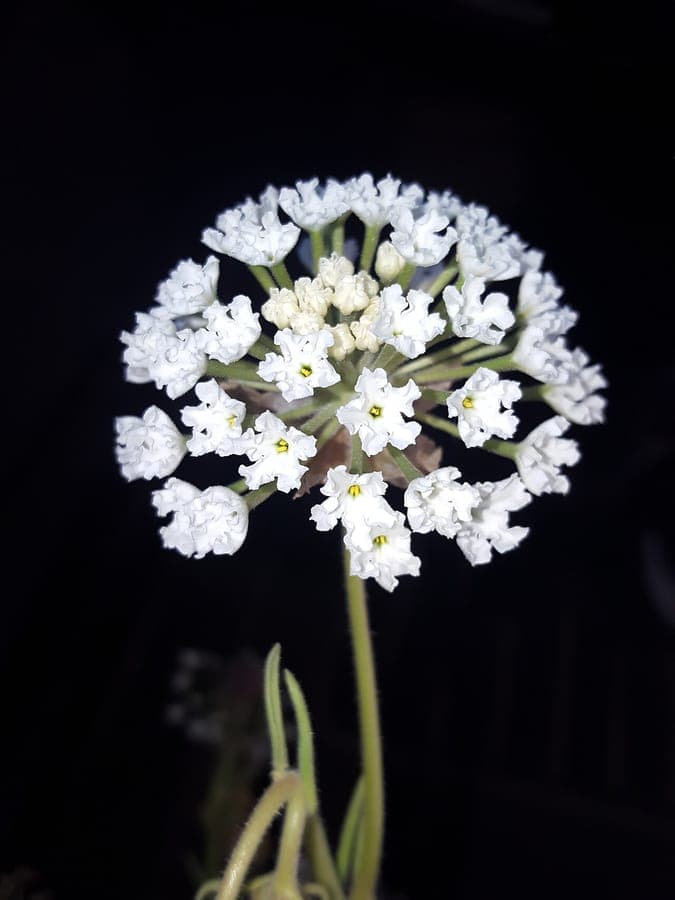
Alex Abair / CC BY 4.0, via Wikimedia Commons
Abronia fragrans: the fragrant sand verbena
Abronia fragrans
Want to see Abronia fragrans: the fragrant sand verbena in your garden?
1 minute, no credit card
Overview
Abronia fragrans, commonly known as the fragrant sand verbena or snowball sand verbena, is a standout prairie plant native to the western Great Plains of North America. This robust perennial from the Nyctaginaceae family (the four o'clock family) draws attention with its spherical clusters of snow-white flowers that open at dusk and release an intoxicating sweet perfume into the evening air. Growing 20 to 60 centimetres tall, it is a compact yet impressive presence that fits perfectly into dry, sunny gardens on every continent where suitable conditions exist.
What makes Abronia fragrans particularly appealing to gardeners worldwide is its combination of extreme drought tolerance, spectacular evening bloom, and intense fragrance that attracts moths and other nocturnal pollinators. For anyone seeking low-maintenance, climate-resilient planting, this plant deserves serious consideration. Explore gardenworld.app for garden designs that incorporate drought-tolerant species like the fragrant sand verbena.
Appearance and bloom cycle
Abronia fragrans is a herbaceous perennial with a spreading, semi-prostrate growth habit that forms a loose mat across the ground. The stems are thick, sticky, and covered with fine glandular hairs that give a slightly tacky feel when touched. The leaves are fleshy and oval to oblong, with a fresh grey-green colour that lends the plant a silvery appearance even when not in bloom.
The flowers are the absolute highlight of this plant. They are arranged in dense, spherical heads measuring 5 to 8 centimetres across, each composed of dozens of individual tubular florets. The colour is pure white to cream-white, sometimes with a faint pink blush. The most remarkable feature is the timing of bloom: the flowers open in the late afternoon to early evening and remain open throughout the night, closing again the following morning.
This evening flowering is accompanied by an intensely sweet, jasmine-like fragrance that carries far on the still evening air. The scent serves as a beacon for hawkmoths (Sphingidae), which are the primary pollinators. Their long proboscises are perfectly adapted to reach the nectar deep within the tubular flowers. The flowering period extends from June through September, peaking in July and August, providing scent and colour through most of the summer.
After pollination, winged fruits develop that are dispersed by the wind. The roots reach deep into the ground through a taproot system that can access moisture at considerable depth, an essential adaptation to life on the dry prairies where surface moisture evaporates rapidly.
Natural habitat and distribution
Abronia fragrans has a far broader distribution than most other Abronia species, reflecting its impressive adaptability. The plant occurs naturally across the Great Plains of North America, from Montana and North Dakota in the north to New Mexico and Texas in the south, and from Iowa in the east to the Rocky Mountain foothills in the west. This vast range encompasses diverse climates and soil types, from cold northern prairies to warm southern grasslands.
The typical habitat consists of open, sandy prairies, roadsides, railway embankments, and disturbed ground at elevations from 900 to 2,400 metres above sea level. The plant grows preferentially in sites with minimal competition from taller vegetation, such as open plains, dune systems, and sandy riverbanks. The climate across its range is characterised by hot summers, cold winters, and annual precipitation of 250 to 500 millimetres, predominantly in the form of summer thunderstorms.
The winter hardiness of Abronia fragrans is excellent, with tolerance down to USDA zone 4, corresponding to minimum winter temperatures of minus 34 degrees Celsius. This makes the plant considerably hardier than most other Abronia species and suitable for cultivation in a remarkable range of temperate climates worldwide, from the northern United States and Canada to much of Europe, parts of Australia and New Zealand, and temperate regions of South America and East Asia.
Soil and site requirements
Abronia fragrans has specific but manageable requirements for soil and site. The foundation is excellent drainage through sandy to gravelly soil. The plant is adapted to poor, mineral soils and will not tolerate heavy clay or waterlogged ground. The ideal pH range is 6.5 to 8.0, a broad span from slightly acidic to slightly alkaline that accommodates most well-drained garden soils.
For garden cultivation, a sand bed or rock garden provides the best conditions. Mix existing garden soil with at least 50 per cent coarse sand and add some gravel or pumice for additional drainage. In climates with wet winters, such as maritime regions of Europe, the Pacific Northwest, or southern Australia, a raised bed of 20 to 30 centimetres helps guarantee water runoff. This simple intervention often makes the difference between success and failure with this species.
The site must be in full sun, with at least six to eight hours of direct sunlight per day. Partial shade is poorly tolerated and leads to leggy growth and minimal flowering. Wind is not an issue; the plant grows naturally on open, windswept plains and actually benefits from good air movement around its foliage. A sheltered, stuffy spot against a wall should be avoided, as poor air circulation can promote fungal problems.
Watering and drought tolerance
Abronia fragrans is one of the most drought-tolerant perennials you can grow in any garden. In its natural habitat, the plant survives on the sparse summer thunderstorms of the Great Plains, thanks to its deep taproot that reaches moisture where other plants have long given up. The fleshy leaves and sticky stems limit moisture loss through transpiration, allowing the plant to remain turgid even during extended dry spells.
In the garden, this means you can virtually stop watering after the establishment period of the first year. During the first growing season, provide a modest weekly watering to allow the root system to establish. Always water at the base of the plant, never over the foliage. From the second year onward, supplemental watering is only necessary during extreme, prolonged dry periods lasting more than three weeks without rain.
Overwatering is the greatest enemy of Abronia fragrans. Excess moisture leads to root rot, stem collapse, and ultimately plant death. This is particularly critical during winter months when the plant is dormant. In regions with wet winters, whether in northern Europe, the Pacific Northwest of North America, or parts of New Zealand, keeping the root zone dry through the cold months is the primary challenge. A gravel mulch around the plant and well-drained soil are your best weapons against winter wet.
Free design
Want to see Abronia fragrans: the fragrant sand verbena in your garden? Make a free design now.
Propagation
Abronia fragrans can be propagated by seed and, to a limited extent, by root cuttings. Seed propagation is by far the most common and successful method. The seeds have a hard seed coat that delays natural germination, a survival strategy ensuring not all seeds sprout simultaneously, spreading germination over multiple seasons to hedge against poor years.
For successful germination, pre-treatment is required. Soak the seeds for 24 hours in lukewarm water to soften the seed coat, followed by cold stratification for four to six weeks at 2 to 5 degrees Celsius. After this treatment, sow the seeds on a medium of pure coarse sand, barely covered with a thin layer of sand, and place in a warm location at 18 to 22 degrees Celsius. Germination takes two to four weeks and is often irregular, with seeds sprouting over a period of weeks to months.
Seedlings must be handled carefully due to their sensitive taproot. Prick out as soon as the first true leaves appear, using deep pots to accommodate the developing root. Plant seedlings into their permanent position once they are robust enough, preferably in spring, giving them an entire growing season to establish before winter.
Root cuttings are possible in early spring but success rates vary. Take pieces of the thick taproot at least 10 centimetres long and plant them vertically in coarse sand. Keep the substrate lightly moist until new shoots appear, then transition to the minimal watering regime the mature plant prefers.
Pests and diseases
Abronia fragrans is a remarkably healthy plant that suffers little from pests and diseases, provided growing conditions are correct. Most problems stem from overly moist conditions rather than pest pressure.
The primary threat is root rot, caused by waterlogging or poorly drained soil. Symptoms include yellowing leaves, limp stems, and a rotting odour at the stem base. Prevention is the only effective approach: ensure excellent drainage and avoid overwatering. Once affected, the plant is rarely salvageable, so getting the soil right from the start is non-negotiable.
Powdery mildew can occur during humid summers with poor air circulation, appearing as a white powdery coating on the leaves. Improve air circulation by giving the plant adequate space and avoiding planting too close to walls or dense shrubs. Aphids sometimes appear on young shoots in spring but rarely cause serious damage. A strong spray of water is usually sufficient to dislodge them.
Slugs and snails can be problematic in wet climates, particularly for young plants that have not yet developed their full sticky-stem defences. A ring of coarse gravel or sharp grit around the plant provides physical protection, and the sticky, glandular hairs on mature stems offer a degree of natural deterrence that improves as the plant matures.
Companion plants and garden design
Abronia fragrans fits beautifully into multiple garden styles, from prairie planting to rock gardens and Mediterranean borders. The key is combining it with plants that share similar requirements for drainage and water.
In a prairie style, Abronia fragrans pairs splendidly with native grasses such as Bouteloua gracilis (blue grama), Schizachyrium scoparium (little bluestem), and Stipa tenuissima (Mexican feather grass). Other strong companions include Oenothera macrocarpa (Missouri evening primrose), which also blooms in the evening, Penstemon grandiflorus (large-flowered beardtongue), and Echinacea pallida (pale coneflower). This combination creates a natural-looking planting that demands minimal care once established.
For a rock garden or gravel border, Armeria maritima (sea thrift), Sedum species, Delosperma cooperi (ice plant), and Eryngium planum (flat sea holly) make excellent companions. The white evening blooms of Abronia fragrans create a beautiful contrast with these predominantly day-blooming partners, extending the garden's visual interest into the twilight hours.
In an evening or twilight garden, Abronia fragrans is a star performer. Combine with Nicotiana alata (jasmine tobacco), Mirabilis jalapa (four o'clock flower), Matthiola bicornis (night-scented stock), and Zaluzianskya capensis (night phlox) for a garden that comes alive after sunset with scent and white flowers that glow in the fading light. This concept works brilliantly on any continent where these species can be grown, from North American backyards to European terraces, Australian courtyards, and South African stoeps.
Maintenance calendar
- January - February (Winter): The plant has died back completely above ground. The root overwinters underground. Check that the soil around the plant is not waterlogged. Remove any pooling water. Begin cold stratification of seed for spring sowing.
- March (Early Spring): Sow stratified seed indoors in a coarse sand mix. Check existing plants for signs of new growth at the stem base. Remove dead material from the previous season to tidy the planting area.
- April - May (Spring): New shoots emerge. Provide a light watering if the soil is dry to support early growth. Plant out seedlings or new specimens into their permanent position. Apply a layer of gravel mulch around the plant to suppress weeds and improve drainage.
- June - July (Summer): Flowering begins. The plant needs virtually no watering now unless conditions are exceptionally dry. Enjoy the evening fragrance and watch for hawkmoths visiting the flowers at dusk. This is the peak of ornamental value.
- August - September (Late Summer): Flowering continues. Collect ripe seeds for propagation by harvesting the winged fruits when they turn brown and dry. The plant gradually produces fewer flowers as days shorten and temperatures begin to drop.
- October - December (Autumn/Winter): Above-ground parts die back gradually. Leave dead stems as winter protection for the root, or cut them back to approximately 5 centimetres above ground level. Ensure the root zone remains dry through winter. Apply additional gravel mulch if needed.
Closing thoughts
Abronia fragrans plays a significant ecological role across the Great Plains ecosystem. Its evening-opening flowers and powerful fragrance form a critical nectar source for nocturnal pollinators, particularly hawkmoths. The white-lined sphinx moth (Hyles lineata), one of the most widespread hawkmoths in North America, is among its most frequent visitors. These moths, with their long tongues perfectly matched to the plant's tubular flowers, form a pollination partnership that has coevolved over millennia.
Beyond moths, the plant supports a range of other wildlife. The seeds provide food for ground-foraging birds and small rodents. The spreading foliage offers shelter for ground-dwelling insects and spiders. The deep taproot, when it eventually dies, creates channels in the soil that improve water infiltration and provide habitat for soil organisms.
For gardeners interested in supporting nocturnal wildlife, planting Abronia fragrans is one of the most effective steps you can take. Most garden plants cater to daytime pollinators such as bees and butterflies, but moths are equally important and often overlooked. By adding evening-blooming, fragrant species to your garden, you create a round-the-clock pollinator habitat that supports the full spectrum of local biodiversity.
Abronia fragrans is a gem for the drought-tolerant garden that truly comes alive after sunset. Its combination of extreme drought resistance, enchanting evening fragrance, and appeal to nocturnal pollinators makes it a unique addition to gardens on any continent where the right conditions can be provided. While the plant has specific requirements for drainage and soil type, it rewards the prepared gardener with months of snow-white flower heads that fill the evening air with irresistible sweetness.
The key to success is straightforward: excellent drainage, full sun, and the confidence to put the watering can away. Gardeners who follow these principles are rewarded with a plant that asks for almost nothing and gives back generously, night after fragrant night. Visit gardenworld.app for garden design tools that combine Abronia fragrans and other drought-tolerant species in the ideal arrangement for your site.
Want to see Abronia fragrans: the fragrant sand verbena in your garden? Make a free design now.
Upload a photo, pick a style, and get a photorealistic design with plant list in under a minute.
No credit card required


Similar plants
Colorado four o'clock: complete guide
Mirabilis multiflora
Complete guide to Mirabilis multiflora: a showstopping perennial with magenta blooms opening at dusk, highly drought-tolerant and pollinator-friendly.
Sand-verbena: complete guide
Abronia umbellata
Discover sand-verbena, a beautiful pink flower from California perfect for sunny, dry gardens and groundcover with low maintenance needs.
Bougainvillea spectabilis: complete guide
Bougainvillea spectabilis
Great bougainvillea from Brazil with spectacular colored bracts. Climbing plant for warm climates. Care and propagation techniques.