
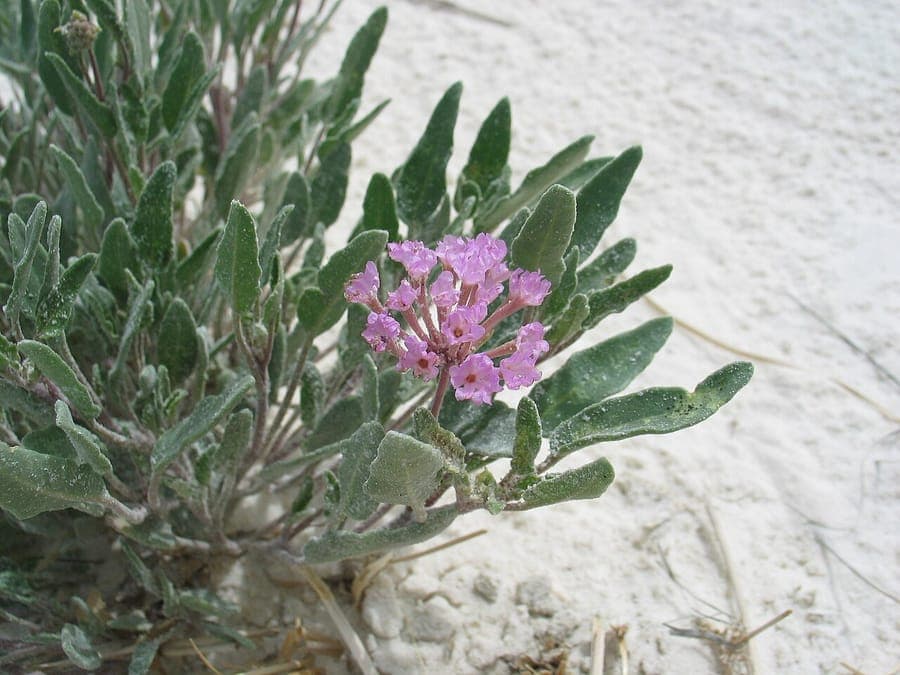
Curtis Hansen / CC BY 4.0, via Wikimedia Commons
Abronia angustifolia: complete guide
Abronia angustifolia
Want to see Abronia angustifolia: complete guide in your garden?
1 minute, no credit card
Overview
Abronia angustifolia, commonly known as purple sand verbena, is an elegant trailing perennial native to the southwestern United States and northern Mexico. With its striking purple-pink flower clusters and graceful spreading habit, this plant brings genuine desert beauty to sunny, dry gardens anywhere in the world. It belongs to the Nyctaginaceae family (four-o'clock family) and grows 15 to 40 centimetres tall, with stems that can spread up to a metre across the ground.
The purple sand verbena thrives in USDA zones 7 through 10, making it suitable for a wide range of climates across the globe - from the mild winters of the southern United Kingdom and coastal western Europe to the warm conditions of Australia, the Mediterranean, southern Africa, and of course its native American Southwest. The key to success everywhere is the same: sharp drainage, lean soil, and generous sunshine. At gardenworld.app you can create a garden design that incorporates drought-loving plants like Abronia angustifolia, ensuring your outdoor space looks its best year-round with minimal water use.
Appearance & bloom cycle
The Abronia angustifolia is a herbaceous perennial with a distinctly trailing to prostrate growth habit. The stems are slender, lightly hairy, and branch freely, forming a dense mat of foliage across the ground. The leaves are narrow and elongated - the species name 'angustifolia' literally means 'narrow-leaved' - and have a fresh green colour with a slightly sticky surface.
The flower clusters are compact and spherical, composed of dozens of small tubular florets that together create a showy display. The colour ranges from deep purple to bright pink, sometimes with a lighter centre. Flowering begins in late spring (May) and can continue through to autumn (October) under favourable conditions, providing an exceptionally long bloom season. Each cluster measures 3 to 5 centimetres in diameter and sits atop a stiff, upright flower stalk that rises above the trailing foliage canopy.
The fragrance is pleasantly sweet, most noticeable in the early evening hours, and attracts a broad spectrum of pollinators from honeybees and bumblebees to hawkmoths. After pollination, small inconspicuous winged fruits develop that are dispersed by the wind. This extended flowering period makes the plant particularly valuable for pollinator gardens and mixed borders that need colour throughout the growing season.
Ideal location: sun, shade or partial shade
The purple sand verbena is a full-sun plant through and through, needing at least six hours of direct sunlight daily to perform at its peak. In its native habitat - the deserts and semi-deserts of Arizona, New Mexico, and northern Mexico - it grows on fully exposed, sun-drenched sites with no shade whatsoever. That preference translates directly to the garden.
In the United Kingdom, a south-facing border, dry gravel garden, or raised bed provides the best conditions. In Australia and New Zealand, a north-facing position achieves the same result. North American gardeners in zones 7 to 10 will find this plant thoroughly at home in any open, sunny spot. The plant also performs brilliantly in hanging baskets, window boxes, and containers on wheels, where its trailing stems cascade elegantly over the edges.
Partial shade produces fewer flowers and a less compact growth form. Full shade is lethal. One often-overlooked benefit is the reflected heat from walls and paving: Abronia angustifolia actually thrives on the extra warmth that stone walls and paved surfaces radiate in the evening. A position against a south-facing wall (north-facing in the Southern Hemisphere) is therefore ideal, especially in cooler climates where every extra degree of warmth counts.
Soil & underground requirements
Like all Abronia species, Abronia angustifolia has exacting soil requirements - or more accurately, it demands very little from the soil except drainage. The plant has a strong preference for poor, sandy ground that lets water pass through rapidly. Rich, moisture-retentive garden soil is its greatest enemy.
An ideal substrate consists of 60 percent coarse river sand, 25 percent perlite or volcanic gravel, and 15 percent lean potting compost. The pH should be neutral to slightly alkaline (6.5-8.0). In gardens with heavy clay or loamy soil, a raised bed or large container filled with custom-blended substrate is almost always necessary. Never use standard multipurpose compost without adding sand, as it retains far too much moisture.
Abronia angustifolia develops a substantial taproot that penetrates deep into the ground. Provide at least 35 centimetres of free-draining substrate depth. For container growing, use a pot at least 30 centimetres wide and 35 centimetres deep. Always place a layer of coarse gravel or broken crocks at the bottom as a drainage layer. Fertilisation is barely needed; a small application of slow-release granular fertiliser in April is sufficient for the entire season. Over-feeding encourages leafy growth at the expense of flowers.
Watering: when and how much
The purple sand verbena is exceptionally drought-tolerant and will die considerably faster from overwatering than from drought. This is the single most important thing to remember when caring for this plant. In the open ground on well-draining sandy soil, you only need to water during prolonged periods of heat and drought (more than two weeks without rain at temperatures above 25 degrees Celsius).
For container-grown plants, let the substrate dry out completely between waterings. Check with your finger: if the soil feels bone-dry to a depth of 5 centimetres, you can water. When you do, drench the pot thoroughly until water runs out the bottom, then always empty the saucer. Never let the plant sit in standing water, even briefly.
During winter, stop watering entirely for plants overwintering outdoors. For plants kept in a frost-free room, a very small amount of water every six to eight weeks is sufficient - just enough to keep the roots alive without making them damp.
The best time to water is early morning. Evening watering increases the risk of fungal growth on the leaves and stems, particularly in humid climates. If in doubt about whether to water, wait another few days. This plant genuinely prefers neglect to attention when it comes to moisture.
Free design
Want to see Abronia angustifolia: complete guide in your garden? Make a free design now.
Pruning: when and how
The Abronia angustifolia is a low-maintenance plant that requires minimal pruning. The most important task is regularly removing spent flower clusters. This encourages the formation of new blooms and extends the already impressive flowering season. Snip the faded flower stalks with sharp secateurs back to just above the first leaf joint.
When the stems become too long or the plant spreads too far, you can trim the tips to encourage a more compact growth habit. Do this preferably in late spring when new growth is just starting. Never cut back more than one third of the total stem length at any one time.
At the end of the growing season, you can remove dead above-ground parts once they are fully withered. For plants overwintering outdoors, it is wise to leave some of the dead leaf material as protection over the root zone until spring. When tidying up in March or April, remove the remnants carefully to avoid damaging new emerging shoots.
Maintenance calendar
March-April: Inspect the plant after winter. Remove dead remnants and any weeds. Apply a thin layer of coarse sand as mulch. Give a light feed with slow-release granular fertiliser.
May: Growth kicks in and the first flower buds appear. Check for aphids, which sometimes attack young growing tips. A strong jet of water is usually sufficient to dislodge them.
June-September: Peak flowering season. Remove spent flower stalks regularly. Enjoy the butterflies and bees visiting the blooms. Water only during extreme drought.
October: Growth slows. Stop fertilising. Collect seed from the last flowers for propagation if desired.
November: Apply winter protection for plants in the ground: a thick layer of dry leaves or straw over the root zone. Move container plants to a frost-free, bright location.
December-February: Winter dormancy. Do not water outdoor plants. For indoor-wintered plants, minimal moisture every six to eight weeks. Check monthly for any signs of mould or rot.
Winter hardiness & protection
Abronia angustifolia is hardy in USDA zones 7 to 10, meaning it can withstand temperatures down to approximately -15 degrees Celsius. In milder parts of the United Kingdom, coastal western Europe, and similar climates worldwide, the plant can overwinter outdoors with good protection. In colder regions, frost-free overwintering in an unheated greenhouse, garage with a window, or cool conservatory is the safest option.
The key to successful overwintering is dryness. As with all Abronia species, it is not the cold but the wetness that kills the plant in winter. Keep the root zone dry by covering the plant with a rain cap or placing it under an overhang. In the open ground, a thick gravel mulch helps excess rainwater drain away quickly.
For container-grown plants, elevate the pot on pot feet so water can drain freely. Place the pot against a sheltered south-facing wall (north-facing in the Southern Hemisphere) and optionally wrap it with bubble wrap or fleece to insulate the root ball against extreme frost. A sheet of polystyrene under the pot provides additional insulation from below.
Important: do not bring the plant into a heated living room. The dry, warm air and lack of light cause the plant to weaken and emerge poorly in spring. A cool, bright space between 2 and 10 degrees Celsius is ideal for winter dormancy.
Companion plants & combinations
The purple sand verbena looks its best in combination with other Mediterranean and drought-tolerant plants. Its trailing habit makes it a perfect ground cover beneath taller plantings. Combine it with lavender (Lavandula angustifolia), rosemary (Rosmarinus officinalis), and sage (Salvia officinalis) for a fragrant, drought-resistant border that requires minimal maintenance.
For striking colour contrast, plant Abronia angustifolia alongside silver-leaved plants such as Artemisia 'Powis Castle', Stachys byzantina (lamb's ears), or Santolina chamaecyparissus (cotton lavender). The purple-pink flowers pop beautifully against the silvery foliage. In a rock garden, it pairs well with succulents like Sedum, Sempervivum, and Delosperma.
A particularly attractive combination emerges when you let the trailing stems cascade over the edge of a wall or raised bed, alongside Aubrieta and Cerastium tomentosum (snow-in-summer). This creates a lush, loosely cascading effect that looks entirely natural and effortless.
Avoid pairing with moisture-loving plants such as hostas, ligularia, or rodgersia. The difference in watering needs is too great for these plants to thrive side by side. Always choose neighbours that share the same preference for dry, lean soil and full sun exposure.
Conclusion
Abronia angustifolia can be propagated in two ways: by seed and by cuttings. Seed propagation is the simplest method. Collect the ripe fruits in late summer and allow them to dry. The seeds germinate best after a cold stratification period of four weeks in the refrigerator. Sow in March in seed trays filled with pure sand, keeping the substrate only lightly moist. Germination takes two to four weeks and is irregular.
Cuttings provide faster results. Take 8 to 10 centimetre stem-tip cuttings in June or July. Remove the lower leaves and insert the cuttings into moist sand. Place them in a warm, bright spot (not in direct sunlight) and keep the sand lightly moist. Roots appear after three to five weeks. Pot the rooted cuttings individually in the sandy substrate described earlier.
A fascinating aspect of Abronia angustifolia is its origin in the Sonoran and Chihuahuan deserts, among the most biodiverse desert regions on Earth. The plant has perfectly adapted to extreme conditions: scorching heat, prolonged drought, and nutrient-poor soils. This makes it a symbol of resilience and a captivating addition to any plant collection.
The name 'Abronia' derives from the Greek 'abros' (graceful), while 'angustifolia' refers to the narrow leaves that are so characteristic of this species. In its native range, the plant has been valued by indigenous communities for centuries as a soil stabiliser on sandy slopes, preventing erosion in fragile desert ecosystems.
Abronia angustifolia is a versatile and rewarding plant for anyone seeking a decorative ground cover for dry, sunny spots. Its long flowering season, handsome purple-pink blooms, and graceful trailing habit make it a valuable addition to the Mediterranean garden, rock garden, or sunny terrace. The single most important factor is getting the drainage right and keeping watering to an absolute minimum.
Although the plant is not a standard offering at every garden centre, specialist nurseries and online seed merchants are reliable sources. With the right position and a little patience, this desert beauty becomes a loyal garden companion that flowers for months on end and draws admiring glances from every visitor.
Curious about how Abronia angustifolia fits best into your garden layout? At gardenworld.app you can create a personalised garden plan that takes into account all your preferences and the specific conditions of your outdoor space.
Want to see Abronia angustifolia: complete guide in your garden? Make a free design now.
Upload a photo, pick a style, and get a photorealistic design with plant list in under a minute.
No credit card required


Similar plants
Colorado four o'clock: complete guide
Mirabilis multiflora
Complete guide to Mirabilis multiflora: a showstopping perennial with magenta blooms opening at dusk, highly drought-tolerant and pollinator-friendly.
Sand-verbena: complete guide
Abronia umbellata
Discover sand-verbena, a beautiful pink flower from California perfect for sunny, dry gardens and groundcover with low maintenance needs.
Bougainvillea spectabilis: complete guide
Bougainvillea spectabilis
Great bougainvillea from Brazil with spectacular colored bracts. Climbing plant for warm climates. Care and propagation techniques.