
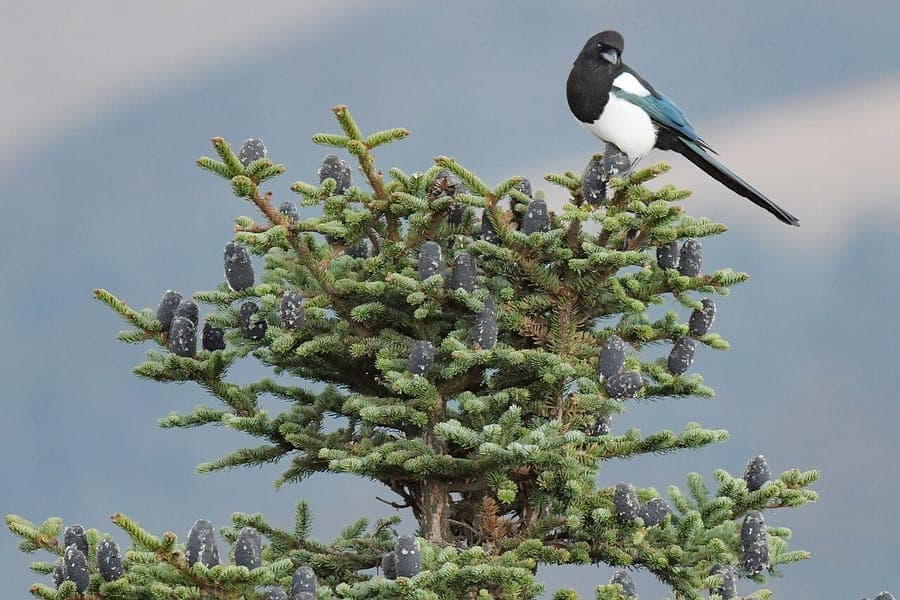
wangqg / CC BY 4.0, via Wikimedia Commons
Flaky Fir (Abies squamata): complete guide
Abies squamata
Want to see Flaky Fir (Abies squamata): complete guide in your garden?
1 minute, no credit card
Overview
The Flaky Fir, scientifically known as Abies squamata, holds a remarkable distinction in the plant kingdom: it is the highest-altitude fir species on Earth. Growing naturally between 3800 and 4700 meters above sea level in the mountains of eastern Tibet and Sichuan province in China, this tree has evolved to withstand conditions that would defeat most other conifers. Its ability to thrive where the air is thin, winters are brutal, and growing seasons are short speaks to millions of years of adaptation.
What sets the Flaky Fir apart visually from every other Abies species is its extraordinary bark. While most firs have smooth or furrowed bark, Abies squamata develops distinctly exfoliating bark plates that peel away in thin, irregular layers to reveal a mosaic of colors beneath, ranging from cream and pale grey to rose-brown and purple. This characteristic is so unusual within the genus that it makes the tree instantly identifiable. Curious how a rare specimen tree like this could fit into your landscape? Explore design possibilities at gardenworld.app to see how extraordinary conifers can anchor your garden plan.
Appearance & growth characteristics
Abies squamata reaches heights of 15 to 40 meters in its native habitat, though cultivated specimens outside of China typically remain more modest, often between 10 and 20 meters over several decades. The crown is narrowly conical to columnar, giving the tree a refined, upright silhouette that works well in both formal and naturalistic settings.
The needles are dark green, 1.5 to 3.5 cm long, and densely arranged along the branches. They are slightly curved with two pale grey stomatal bands on the underside, a feature common to many fir species. When crushed, the needles release a pleasant resinous fragrance that is characteristic of high-altitude conifers.
The bark is unquestionably the star feature. Young trees start with smooth, grey bark that gives little hint of what is to come. As the tree matures, typically from around 15 to 20 years of age, the bark begins to exfoliate in thin, papery to corky plates. These plates curl and peel away from the trunk, exposing fresh bark beneath in a range of warm tones. The effect becomes more dramatic with age, and old specimens can develop a trunk that rivals the finest paperbark maples for ornamental interest.
The cones are erect, cylindrical, 6 to 10 cm long, and mature from green to dark purple. As with all true firs, the cone scales disintegrate at maturity while the central axis persists on the branch.
Ideal location: sun, shade, or partial shade
Given its origin at extreme altitudes, the Flaky Fir is fundamentally a cool-climate tree. It performs best in regions with cool summers and cold winters. In warmer lowland areas, site selection becomes critical to long-term success.
Partial shade is the safest choice in most temperate gardens. Position the tree where it receives morning sun and afternoon shade, or dappled light throughout the day. North-facing or east-facing aspects are particularly suitable. Full sun is acceptable only in cooler climates, at higher elevations, or in areas with reliably cool summers.
Avoid south-facing walls or paved areas that radiate heat. The reflected warmth can stress the tree significantly during summer months. Wind exposure is generally less of a concern, as the Flaky Fir is naturally adapted to exposed mountain ridges, but shelter from hot, drying winds is beneficial in lowland gardens.
Allow a clear radius of 5 to 8 meters around the planting site. Although growth is moderate in cultivation, the tree needs adequate space for root development and air circulation around the crown.
Soil & underground requirements
The Flaky Fir requires well-drained, acidic to neutral soil with a pH between 5.0 and 6.5. This is non-negotiable: the tree originates from rocky mountain slopes where water never pools, and it will not tolerate waterlogged conditions under any circumstances.
Prepare the planting hole with a mix of quality topsoil, coarse sand or perlite, and composted pine bark. Adding granite chips or pumice to the backfill further improves drainage. On heavy clay soils, consider creating a raised planting mound 30 to 50 cm above the surrounding grade to ensure the root zone stays free-draining.
The soil should be moderately fertile, not rich. In its natural habitat, the Flaky Fir grows in lean, mineral soils where organic matter is sparse. Excessive nitrogen produces soft, leggy growth that is more susceptible to disease and less winter-hardy. A thin mulch layer of pine needles or bark chips helps maintain soil acidity and moisture without creating waterlogging.
Avoid planting near concrete foundations or limestone rock gardens, as lime leaches into the soil and raises the pH beyond the tree's tolerance.
Watering: when and how much
The Flaky Fir has a somewhat surprising tolerance for dry conditions compared to most fir species, an adaptation to the continental climate of the Tibetan Plateau where rainfall is concentrated in summer monsoons with dry periods in between. However, consistent moisture during the growing season remains important for healthy growth.
For newly planted trees, provide 10 to 15 liters of water per week during the first two growing seasons, split between two deep watering sessions. Water slowly to allow penetration to the full depth of the root ball. Use rainwater or soft water where possible, as the tree prefers low-calcium conditions.
Established trees are more self-sufficient but still benefit from supplemental watering during extended dry spells, particularly in summer. Check soil moisture regularly by pushing a finger 5 to 8 cm into the ground near the root zone. If the soil feels dry at that depth, water thoroughly.
The critical rule is this: moist but never wet. Standing water around the roots, even for short periods, can trigger root rot and decline. Ensure the planting site has excellent drainage year-round, including during heavy autumn and winter rains.
Free design
Want to see Flaky Fir (Abies squamata): complete guide in your garden? Make a free design now.
Pruning: when and how
The Flaky Fir requires minimal pruning under normal garden conditions. Its natural growth habit produces a regular, narrow conical crown that seldom needs correction. Pruning should be limited to the removal of dead, damaged, or crossing branches.
If pruning is necessary, perform it in late winter, from January through early March, before sap begins to flow and new buds break. Use clean, sharp tools and sterilize blades with rubbing alcohol between cuts to prevent the spread of fungal infections.
Never remove the central leader. Topping the tree permanently disrupts its growth form and leads to an unnatural, multi-stemmed crown that weakens the overall structure. Similarly, never cut into old wood that lacks green foliage, as conifers cannot regenerate from bare wood.
The exfoliating bark is entirely natural and not a sign of disease or distress. Do not attempt to peel or remove bark plates manually. The tree sheds them on its own schedule, and the peeling pattern becomes increasingly attractive as the tree ages. Interfering with this process can damage the living bark tissue beneath.
Maintenance calendar
- January - February (Winter): Inspect for winter damage and remove any broken branches. Check that mulch is still in place around the root zone. This is the best window for any necessary pruning.
- March (Early spring): Refresh the mulch layer around the base, keeping it 10 cm away from the trunk to prevent collar rot. Apply a light dose of acidifying fertilizer as growth resumes.
- April - May (Spring): Monitor for new growth and watch for pests such as adelgids. Begin regular watering as conditions dry out. Protect young trees from late frost with horticultural fleece if needed.
- June - August (Summer): The most critical period for watering. Provide extra water when temperatures exceed 25 degrees Celsius. Watch for signs of heat stress such as yellowing or browning needle tips. Evening misting of the crown can help raise humidity around the tree.
- September - October (Autumn): Cones ripen during this period. Gradually reduce watering. Topdress with composted pine bark. Test soil pH and adjust with sulfur if needed.
- November - December (Late autumn): Water deeply before the ground freezes. Apply a fresh protective mulch layer. Young trees may benefit from a burlap windscreen in exposed locations.
Winter hardiness & protection
The Flaky Fir is exceptionally winter-hardy, which comes as no surprise given its origin at altitudes where temperatures regularly plunge below minus 30 degrees Celsius. It is rated for USDA zones 5 through 7, meaning it handles severe cold without difficulty across most of Europe, North America, and temperate Asia.
The challenge in cultivation is not winter cold but summer heat. In regions with hot, humid summers, the tree can suffer from heat stress, fungal issues, and overall decline. This is the single most important factor in determining whether Abies squamata will thrive in your garden.
Mature specimens need no winter protection whatsoever. Young trees in their first two to three years after planting may benefit from a mulch layer of 8 to 12 cm around the base to insulate shallow roots, and horticultural fleece draped over the crown during severe cold snaps with drying wind.
Late spring frosts in April or May, after new shoots have already emerged, pose a greater risk than winter cold. The tender new growth can be killed by a hard frost, though the tree will typically recover by producing secondary buds. Fleece protection on forecast frost nights is worthwhile for young specimens during their first five years.
Companion plants & garden design
The Flaky Fir is a natural focal point in any garden setting, thanks to its extraordinary bark texture. Position it where the trunk is clearly visible, ideally against a simple backdrop such as a lawn edge, gravel garden, or low groundcover planting that does not compete with the bark display.
For underplanting, choose shade-tolerant perennials and groundcovers that complement the tree's woodland character. Ferns such as Dryopteris erythrosora (autumn fern) and Polystichum setiferum (soft shield fern) work beautifully. Epimedium species, Tiarella cordifolia (foamflower), and Galium odoratum (sweet woodruff) provide attractive ground-level interest without competing for root space.
To honor the tree's Chinese origins, consider an East Asian planting theme with Japanese maples (Acer palmatum), clumping bamboo (Fargesia), and ornamental grasses (Hakonechloa macra). Rhododendrons and Pieris japonica thrive in the same acidic soil conditions and add seasonal flower interest.
Avoid pairing with plants that prefer alkaline soil or have aggressive root systems. Maintain adequate spacing from other large trees to prevent competition for water and nutrients in the root zone.
Closing thoughts
The Flaky Fir stands as one of the most captivating conifers available to the dedicated gardener. Its record-breaking altitude tolerance, its one-of-a-kind exfoliating bark, and its rarity in cultivation all contribute to a tree that rewards patience and careful siting with decades of growing interest. The bark display alone justifies the effort, developing ever more dramatic patterns and colors as the tree matures.
For collectors and garden enthusiasts seeking something genuinely extraordinary, Abies squamata deserves serious consideration. While it does demand attention to drainage and summer cooling, these are manageable requirements for the thoughtful gardener. Explore how rare specimen trees can transform your outdoor space at gardenworld.app, where you can design a garden that gives exceptional trees the setting they deserve.
Want to see Flaky Fir (Abies squamata): complete guide in your garden? Make a free design now.
Upload a photo, pick a style, and get a photorealistic design with plant list in under a minute.
No credit card required


Similar plants
Abies delavayi: complete guide
Abies delavayi
Delavayi fir is an elegant, medium-sized coniferous tree from the Pinaceae family with dark green needles. This Asian evergreen is perfect for alpine gardens and large landscapes.
Taiwan fir: complete guide
Abies kawakamii
Discover the magnificent Taiwan fir, a rare evergreen conifer from Taiwan's mountain regions. Learn growth requirements, care tips, and why this beautiful tree is perfect for collectors of unique garden specimens.
Farges fir: complete guide
Abies fargesii
Discover the majestic Farges fir, an impressive conifer from China's mountains with elegant foliage and columnar form. Ideal for large gardens.