
Inti-sol / CC BY-SA 3.0, via Wikimedia Commons
Sakhalin Fir (Abies sachalinensis): complete guide
Abies sachalinensis
Want to see Sakhalin Fir (Abies sachalinensis): complete guide in your garden?
1 minute, no credit card
Overview
The Sakhalin Fir, botanically known as Abies sachalinensis, is a robust and elegant conifer native to the northernmost reaches of Japan and the Russian island of Sakhalin. Reaching heights of 25 to 40 metres in its natural habitat, this tree is a testament to resilience in extreme climatic conditions. The Sakhalin Fir ranks among the most cold-hardy fir species on the planet, surviving temperatures down to -40 degrees Celsius and below without difficulty, making it exceptionally well suited for gardens in cold regions where many other conifers fail.
In Japan, this fir is known as 'Todo-matsu' and plays an important role in the forestry of Hokkaido, the country's northernmost main island. The forests of Abies sachalinensis form an essential part of the subarctic ecosystem, providing habitat for diverse wildlife including Blakiston's fish owl, the largest owl species in the world. Over thousands of years, the tree has adapted to heavy snowfall, biting winds and short growing seasons, and it carries these traits with it when planted in gardens across North America, Europe and other temperate regions. Explore how cold-hardy conifers like the Sakhalin Fir fit into your garden design at gardenworld.app.
Appearance & bloom cycle
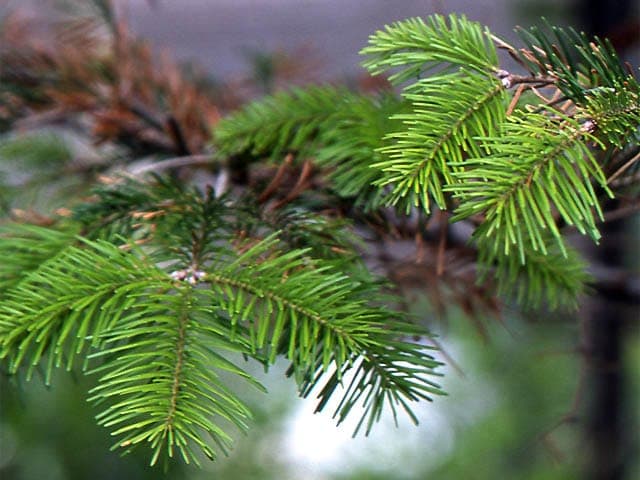
Abies sachalinensis is an evergreen conifer with a broad, conical crown that is regular and symmetrical on young specimens but can become wider and more irregular on older trees. The needles are 20 to 35 mm long, flat and dark green on the upper surface, with two distinct whitish-grey stomatal bands on the underside. They are arranged in two rows along the branches in a comb-like pattern, giving the tree a dense and full appearance. When crushed, the needles release a fresh, resinous aroma reminiscent of the northern boreal forest.
The bark of young trees is smooth and light grey with conspicuous resin blisters containing sticky, aromatic resin. As the tree ages, the bark darkens and develops scaly fissures. In its natural habitat, the tree can live for 200 to 300 years.
Flowering occurs in late spring, usually in May or early June. Male flowers are small, reddish to yellowish-green catkins positioned on the underside of branches. Female flowers appear as upright, green to purplish structures higher in the crown. After wind pollination, these develop into cylindrical cones measuring 6 to 8 cm in length, initially greenish and turning dark brown to purplish-brown as they ripen. The cones stand upright on the branches, typical of the genus Abies, and disintegrate on the tree in autumn, releasing their scales and seeds while the central axis remains on the branch.
A notable characteristic is the snow adaptation of the branches. The flexible, slightly pendulous lateral branches bend under the weight of heavy snow loads without breaking, then spring back resiliently when the snow melts or shakes off. This natural flexibility makes the Sakhalin Fir particularly well suited for areas with regular heavy snowfall.
Ideal location: sun, shade, or partial shade
The Sakhalin Fir is a versatile tree regarding light conditions. In its natural habitat, it grows both in closed forests and at forest edges, which has given it tolerance for a range of light levels. The ideal position is in full sun to partial shade. Full sun promotes a dense, symmetrical crown form and stimulates cone production. Partial shade is well tolerated, especially during the juvenile phase, but prolonged deep shade leads to a sparser growth habit and reduced vitality.
When selecting a site, it is important to consider this tree's origin in cool, northern latitudes. The Sakhalin Fir performs best where summers are not excessively hot and dry. In the Pacific Northwest of North America, Scandinavia, the British Isles and the cooler parts of central Europe, the tree thrives in fully open positions. In warmer continental regions, or in areas where summer temperatures regularly exceed 30 degrees Celsius, a position with some afternoon shade can be beneficial.
Allow the tree adequate space to develop. Plan for at least 6 to 8 metres of clearance around the trunk. The eventual crown spread is 5 to 7 metres depending on growing conditions. The tree develops a sturdy root system with both a taproot and extensive lateral roots, giving it excellent wind stability.
Soil & underground requirements
The Sakhalin Fir is less demanding in its soil requirements than many other fir species, which contributes to its reputation as a robust, tolerant conifer. The ideal soil is deep, moist, well-drained and slightly acidic to neutral with a pH between 5.0 and 7.0. The tree grows best in loamy or sandy-loam soil that retains adequate moisture without causing waterlogging.
On heavy clay soil, it is advisable to improve drainage by mixing coarse sand, perlite or gravel through the soil. Make the planting hole generous, at least one and a half times the width and depth of the root ball, and work the excavated soil through with compost and a handful of peat or pine needle compost. A drainage layer of 15 to 20 cm of pumice or gravel beneath the planting hole prevents roots from sitting in standing water, which can cause root rot.
Sandy soil is perfectly suitable for this fir, provided sufficient organic matter is added to improve moisture retention. An annual mulch layer of bark chips or pine needles around the base helps maintain soil moisture, regulate temperature and keep the pH at appropriate levels. Avoid lime-based fertilisers and lime applications, as the Sakhalin Fir prefers a slightly acidic environment. A slow-release conifer fertiliser applied in early spring provides the nutrients needed without disrupting soil chemistry.
Watering: when and how much
While the Sakhalin Fir tolerates drought better than many other Abies species, it performs best with a regular moisture supply. In its natural habitat, it receives ample precipitation distributed throughout the year, including significant snowfall in winter that gradually releases moisture into the soil as it melts in spring.
Young trees in their first three to four years after planting need weekly watering, particularly during dry spells in spring and summer. Apply 10 to 20 litres per session, delivered slowly so the water penetrates deep into the soil. Surface sprinkling is not effective and promotes shallow root development. Use a watering can with a rose attachment or a soaker hose that slowly releases water around the canopy drip line.
Mature trees are considerably less demanding in their water needs. Their extensive root system reaches deeper soil layers and can tap into groundwater reserves. During prolonged dry periods in summer, particularly when more than two weeks pass without significant rainfall, supplemental watering is still advisable. Apply a deep soaking of 20 to 30 litres distributed across the root zone.
Check soil moisture by pushing a finger or a wooden stick 10 cm deep into the ground. If the soil feels dry at that depth, it is time to water. During winter, watering is rarely necessary unless a prolonged frost-free dry spell occurs. In that case, ensure the tree takes up sufficient moisture before severe frost sets in, to prevent winter desiccation of the needles.
Free design
Want to see Sakhalin Fir (Abies sachalinensis): complete guide in your garden? Make a free design now.
Pruning: when and how
The Sakhalin Fir naturally develops a beautiful, regular conical shape and requires virtually no pruning. The tree grows with a clear central leader and symmetrically arranged branch whorls, resulting in a harmonious form that needs little correction. This makes the Sakhalin Fir a particularly low-maintenance choice for garden owners who appreciate a tidy appearance without much effort.
Pruning is limited to removing dead, damaged or disease-affected branches. The best time for this is late winter, in February or March, before new growth begins. Always use sharp, clean pruning tools and disinfect cutting surfaces with a seventy percent alcohol solution to prevent infections.
Do not touch the central leader unless it has been damaged by storm, snow breakage or wildlife. Loss of the leader disrupts the symmetrical growth pattern and results in a multi-stemmed or irregular crown. If the leader is damaged, select the strongest lateral shoot near the top and gently guide it upward using a bamboo cane as a replacement leader. Tie the shoot loosely with a soft band and remove the cane after one year when the shoot has established its position.
Avoid pruning into old wood that has no green needles. Like all Abies species, the Sakhalin Fir does not regenerate from bare wood, making bare patches permanent. For branches that extend too far, prune back to just beyond a side branch that still carries green growth. Large pruning wounds are rarely necessary and should be avoided, as they create entry points for fungi and bacteria.
Maintenance calendar
- January - February (Winter): Check the tree for snow breakage. Although the flexible branches typically handle snow loads well, exceptionally heavy wet snow can still cause damage. Gently remove excess snow from vulnerable branches. Inspect the bark for frost cracks. This is the ideal period for removing dead branches.
- March - April (Early spring): The planting season begins once the ground has thawed and is workable. Prepare the planting hole carefully. Apply the first feed with a slow-release conifer fertiliser. Check the mulch layer and top up if needed. Resume watering as the soil begins to dry out.
- May - June (Late spring): The tree is now in active growth. Fresh light green shoots appear at the branch tips. Ensure regular watering during dry weather. Check for pests such as adelgids and spider mites. Apply a fresh mulch layer of 5 to 8 cm, keeping it away from direct contact with the trunk.
- July - August (Summer): Continue monitoring watering, especially during warm periods. The Sakhalin Fir may show heat stress during prolonged temperatures above 30 degrees Celsius. Provide extra water and consider light shading for young trees during extreme heat. Watch for needle browning, which may indicate drought stress or spider mite infestation.
- September - October (Autumn): Cones ripen and disintegrate. This is an excellent time to enrich the soil around the tree with a layer of compost or shredded leaves. New planting is still possible until mid-October, giving the tree time to establish roots before winter. Gradually reduce watering frequency.
- November - December (Early winter): Give a final thorough watering before the soil freezes. Check the mulch layer and top up to 10 cm if necessary. Young trees in windy locations may benefit from a temporary windbreak of hessian or reed screens, although this species generally handles wind and cold excellently.
Winter hardiness & protection
The winter hardiness of the Sakhalin Fir is nothing short of remarkable and represents the most distinguishing characteristic of this species. Hardy to USDA zone 2, which corresponds to temperatures down to -45 degrees Celsius and below, this tree ranks among the most frost-resistant conifers available for garden use. Throughout the United Kingdom, Ireland, most of continental Europe, and the vast majority of North America, winter protection for established specimens is entirely unnecessary.
This extreme cold hardiness is the product of thousands of years of evolution in the subarctic climate of Hokkaido and Sakhalin, where winters are long, bitterly cold and snow-rich. The tree has developed multiple adaptations that protect it against extreme cold. The needles contain natural antifreeze compounds that prevent cellular damage during severe frost. The flexible branch structure prevents snow breakage by bending under the weight and springing back when the snow falls away.
Even young trees are remarkably winter hardy and rarely need protection in most temperate gardens. Only freshly planted specimens in their first winter may benefit from a light mulch layer of 10 cm around the base, not so much against frost itself but to protect roots from the heaving action of freeze-thaw cycles that can lift and damage young roots.
Where the Sakhalin Fir is less comfortable is during prolonged summer heat combined with drought. In the increasingly warm summers across western Europe and parts of North America, heat stress poses a more realistic risk than frost damage. During hot periods, provide extra water and consider a site that offers some afternoon shelter from the most intense sun.
Companion plants & combinations
The Sakhalin Fir provides an excellent backdrop for varied garden compositions with its broad, dense crown and dark green needles. Its robust character and tolerance for cold conditions make it a reliable structural plant that retains its value throughout the year.
Beneath the canopy, where partial shade prevails, shade-loving perennials thrive. Hostas bring a striking textural contrast between their broad, decorative leaves and the fine needles. Ferns, particularly Matteuccia struthiopteris (ostrich fern) and Dryopteris filix-mas (male fern), create a natural woodland feel that pairs perfectly with the character of a northern conifer. Brunnera macrophylla (Siberian bugloss) adds blue flowers to the shade zone in spring.
On the sunnier side of the tree, ornamental grasses make ideal partners. Miscanthus sinensis (maiden grass) in compact cultivars provides an elegant contrast with its plume-like flower heads. Calamagrostis x acutiflora (feather reed grass) offers architectural counterpoint with its strict, vertical growth habit against the broad conical form of the fir.
For underplanting that delivers seasonal colour, bulbs are a smart choice. Daffodils, crocuses and snowdrops appear early in spring when the fir itself shows no floral display. Helleborus (Christmas rose) blooms even in winter and forms an evergreen ground layer that beautifully complements the dark needles above.
Rhododendrons and azaleas are classic companions here too, provided the soil is slightly acidic. Choose lower-growing varieties that will not overgrow the lower branches of the fir. Pieris japonica (lily of the valley bush) is an additional suggestion, with its striking red young foliage and white flower clusters in spring.
Closing paragraph
The Sakhalin Fir is an outstanding choice for gardeners seeking a reliable, cold-hardy conifer with a stately presence. Where many exotic trees require winter protection in temperate climates, the Sakhalin Fir positively shines when temperatures plunge well below zero and snow settles on its flexible branches. Its origins in the subarctic forests of Hokkaido and Sakhalin have shaped it into a tree that can handle everything our climate throws at it, and considerably more.
With its modest maintenance requirements, naturally beautiful growth form and ability to flourish even in cold, windy locations, the Sakhalin Fir deserves a more prominent place in garden culture worldwide. Whether you are looking for a wind-resistant specimen tree for an open garden, a structural plant for a woodland border or simply a tree that will never let you down, Abies sachalinensis delivers. Visit gardenworld.app to discover how this indestructible conifer fits into your garden design and which combinations produce the best results for your particular situation.
Want to see Sakhalin Fir (Abies sachalinensis): complete guide in your garden? Make a free design now.
Upload a photo, pick a style, and get a photorealistic design with plant list in under a minute.
No credit card required


Similar plants
Abies delavayi: complete guide
Abies delavayi
Delavayi fir is an elegant, medium-sized coniferous tree from the Pinaceae family with dark green needles. This Asian evergreen is perfect for alpine gardens and large landscapes.
Taiwan fir: complete guide
Abies kawakamii
Discover the magnificent Taiwan fir, a rare evergreen conifer from Taiwan's mountain regions. Learn growth requirements, care tips, and why this beautiful tree is perfect for collectors of unique garden specimens.
Farges fir: complete guide
Abies fargesii
Discover the majestic Farges fir, an impressive conifer from China's mountains with elegant foliage and columnar form. Ideal for large gardens.