
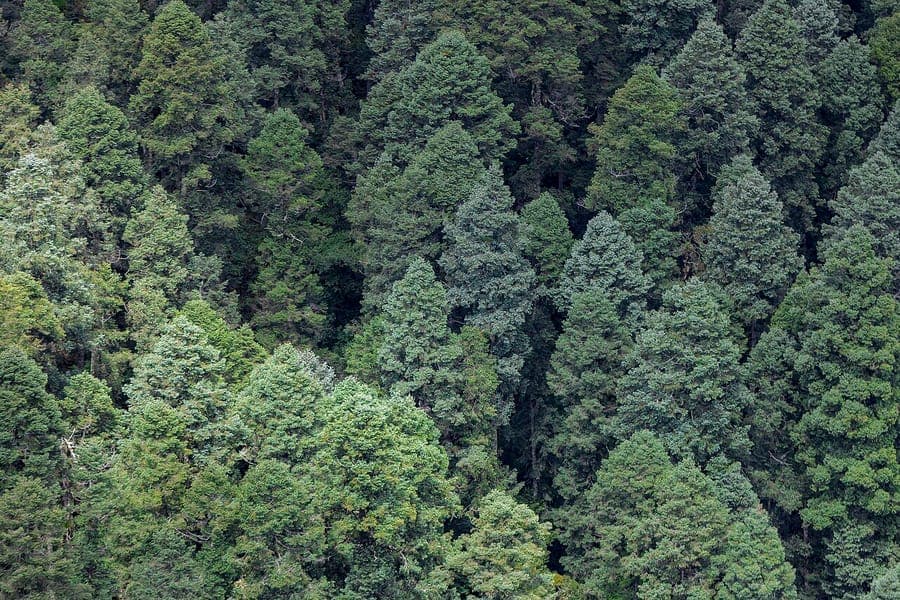
Rafael Saldaña from mexico city, Mexico / CC BY 2.0, via Wikimedia Commons
Sacred Fir (Abies religiosa): complete guide
Abies religiosa
Want to see Sacred Fir (Abies religiosa): complete guide in your garden?
1 minute, no credit card
Overview
The Sacred Fir, botanically known as Abies religiosa, is a striking conifer native to the high-altitude cloud forests of Mexico and Guatemala. Reaching heights of 25 to 50 metres in its natural habitat, this tree is recognised for its slender pyramidal silhouette and densely arranged deep green needles. The epithet 'religiosa' refers to the centuries-old tradition of using its aromatic branches in religious ceremonies by the indigenous peoples of Mexico, where the tree holds deep cultural and spiritual significance.
Beyond its cultural importance, the Sacred Fir plays a critical ecological role as the primary overwintering habitat for the monarch butterfly. Each November, hundreds of millions of monarchs migrate from the United States and Canada to the Abies religiosa forests in the Mexican states of Michoacán and México, clustering in dense masses on the branches and trunks until spring. This phenomenon is so extraordinary that UNESCO designated the overwintering sites as World Heritage. For gardeners across North America, Europe, and mild-climate regions of the Southern Hemisphere, this tree offers both a conversation piece and a genuine horticultural challenge. Explore how exotic conifers fit into your garden design at gardenworld.app.
Appearance & bloom cycle
Abies religiosa develops a slender, conical to narrowly pyramidal crown that broadens gradually with age. The needles are 15 to 35 mm long, gently curved and glossy dark green on the upper surface, with two conspicuous white-blue stomatal bands on the underside. They are arranged in dense spirals along the branches and release a pleasant balsamic fragrance when crushed. The bark of young trees is smooth and pale grey, becoming darker, rougher and deeply furrowed on mature specimens.
Flowering occurs in spring, typically April or May depending on climate. Male flowers are small yellowish-green catkins that release pollen into the wind. Female flowers appear higher in the canopy as upright, purplish structures. After pollination, these develop into upright cylindrical cones measuring 8 to 16 cm in length. Young cones display a striking dark purple to bluish colour that turns brown as they ripen. At full maturity in autumn, the cone scales detach one by one while the central axis remains attached to the branch, a hallmark of the Abies genus.
A distinctive feature of the Sacred Fir is its resin production. The bark contains blisters filled with aromatic oleoresin, historically harvested for medicinal and ceremonial purposes. This resin has a characteristic sweet, balsamic scent that sets the tree apart from other fir species. The overall texture and colour of the foliage make it an exceptionally handsome specimen tree, even before considering its fascinating natural history.
Ideal location: sun, shade, or partial shade
In its native range, Abies religiosa grows at elevations between 2,400 and 3,600 metres in the Mexican highlands, in a climate characterised by cool temperatures, regular rainfall and frequent fog. Understanding this preference for a cool, moist microclimate is essential before attempting to grow this tree outside its homeland.
The Sacred Fir prefers partial shade, particularly during its juvenile years. Mature trees tolerate more direct sunlight, but the soil must remain consistently moist. Full southern exposure combined with drying winds is detrimental and can cause needle scorch. In warmer regions of the United States, southern Europe or Australia, a sheltered position behind a building, fence or taller trees is advisable. An east-facing aspect that receives morning sun but is shielded from the fierce afternoon heat works well.
In the United Kingdom, Ireland and the Pacific Northwest of North America, where summers remain relatively cool and moist, this species can thrive in more open positions. Coastal areas of New Zealand and southern Chile also offer suitable climatic conditions. Regardless of location, plan for at least 8 to 10 metres of clearance around the trunk. The tree develops a deep taproot system and an eventual crown spread of 6 to 8 metres.
Soil & underground requirements
Abies religiosa has specific soil requirements that differ from many other fir species. In its natural habitat, it grows in volcanic, free-draining soil rich in organic matter. For garden cultivation, this translates to a deep, humus-rich, slightly acidic to neutral soil with a pH between 5.5 and 6.8.
Drainage is paramount. This fir will not tolerate waterlogging or standing water around its roots. At the same time, the soil must never dry out completely, which makes getting the right soil composition critical. A blend of garden soil, leaf compost and coarse sand or perlite provides a good balance between moisture retention and drainage. In areas with heavy clay soil, it is wise to create a raised planting bed or place a generous drainage layer of gravel or pumice beneath the planting hole.
When planting, incorporate ample organic matter such as well-rotted leaf compost or pine needle compost. A mulch layer of pine needles or bark chips around the trunk helps maintain soil moisture and keeps the pH at appropriate levels. Avoid lime-based fertilisers, as these raise the pH too much for this acid-loving tree. An annual application of a specialised conifer fertiliser in early spring provides the nutrients needed for healthy growth without altering the soil chemistry unfavourably.
Watering: when and how much
Water is the lifeblood of the Sacred Fir. In its natural habitat, this tree receives regular rainfall and benefits from foggy conditions that keep the needles moist. In garden settings, you need to replicate this pattern as closely as possible, which demands particular attention during summer months.
Young trees in their first three to five years after planting require deep watering weekly. Apply 15 to 25 litres per session, delivered slowly so the water penetrates deep into the soil profile. Avoid surface sprinkling, as this encourages shallow root development and makes the tree more vulnerable to drought stress. During hot spells when temperatures exceed 25 degrees Celsius, increase watering frequency to twice weekly.
Mature trees are less demanding but still benefit from supplemental irrigation during prolonged dry periods. A drip irrigation system placed around the canopy drip line is an efficient method of providing regular, deep moisture without excessive water consumption. This approach also reduces the risk of fungal diseases that can develop when foliage stays wet for extended periods.
A practical tip for hot summers is to mist the needles lightly with water in the early morning or late evening. This mimics the foggy conditions of the Mexican cloud forest and helps keep the foliage healthy. Always check soil moisture by inserting a finger 8 to 10 cm deep. If the soil feels dry at that depth, water thoroughly.
Free design
Want to see Sacred Fir (Abies religiosa): complete guide in your garden? Make a free design now.
Pruning: when and how
Abies religiosa naturally develops a beautiful, symmetrical crown and generally requires no corrective pruning. The tree produces a clear central leader and evenly spaced lateral branches that together create the characteristic pyramidal shape. Interfering with this natural growth habit is rarely necessary and usually inadvisable.
Pruning should be limited to removing dead, damaged or diseased branches. Carry out this work in late winter or early spring, before the new growing season begins, typically in February or March. Always use clean, sharp tools and disinfect cutting surfaces with a 70 percent alcohol solution to prevent the spread of fungal infections.
Never cut the central leader unless it has been damaged by storm or animal browsing. Loss of the leader results in an irregular crown shape that is difficult to restore. If the leader is damaged, you can carefully train a nearby lateral branch upward and secure it as a replacement leader. This process, known as re-leading, requires patience but can produce a reasonable result after several years.
Avoid cutting into old wood that has no green needles. Like other Abies species, the Sacred Fir does not regenerate from bare wood, resulting in permanent bare patches. For branches that extend too far, prune back to just beyond a side branch that still carries green growth, allowing the branch to remain compact while continuing to develop.
Maintenance calendar
- January - February (Winter): Inspect the tree for frost damage, especially young specimens. Remove dead or damaged branches with sharp, clean tools. Apply an extra layer of mulch around the base if severe cold is forecast. Check for signs of winter desiccation on the needles.
- March - April (Early spring): The planting season for new specimens begins. Prepare the planting hole with the correct soil blend. Apply the first feed of conifer fertiliser once the soil warms. Monitor for signs of new growth and adjust watering as temperatures rise. Watch for the emergence of male flowers.
- May - June (Late spring): New shoots are growing actively. Water regularly, particularly during dry weather. Check for pests such as aphids or adelgids. Apply a fresh mulch layer of 5 to 8 cm to keep the soil cool and moist through summer. Keep mulch away from direct contact with the trunk.
- July - August (Summer): The most critical period for watering. Provide deep irrigation twice weekly when temperatures exceed 25 degrees Celsius. Mist the foliage lightly in the early morning during sustained heat. Monitor regularly for spider mites, which thrive in hot, dry conditions. Avoid fertilising during the summer months.
- September - October (Autumn): Cones ripen and disintegrate. Collect seeds if propagation is desired. Add a layer of compost or leaf mould around the tree to enrich the soil before winter. Plant new specimens while the soil is still warm enough to encourage root establishment.
- November - December (Early winter): Give a final thorough watering before the soil freezes. Protect young trees with windbreak material such as hessian or horticultural fleece against desiccating winter winds. Check for snow accumulation on branches and gently remove excess to prevent breakage.
Winter hardiness & protection
Abies religiosa is hardy in USDA zones 8 to 10, meaning it can tolerate temperatures down to approximately -12 degrees Celsius. This places it at the edge of viability in many temperate gardens. In the mild, maritime climates of western Britain, Ireland, coastal Oregon and Washington, parts of New Zealand and southern Chile, this species can grow successfully with minimal winter protection. In continental climates with harsh winters, such as the interior of North America or central and eastern Europe, growing this tree outdoors is not practical without significant intervention.
Young trees are most vulnerable to frost during their first three to five years. Protect them in winter by wrapping the trunk and lower branches with horticultural fleece or hessian. A thick mulch layer of 15 to 20 cm around the base insulates roots against freezing. In particularly cold winters, you can also cover the root zone with a layer of straw or leaves for additional protection.
Wind protection is equally important as frost protection. Cold, desiccating winds combined with frost can damage the needles, even when the temperature alone is not critically low. Plant the tree in a location sheltered from prevailing winds, for example against a wall, fence or established hedge. A temporary windbreak of reed screens can be erected during the first few winters.
Be vigilant about late spring frost, which can damage tender new shoots. Monitor weather forecasts in April and May, and cover the tree temporarily with fleece if frost is predicted after new growth has emerged.
Companion plants & combinations
The Sacred Fir provides a stately backdrop for underplanting and garden compositions with its imposing stature and deep green needles. When selecting companion plants, choose species that share similar soil and light requirements.
For the partial shade beneath the canopy, shade-loving perennials make excellent partners. Hostas bring a pleasing contrast between their broad leaves and the fine needle texture of the fir. Ferns, particularly Dryopteris erythrosora (autumn fern) and Polystichum setiferum (soft shield fern), create a woodland atmosphere beneath conifers that feels both natural and refined.
Rhododendrons and azaleas are classic companions for acid-loving conifers. They appreciate the same slightly acidic soil and partial shade, and they bring vibrant spring colour to the planting scheme when the fir itself offers little floral display. Choose compact cultivars that will not compete with the tree for resources.
At the sunnier edges of the canopy projection, ornamental grasses perform well. Hakonechloa macra (Japanese forest grass) and Carex morrowii (Japanese sedge) form elegant ground covers that create a flowing transition to the lawn or wider garden. For seasonal colour, consider shade-tolerant bulb plantings such as Galanthus (snowdrop), Cyclamen hederifolium and Anemone nemorosa (wood anemone).
Avoid plants with aggressive root systems close to the trunk. In garden soils, Abies religiosa tends to develop a relatively shallow root system and cannot compete effectively with vigorous spreaders.
Closing paragraph
The Sacred Fir is a tree with a remarkable story, from the misty mountain forests of Mexico to its vital role as a sanctuary for hundreds of millions of monarch butterflies. While it may not reach its full 50-metre potential outside its native range, it brings a unique and exotic presence that few other conifers can match. With careful site selection, thorough soil preparation and appropriate winter protection, this extraordinary fir can thrive in mild-climate gardens and become a true focal point.
Success lies in replicating its natural conditions as closely as possible: a sheltered, partially shaded position with moist, free-draining soil and protection from the harshest winter cold. For those willing to invest the extra care, the reward is a genuinely impressive tree with both character and history. Visit gardenworld.app to discover how an exotic conifer like Abies religiosa fits into your garden design and which companion combinations work best for your particular situation.
Want to see Sacred Fir (Abies religiosa): complete guide in your garden? Make a free design now.
Upload a photo, pick a style, and get a photorealistic design with plant list in under a minute.
No credit card required


Similar plants
Abies delavayi: complete guide
Abies delavayi
Delavayi fir is an elegant, medium-sized coniferous tree from the Pinaceae family with dark green needles. This Asian evergreen is perfect for alpine gardens and large landscapes.
Taiwan fir: complete guide
Abies kawakamii
Discover the magnificent Taiwan fir, a rare evergreen conifer from Taiwan's mountain regions. Learn growth requirements, care tips, and why this beautiful tree is perfect for collectors of unique garden specimens.
Farges fir: complete guide
Abies fargesii
Discover the majestic Farges fir, an impressive conifer from China's mountains with elegant foliage and columnar form. Ideal for large gardens.