
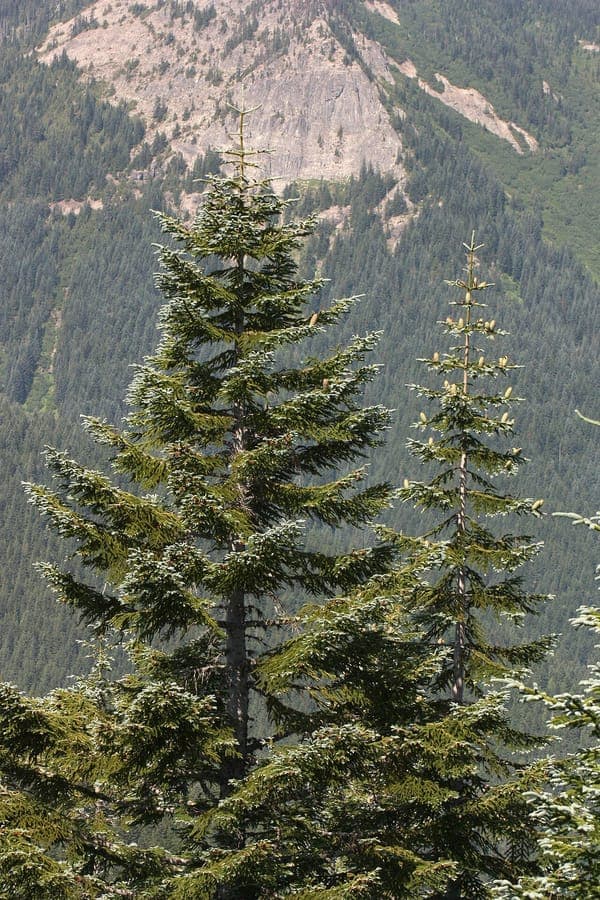
Walter Siegmund (talk) / CC BY-SA 3.0, via Wikimedia Commons
Noble Fir (Abies procera): complete growing guide
Abies procera
Want to see Noble Fir (Abies procera): complete growing guide in your garden?
1 minute, no credit card
Overview
The Noble Fir, botanically known as Abies procera, ranks among the most impressive conifers you can grow in a spacious garden. Native to the Pacific Northwest of North America, where it thrives in the Cascade Range and Coast Range mountains from Washington state through Oregon, this tree reaches staggering heights of 40 to 70 metres in its natural habitat. The striking blue-green foliage, stately pyramidal form and remarkably large upright cones make it a standout specimen in any landscape.
Across temperate regions worldwide, the Noble Fir has found a devoted following among gardeners and landscapers who appreciate its year-round structure and colour. It is widely regarded as one of the finest Christmas tree species on earth, valued for its strong branches, pleasant fragrance and exceptional needle retention. Beyond seasonal use, however, it makes a magnificent permanent garden tree. Visit gardenworld.app to create a garden design that accounts for the generous dimensions and specific requirements of this remarkable conifer.
Appearance and growth characteristics
Abies procera develops a regular, conical crown that gradually broadens with age. Young trees grow relatively fast and form a dense, symmetrical silhouette that is highly ornamental from the start. The needles measure 2.5 to 3.5 cm in length, are stiff and curved upward, and display a distinctive blue-green to silvery-blue colour. The silvery undersides of the needles become visible as they twist upward along the twigs, giving the tree a shimmering appearance in sunlight.
The bark on young trees is smooth and grey-brown with resin blisters. On older specimens it thickens, becomes deeply furrowed and takes on a reddish-brown to grey colour. The cones are truly spectacular, measuring 12 to 25 cm in length. They stand upright on the upper branches and feature conspicuous reflexed bract scales that give each cone an ornate, almost decorative appearance. At maturity, the cone scales disintegrate while the central axis remains attached to the branch.
Growth rate averages 30 to 60 cm per year during the first decades. In cultivation across temperate Europe, North America and parts of Australasia, the tree typically reaches 25 to 40 metres. Expect a spread of 6 to 10 metres on a mature specimen. The lifespan commonly exceeds 400 years in the wild, though garden specimens rarely reach that age.
Ideal site and soil requirements
The Noble Fir performs best in a sunny to lightly shaded position. Full sun produces the finest blue needle colour and the most compact, dense growth habit. In shade, the crown becomes more open and the needles lose their intense colouration. Choose a site sheltered from strong prevailing winds, as the broad crown can sustain wind damage during storms.
In terms of soil, the Noble Fir prefers moist, well-drained, slightly acidic to neutral ground. A pH between 5.0 and 6.5 is optimal. The tree does not tolerate prolonged waterlogging or compacted soils. Heavy clay should be amended with compost and coarse grit to improve drainage. Sandy soils work well provided you incorporate sufficient organic matter to improve moisture retention.
In USDA zones 5 to 7, the Noble Fir thrives comfortably. Gardeners in zones 8 and warmer should note that prolonged summer heat can stress the tree, particularly when combined with drought. In those regions, afternoon shade and consistent moisture become critical. Always allow at least 8 to 10 metres from buildings and boundary lines to accommodate the mature spread.
Planting step by step
The best planting window is early spring (March to April) or autumn (October to November). Autumn planting gives the roots time to establish before the growing season begins. Purchase a nursery-grown tree with a root ball from a reputable specialist grower. Specimens between 80 and 150 cm tall establish most reliably.
Dig a planting hole twice as wide and one and a half times as deep as the root ball. Mix the excavated soil with mature compost and a handful of bone meal for slow-release nutrition. Position the tree at the same depth it was growing previously, with the top of the root ball level with the surrounding ground. Backfill with the amended soil mix, firm gently and water thoroughly.
Apply a mulch layer of 5 to 8 cm of composted bark around the base, keeping a 10 cm gap from the trunk to prevent rot. Stake larger specimens on the windward side. Water regularly during the first two years, especially during dry spells. Ten to fifteen litres per week is a sound guideline during establishment.
Watering and feeding
Once established after two to three years, the Noble Fir is reasonably drought-tolerant but performs best with consistent moisture. During dry summers, supplementary watering is advisable. Water deeply once a week rather than lightly every day, as deep watering encourages deep root growth and builds resilience.
Feed in early spring (March to April) with an organic conifer fertiliser or a slow-release granular feed. A second, lighter application can be given in June. Avoid fertilisers with a high lime content, as these raise the soil pH and can cause needle discolouration and growth inhibition. Ericaceous fertilisers designed for rhododendrons work well as an alternative.
Top up the mulch layer each spring to maintain a depth of 5 to 8 cm. Pine needle mulch or composted bark are excellent choices that help keep the soil acidic and retain moisture around the root zone.
Free design
Want to see Noble Fir (Abies procera): complete growing guide in your garden? Make a free design now.
Pruning and maintenance
The Noble Fir requires minimal pruning. Its natural growth form is already beautifully symmetrical, and heavy intervention can disrupt its habit. Limit pruning to the removal of dead, damaged or diseased wood. The best time for this is late winter (February to March), before new growth begins.
If you wish to moderate growth slightly, you can shorten new candles by half in June. This encourages denser growth without spoiling the natural outline. Always use clean, sharp tools and disinfect between cuts to prevent the spread of fungal diseases.
Inspect the trunk and branches annually for signs of resin bleeding, fungal infection or insect activity. Clear fallen needles and debris from beneath the tree to maintain a tidy growing environment and reduce habitat for pests.
Pests and diseases
The Noble Fir is generally a healthy tree, but several issues deserve attention. The green spruce aphid (Elatobium abietinum) can cause problems after mild winters. These aphids feed on needle sap, leading to yellowing and needle drop. Inspect the undersides of needles in early spring and treat infestations with a biological insecticide based on pyrethrins.
Bark beetles such as Cryphalus piceae may attack weakened trees. Keeping the tree vigorous with adequate water and nutrition is the best preventive measure. Root rot caused by Armillaria fungi is a risk on waterlogged soils, so ensuring good drainage from the outset is essential.
Adelgids, recognisable by white, woolly tufts on needles and branches, occasionally appear. Light infestations can be dislodged with a strong jet of water. For heavier attacks, horticultural oil sprays applied during the dormant season are effective. In all cases, maintaining overall tree health through proper siting, watering and feeding remains the most powerful defence.
Winter hardiness and climate resilience
The Noble Fir is hardy in USDA zones 5 to 7, tolerating temperatures down to minus 30 degrees Celsius without difficulty. In milder maritime climates (zones 8a and above), it survives winter easily but may struggle during prolonged summer heat. Young trees can be sensitive to late spring frosts that damage soft new growth. A sheltered position reduces this risk considerably.
Although the tree naturally prefers cool, moist climates, it adapts reasonably well to warmer conditions when given adequate moisture and some afternoon shade. Extended heat above 35 degrees Celsius can cause stress, especially combined with drought. In the context of a changing climate, paying extra attention to soil quality and water supply at planting time is a worthwhile investment.
Snow load is rarely problematic thanks to the flexible branch structure. Branches flex under the weight of heavy snow and spring back without breaking, a useful adaptation inherited from its mountain origins.
The Noble Fir as a Christmas tree
Abies procera is internationally acclaimed as one of the premier Christmas tree species. In the Christmas tree industry, it is prized for its sturdy, horizontal branches that can support heavy decorations without drooping. The blue-green needles are soft to the touch and release a pleasant, fresh pine fragrance that fills a room.
What sets the Noble Fir apart from other Christmas tree species is its exceptional needle retention. Provided you buy the tree fresh and give the trunk a fresh cut before bringing it indoors, it will hold its needles for weeks, even in a heated living room. Place the tree in a stand with a water reservoir and top it up daily. A fresh Noble Fir can easily drink a litre of water per day.
In North America, the Pacific Northwest remains the heartland of Noble Fir Christmas tree production. In Europe, Scandinavian and British growers have increasingly added the species to their plantations. In Australia and New Zealand, imported Noble Firs command a premium price during the Southern Hemisphere holiday season.
Companion planting and closing thoughts
The Noble Fir is a dominant tree that casts dense shade and acidifies the soil around its base through needle fall. Choose companion plants that tolerate or thrive in these conditions. Rhododendrons and azaleas are outstanding partners, relishing the acidic soil and performing well in the dappled shade beneath the broad canopy.
Ferns such as Dryopteris filix-mas (male fern) and Polystichum setiferum (soft shield fern) bring a lush, woodland atmosphere. Hostas add foliage contrast with their broad, elegant leaves. For ground cover, Pachysandra terminalis and Vinca minor are reliable choices that carpet the bare ground beneath the tree attractively.
For a natural transition to the rest of the garden, plant low-growing heathers (Calluna vulgaris, Erica carnea) around the drip line. Blueberries (Vaccinium corymbosum) also thrive on the acidic soil and offer an edible bonus. Shade-tolerant grasses such as Carex species fill gaps effectively with fine-textured foliage.
The Noble Fir is a tree for gardeners with vision and patience. Its imposing stature, beautiful blue-green needles and spectacular cones make it an unforgettable element in any large garden. Give it the space, the right soil and sufficient moisture, and it will reward you with decades of evergreen splendour.
Whether you are seeking a majestic specimen tree, planning a windbreak or simply want the finest Christmas tree from your own garden, Abies procera delivers on every front. Visit gardenworld.app to create a complete garden design perfectly tailored to planting and combining impressive conifers like the Noble Fir.
Want to see Noble Fir (Abies procera): complete growing guide in your garden? Make a free design now.
Upload a photo, pick a style, and get a photorealistic design with plant list in under a minute.
No credit card required


Similar plants
Abies delavayi: complete guide
Abies delavayi
Delavayi fir is an elegant, medium-sized coniferous tree from the Pinaceae family with dark green needles. This Asian evergreen is perfect for alpine gardens and large landscapes.
Taiwan fir: complete guide
Abies kawakamii
Discover the magnificent Taiwan fir, a rare evergreen conifer from Taiwan's mountain regions. Learn growth requirements, care tips, and why this beautiful tree is perfect for collectors of unique garden specimens.
Farges fir: complete guide
Abies fargesii
Discover the majestic Farges fir, an impressive conifer from China's mountains with elegant foliage and columnar form. Ideal for large gardens.