
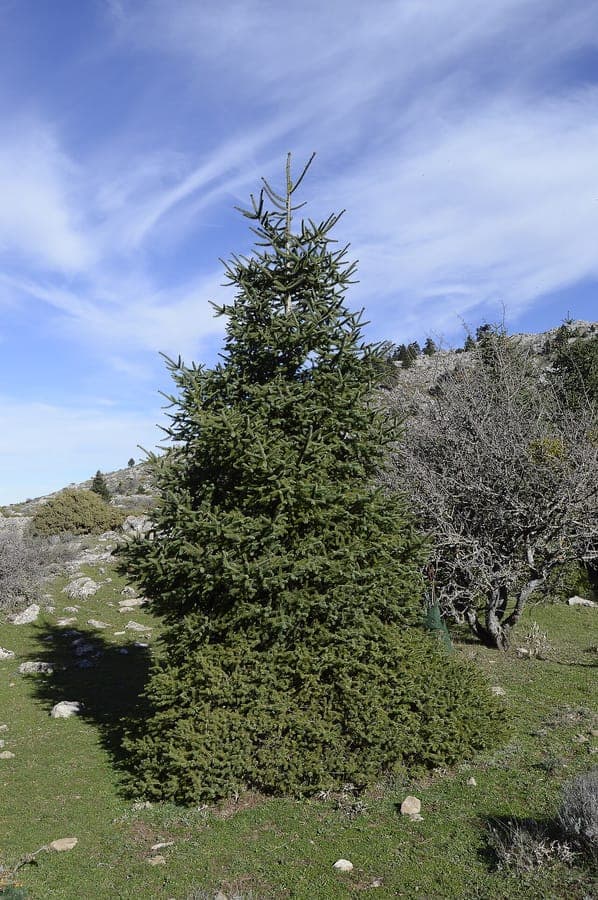
JABerrocal / CC BY-SA 4.0, via Wikimedia Commons
Spanish fir (Abies pinsapo): complete guide
Abies pinsapo
Want to see Spanish fir (Abies pinsapo): complete guide in your garden?
1 minute, no credit card
Overview
The Spanish fir, botanically Abies pinsapo, is a striking conifer found naturally in just a handful of mountain ranges in southern Spain's Andalusia region: the Sierra de las Nieves, Sierra Bermeja and Sierra de Grazalema. This is a tree with a story to tell. A living relic that survived the ice ages in its Mediterranean mountain refugia, it now holds protected status as an endemic species. Growing 20 to 30 meters tall with a broad, densely branched conical form, the Spanish fir commands attention wherever it is planted.
What makes it truly unique among firs is its needle arrangement. While most Abies species carry flat needles in two rows, the needles of Abies pinsapo grow stiffly and radially around the entire twig, like the bristles of a bottle brush. This gives the branches a remarkable three-dimensional appearance unlike any other fir. Add to this its exceptional drought tolerance for a fir species, and you have a tree that is increasingly valuable as climates warm across the temperate world.
The Spanish fir thrives in USDA hardiness zones 6 through 9, making it adaptable across a vast range of climates from the British Isles and Pacific Northwest to the Mediterranean, southeastern Australia and parts of South America. At gardenworld.app, you can design a garden layout that showcases the unique qualities of this Mediterranean beauty.
Appearance and growth habit
Abies pinsapo develops a broad, regularly conical crown that becomes increasingly dense with age. The branches arrange themselves in distinct horizontal tiers around the trunk, giving the tree an architectural quality that landscape designers prize. Older specimens often develop a broader, more flattened crown, approaching an almost cedar-like silhouette that adds gravitas to any landscape.
The needles are the most distinctive feature. Short but thick, measuring 1 to 2 centimeters long, they are stiff and awl-shaped with a blunt tip. Rather than arranging in two flat rows like most firs, they radiate stiffly around the entire twig, making each branch look identical from every angle. Color ranges from dark green to a striking blue-green depending on the variety. The cultivar 'Glauca' produces particularly blue needles that deliver strong decorative impact throughout every season.
Cones stand upright on the uppermost branches, cylindrical in form, 10 to 18 centimeters long, and initially green-purple. They mature to brown and shed their scales while the central axis persists on the branch, as with all true firs. The bark starts smooth and grey on young trees, thickening and darkening with deep fissures over the decades.
Growth rate is moderate: expect 20 to 40 centimeters per year during the first two decades. In garden settings, the Spanish fir typically reaches 15 to 20 meters, more compact than many other firs and therefore better suited to medium-sized gardens where space is at a premium.
Ideal location: sun, shade or partial shade
The Spanish fir is more flexible about sunlight than most Abies species. In its Andalusian homeland, it often grows in full sun on limestone slopes, exposed to intense Mediterranean radiation. This background makes it well suited to sunny positions in northern European, North American and southern hemisphere gardens, where the sun is considerably less fierce.
Full sun to partial shade both work excellently. Only deep shade is detrimental, causing the tree to lose its characteristic dense, conical habit and grow thin and open. Young specimens may benefit from light shelter during their first two years after planting, but thereafter they thrive happily in full exposure.
Wind is less problematic than for many other firs. The Spanish fir has a naturally sturdy structure and short, stiff needles that offer minimal wind resistance. Nevertheless, shelter from persistent, bitter winter winds remains advisable in continental climates with harsh winters.
Account for the ultimate dimensions: 15 to 20 meters tall and 6 to 10 meters wide. Provide at least 6 meters of clearance on all sides for the tree to develop its full symmetrical form.
Soil and nutritional needs
Here the Spanish fir distinguishes itself again from its relatives. Where most firs demand acidic, moist soils, Abies pinsapo tolerates both acidic and alkaline conditions with equal grace. In its homeland, it grows on pure limestone, a feat unmatched by virtually any other fir species. This makes it one of the most versatile firs for gardens worldwide, particularly in regions with calcareous clay soils that would defeat other Abies species.
The ideal soil is well-drained and moderately fertile, with a pH anywhere between 5.5 and 8.0. Good drainage is the single most important requirement: the Spanish fir handles drought far better than wet feet. Heavy, poorly drained clay is its only real enemy. Improve such soil by incorporating coarse sand or volcanic rock to enhance drainage, and consider raising the planting area slightly above the surrounding grade.
Fertilization needs are minimal: an annual application of compost in spring suffices. Avoid nitrogen-heavy fertilizers that promote soft growth more susceptible to frost damage and disease. The tree's modest appetite makes it an easy-care specimen for gardeners who prefer low-maintenance plantings.
Watering: when and how much
Drought tolerance is the Spanish fir's greatest asset. Once well established after three to four years, it can endure extended periods without rainfall. This is exceptional for a fir and makes it particularly well suited to gardens where water conservation matters, from drought-prone Mediterranean and Californian climates to water-conscious gardens everywhere.
That said, young trees do need regular watering during their establishment years. Provide 10 to 15 liters of water per meter of trunk height weekly during the first year. In the second and third years, gradually reduce the frequency. Always water deeply and slowly so moisture reaches the deeper root zone, encouraging downward root growth.
Mature trees in temperate climates rarely need supplemental watering in most years. Only during extreme heat waves with weeks of no rain and temperatures exceeding 35 degrees Celsius is additional watering advisable. Waterlogging is more harmful than drought: never allow water to pool around the trunk.
A thin mulch layer of about 5 centimeters around the base helps regulate soil moisture without keeping the root collar excessively wet. Avoid piling mulch against the trunk itself.
Free design
Want to see Spanish fir (Abies pinsapo): complete guide in your garden? Make a free design now.
Pruning and shaping
The Spanish fir has one of the most beautiful natural forms of any conifer and requires minimal pruning. The regularly tiered branch structure and dense needle coverage naturally produce a symmetrical cone that needs little correction.
Pruning is limited to removing dead or damaged branches and any crossing branches that rub against each other. The best window for this work falls in late winter, from February through early March. Always use clean, sharp tools to prevent the spread of disease.
The Spanish fir tolerates light formative pruning better than many other firs, making it suitable for formal garden styles. However, caution is still warranted: never cut into old wood that lacks green needles, as bare patches will not regenerate. The central leader should only be removed if you deliberately wish to halt height growth.
Thanks to its compact growth habit, the Spanish fir is one of the few firs that maintains a tidy appearance without pruning, even in smaller gardens. The cultivar 'Kelleris' stays even more compact and is an option for tighter spaces where a full-sized tree would overwhelm.
Maintenance calendar
- January - February: Check branches for snow breakage. Perform corrective pruning of dead wood if needed. This is also a good time to visually assess the tree's symmetry and overall health.
- March: Ideal planting month for new specimens. Prepare the planting site with good drainage. Apply a light compost dressing around established trees.
- April - May: New growth appears, recognizable by its lighter color. Check for woolly adelgid and other aphid species. Begin watering if spring is dry, but do not overdo it.
- June - August: The least intensive maintenance period. After establishment, the Spanish fir needs minimal watering. Check monthly for pests. Enjoy the tree.
- September - October: Cones ripen and disintegrate. A good time for autumn planting, allowing roots to establish before winter. Apply a thin layer of compost.
- November - December: Deliver a final watering before the frost period. Protect first-year trees with a light mulch layer around the base.
Winter hardiness and protection
The Spanish fir is hardy to approximately minus 15 to minus 20 degrees Celsius, corresponding to USDA zones 6 through 9. Across most of temperate Europe, the British Isles, the Pacific Northwest, much of Australia and New Zealand, and equivalent climates in South America, it overwinters without difficulty. Prolonged periods below minus 15 degrees Celsius can damage needles, but this is rare outside continental interiors.
Young trees are slightly more sensitive and benefit from a mulch layer of 8 to 10 centimeters around the base during their first two winters. A windbreak is rarely necessary thanks to the tree's sturdy, compact build. During exceptional cold snaps with temperatures below minus 18 degrees Celsius, temporary horticultural fleece around the crown can protect the foliage.
The greatest winter threat is not cold itself but the combination of frost and waterlogged soil. Ensure the ground around the trunk drains freely, especially during winter months when evaporation is minimal.
Companion plants and garden design
The Spanish fir is an architectural tree that shines both as a solitary specimen and in group plantings. Its regular conical form and unusual needle texture make it a powerful structural element in garden design.
As a solitary specimen on a lawn, its symmetrical silhouette reaches its full visual potential. Position it where it is clearly visible from the house or terrace. The blue-needled cultivar 'Glauca' is particularly effective as a focal point due to its eye-catching color that complements both green lawns and stone surfaces.
For underplanting, Mediterranean and drought-tolerant plants are logical companions: lavender, rosemary, Cistus, Santolina and ornamental grasses such as Stipa tenuissima. These plants share the preference for well-drained soil and create a cohesive planting scheme with a Mediterranean character.
In a more traditional garden style, rhododendrons and azaleas combine well with the Spanish fir, provided the soil is not too alkaline. Low groundcovers like Geranium macrorrhizum or Epimedium form a neat base layer without competing aggressively for water and nutrients.
The Spanish fir also pairs beautifully with other Mediterranean trees: Pinus pinea, Olea europaea in mild regions, and Cupressus sempervirens for a southern European atmosphere. In larger landscapes, grouping several Spanish firs at varying distances creates a grove effect that recalls their native mountain habitat.
Closing thoughts
The Spanish fir is one of the most versatile and low-maintenance conifers you can plant in a temperate garden. Its drought tolerance, adaptability to different soil types and stunning architectural form make it a tree built for the future as climates shift. The unique radial needles and compact silhouette distinguish it from every other fir species available in the nursery trade.
Considering a Spanish fir for your garden? At gardenworld.app, you can create a personalized garden design that accounts for the specific characteristics of this exceptional conifer. A tree that rewards you for decades with minimal maintenance and maximum visual impact.
Want to see Spanish fir (Abies pinsapo): complete guide in your garden? Make a free design now.
Upload a photo, pick a style, and get a photorealistic design with plant list in under a minute.
No credit card required


Similar plants
Abies delavayi: complete guide
Abies delavayi
Delavayi fir is an elegant, medium-sized coniferous tree from the Pinaceae family with dark green needles. This Asian evergreen is perfect for alpine gardens and large landscapes.
Taiwan fir: complete guide
Abies kawakamii
Discover the magnificent Taiwan fir, a rare evergreen conifer from Taiwan's mountain regions. Learn growth requirements, care tips, and why this beautiful tree is perfect for collectors of unique garden specimens.
Farges fir: complete guide
Abies fargesii
Discover the majestic Farges fir, an impressive conifer from China's mountains with elegant foliage and columnar form. Ideal for large gardens.