
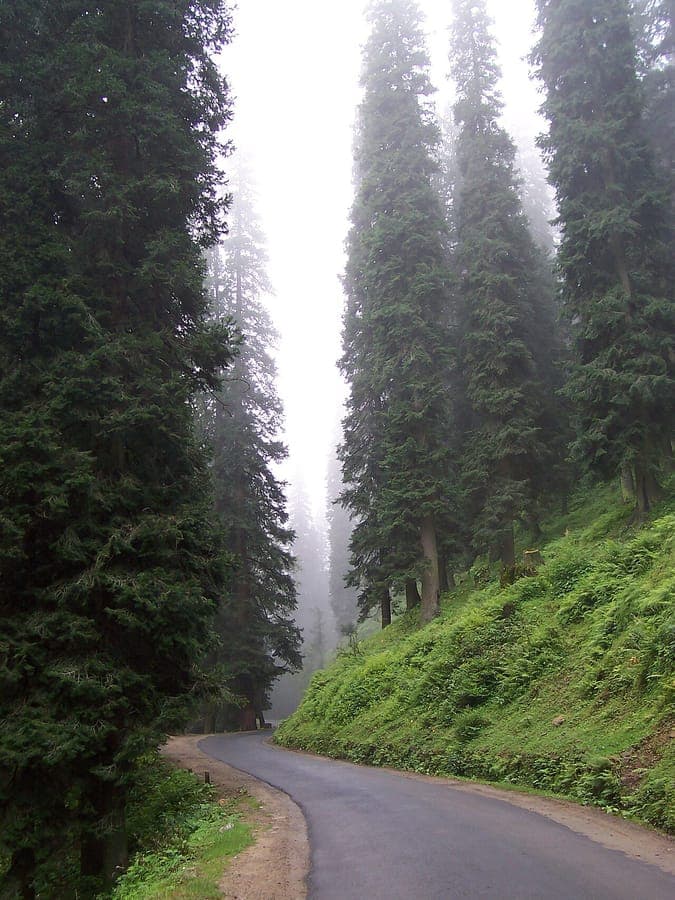
Abhineet Khorana / CC BY-SA 2.0, via Wikimedia Commons
Pindrow fir (Abies pindrow): complete guide
Abies pindrow
Want to see Pindrow fir (Abies pindrow): complete guide in your garden?
1 minute, no credit card
Overview
The Pindrow fir, botanically Abies pindrow, is a stately conifer native to the western Himalayas, where it grows at elevations between 2,000 and 3,700 meters across Kashmir, Nepal, northern Pakistan and parts of Afghanistan. In its mountain homeland, this tree can reach a breathtaking 40 to 60 meters tall, making it one of the tallest fir species on the planet. What truly sets it apart from every other fir is its needles: at 5 to 9 centimeters long, they are the longest of any Abies species worldwide.
The Pindrow fir remains relatively uncommon in Western gardens, which makes it a genuinely distinctive choice for gardeners across Europe, North America and temperate Asia who want something beyond the usual conifers. It thrives in USDA hardiness zones 6 through 8, covering a broad swathe of temperate climates from the British Isles and the Pacific Northwest to parts of Japan and New Zealand. At gardenworld.app, you can create a garden design that perfectly accommodates a specimen tree like the Pindrow fir.
Appearance and growth habit
Abies pindrow develops a broad, conical crown that becomes increasingly full and layered with age. The lower branches sweep gracefully downward in an arching habit, giving the tree a cascading profile that distinguishes it from the rigid silhouettes of most other conifers. The trunk grows straight and can exceed one meter in diameter under favorable conditions.
The needles are the undisputed highlight. Measuring 5 to 9 centimeters, they are flat, leathery, and flexible with a glossy dark green upper surface. The underside features two broad silvery-white bands running the full length of each needle. They arrange themselves in two distinct rows along the twigs, creating a comb-like pattern that catches the light beautifully. When crushed, the needles release a pleasant resinous fragrance that is more subtle than most firs.
Cones appear on the upper branches and stand upright, as with all true firs. They are cylindrical, 10 to 14 centimeters long, and start a striking dark purple before maturing to brown. At maturity, the scales detach while the central axis persists on the branch. The bark transitions from smooth grey-brown on young trees to a rougher, darker surface with shallow fissures on mature specimens.
In European and North American gardens, expect heights of 15 to 25 meters, considerably less than in its native range but still a commanding presence that demands space in the landscape.
Ideal location: sun, shade or partial shade
In the wild, the Pindrow fir grows in moist montane forests where it often develops under the canopy of taller trees. This ancestry means it performs best in partial shade to light shade in the garden. Full sun is tolerated once established, but only if the soil stays consistently moist and the tree is sheltered from drying winds.
Young specimens are particularly vulnerable to intense sunlight and genuinely need overhead or lateral shade during their first several years. As the tree matures and develops a deeper root system, its sun tolerance increases noticeably. Ideal planting spots include woodland edges, north-facing slopes, or areas where buildings or larger trees filter the harshest afternoon sun.
Allow at least 8 to 10 meters of clearance from structures and other large trees. The sweeping lower branches need room to maintain their elegant draping habit, so avoid crowding with understory shrubs planted too close to the trunk. In regions with hot summers like the southern United States, southeastern Australia or central Spain, afternoon shade is virtually mandatory.
Soil and nutritional needs
The Pindrow fir demands a deep, moist, well-drained soil with a slightly acidic to neutral pH between 5.5 and 7.0. In its Himalayan home, it grows on rich forest floors thick with decomposed organic matter, and it carries that preference into cultivation.
Heavy clay is unsuitable due to waterlogging risk and root rot potential. Sandy soils work if heavily amended with compost, leaf mold or well-rotted bark. The ideal growing medium is a loamy soil with high humus content that retains moisture without becoming soggy. Garden centers everywhere stock soil conditioners and ericaceous compost that can dramatically improve your existing ground.
Fertilize in spring with a slow-release conifer fertilizer at the rate recommended on the package. Heavy feeding is unnecessary and potentially harmful. An annual top-dressing of compost or decomposed leaves around the root zone often suffices to maintain soil health. Mulch with a 7 to 10 centimeter layer of wood chips or pine needles to conserve moisture and maintain a slightly acidic pH at the surface.
Watering: when and how much
Moisture management is the single most important factor for success with Abies pindrow. This tree evolved in a climate of monsoon rains and cool, humid mountain air. Drought is its greatest enemy. During the first three to five years after planting, regular deep watering is non-negotiable.
Provide young trees with 15 to 25 liters of water per meter of trunk height per week, split across two watering sessions. Water slowly at the base so moisture penetrates deep into the soil, encouraging roots to grow downward rather than staying shallow. During hot spells above 30 degrees Celsius, daily watering may be necessary, particularly for trees in anything approaching full sun.
Mature trees are more resilient, but supplemental watering during extended dry periods remains wise. Test soil moisture by pushing a finger 8 to 10 centimeters into the ground near the drip line. If it feels dry, water thoroughly. A thick organic mulch layer around the base dramatically reduces evaporation and can cut your watering frequency by half.
Free design
Want to see Pindrow fir (Abies pindrow): complete guide in your garden? Make a free design now.
Pruning and shaping
The Pindrow fir naturally develops a beautiful form that requires minimal pruning intervention. The gracefully drooping branches are precisely what makes this tree so special, so leave them intact whenever possible. Pruning should be limited to removing dead, damaged, or diseased wood.
The optimal pruning window falls in late winter, from February through early March in the Northern Hemisphere, before new growth emerges. Use clean, sharp tools and make smooth cuts close to the branch collar. Avoid removing the central leader unless you deliberately want to limit height, as this permanently disrupts the natural conical form.
Like all firs, Abies pindrow responds poorly to pruning into old wood that lacks green foliage. Bare patches created by aggressive pruning will not regenerate. Always prune conservatively and never remove more than a quarter of the living crown in a single season. If a branch must be shortened rather than removed entirely, cut back to a side branch that has healthy green growth.
Maintenance calendar
- January - February: Inspect branches for snow load damage and gently brush off heavy accumulations. This is the window for corrective pruning of dead or damaged wood.
- March: Prime planting month in most temperate regions. Prepare the planting hole with generous compost and soil amendment. Apply fresh mulch around established trees.
- April - May: Watch for new growth and check for adelgid or aphid activity. Apply slow-release conifer fertilizer. Begin regular watering if conditions turn dry.
- June - August: Most critical watering period. Water deeply and consistently, especially young trees. Monitor weekly for spider mites and other pests. Top up the mulch layer as it decomposes.
- September - October: Cones mature on upper branches. Enrich soil with compost or leaf mold. Autumn planting is still possible, giving roots time to establish before winter.
- November - December: Deliver a thorough final watering before the ground freezes. Protect young specimens with burlap windbreaks if they occupy exposed positions.
Winter hardiness and protection
The Pindrow fir is hardy to approximately minus 20 to minus 25 degrees Celsius, corresponding to USDA zones 6 through 8. Across most of temperate Europe, the British Isles, the Pacific Northwest, and comparable climates worldwide, it overwinters without difficulty provided it has shelter from desiccating winter winds.
Young trees deserve extra attention during their first two to three winters. Apply a thick mulch layer of 10 to 15 centimeters around the root zone to buffer soil temperatures and protect shallow roots from freeze-thaw cycles. In exposed locations, a burlap or horticultural fleece screen on the windward side prevents needle desiccation.
Late spring frost poses a greater threat than midwinter cold because the emerging new shoots are extremely frost-sensitive. If overnight frost warnings coincide with active new growth in spring, drape the tree temporarily with horticultural fleece. Established mature specimens are considerably hardier and typically sail through normal winters without any intervention.
Companion plants and garden design
The Pindrow fir is at its finest as a solitary specimen on an open lawn, where its elegant silhouette and drooping branches can be appreciated from every angle. The long, glossy needles and graceful growth habit make it a natural focal point in any garden or park setting.
For underplanting, shade-tolerant perennials work beautifully. Hostas in various shades of green, blue and gold, elegant ferns like Dryopteris or Polystichum, and groundcovers such as Pachysandra or Vinca minor create a lush woodland floor effect. Rhododendrons and azaleas are natural companions since they share the same preference for acidic, moist soil.
For seasonal color, plant spring bulbs like crocuses, snowdrops and scilla in the outer zone of the crown projection, where sufficient light still reaches the ground. Ornamental grasses such as Hakonechloa macra offer a beautiful textural contrast against the long fir needles. In larger landscapes, grouping the Pindrow fir with other Himalayan species like Cedrus deodara or Picea smithiana creates a cohesive botanical narrative.
Avoid plants with aggressive root systems near the trunk. Running bamboo and certain willow species are poor neighbors for any fir tree.
Closing thoughts
The Pindrow fir is a tree for the patient gardener willing to invest in something genuinely extraordinary. With its record-breaking long needles, gracefully drooping branches and commanding stature, it brings a piece of the Himalayan mountains into your own garden. It asks for attention to moisture and a sheltered position, but repays that care with decades of year-round green beauty that few conifers can match.
Curious how a Pindrow fir would fit into your garden layout? At gardenworld.app, you can create a personalized garden design that accounts for the specific needs of this remarkable conifer, ensuring your tree gets the perfect spot to grow into the showpiece it deserves to be.
Want to see Pindrow fir (Abies pindrow): complete guide in your garden? Make a free design now.
Upload a photo, pick a style, and get a photorealistic design with plant list in under a minute.
No credit card required


Similar plants
Abies delavayi: complete guide
Abies delavayi
Delavayi fir is an elegant, medium-sized coniferous tree from the Pinaceae family with dark green needles. This Asian evergreen is perfect for alpine gardens and large landscapes.
Taiwan fir: complete guide
Abies kawakamii
Discover the magnificent Taiwan fir, a rare evergreen conifer from Taiwan's mountain regions. Learn growth requirements, care tips, and why this beautiful tree is perfect for collectors of unique garden specimens.
Farges fir: complete guide
Abies fargesii
Discover the majestic Farges fir, an impressive conifer from China's mountains with elegant foliage and columnar form. Ideal for large gardens.