
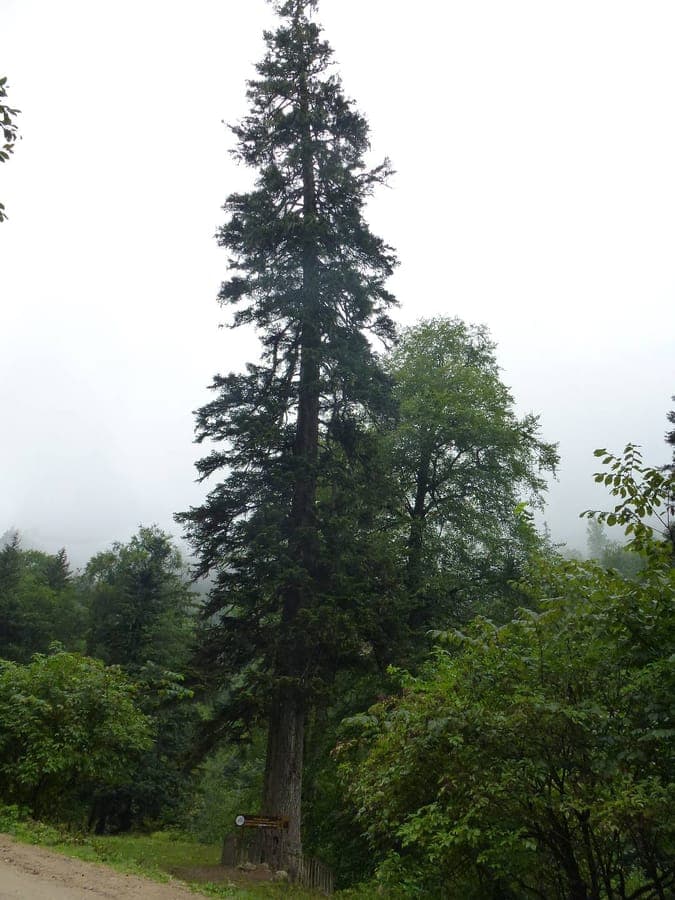
Şahin 1 / CC BY-SA 4.0, via Wikimedia Commons
Nordmann Fir (Abies nordmanniana): complete guide
Abies nordmanniana
Want to see Nordmann Fir (Abies nordmanniana): complete guide in your garden?
1 minute, no credit card
Overview
The Nordmann Fir, botanically Abies nordmanniana, is the best-selling Christmas tree across Europe and simultaneously one of the most impressive ornamental conifers for gardens and landscapes. Native to the Caucasus Mountains, where it grows on slopes between 900 and 2,200 metres elevation in Georgia, Turkey and Russia, this fir has built an extraordinary reputation thanks to its soft, glossy needles that do not prick and barely drop. In the wild it can reach 40 to 60 metres in height, though garden specimens usually remain more compact, especially when pruned or when a dwarf cultivar is selected.
What makes the Nordmann Fir so appealing for gardeners worldwide is its dense, regular conical shape that provides a green beacon in the landscape all year round. The tree grows relatively slowly, averaging 25 to 30 centimetres per year, which means you can enjoy controlled growth for many years before it becomes a towering specimen. Whether you are looking for a stately solitary tree, a windbreak, or simply a reliable evergreen backbone for your garden, the Nordmann Fir delivers on every front. You can explore garden designs that incorporate this magnificent tree at gardenworld.app.
Appearance & characteristics
The Nordmann Fir is recognised by its broad-pyramidal to conical growth habit. Branches are arranged in regular whorls, giving the tree a remarkably symmetrical and well-groomed appearance even without any pruning intervention. The needles are the star feature: 2 to 3.5 centimetres long, glossy dark green on the upper surface, with two striking silvery-white bands on the underside. Unlike many other fir species, the needles are soft and non-prickly, which is the primary reason the tree dominates the Christmas tree market from Scandinavia to the Mediterranean.
The bark is smooth and grey-brown on young trees, developing a rougher, light grey texture with irregular fissures as the tree matures. Cones are a distinctive ornamental feature: they stand upright on the upper branches, grow 12 to 20 centimetres long, and transition from green-brown to dark brown as they ripen. Like all true firs, the cone scales disintegrate in autumn while the central axis remains attached to the branch. Male flowers appear in April to May as small yellowish clusters on the undersides of branches. The tree can live 200 to 300 years and typically begins producing cones only after 20 to 30 years of growth.
Ideal location
The Nordmann Fir performs best in a position that receives partial shade to full sun. In its native habitat, young trees grow as understorey specimens beneath taller canopy trees, so they tolerate shade well in their early years. As the tree matures, it increasingly benefits from a sunny position that allows its dense crown to develop fully. In warmer climates, afternoon shade can help prevent needle scorch during heatwaves.
Wind protection is advisable, particularly during the first few years after planting. The tree has a relatively shallow root system and can be toppled by strong storms before it has fully anchored itself. Allow at least 6 to 8 metres of space on all sides to accommodate the mature spread. Suitable positions include a solitary placement on a larger lawn, the edge of a woodland garden, or as a backdrop in a deep mixed border. In smaller gardens, consider compact cultivars such as Abies nordmanniana 'Golden Spreader', which grows wider than tall and stays under 2 metres for many years. The species performs well across USDA zones 4 through 7, making it suitable for gardens from southern Scandinavia through to the Mediterranean highlands.
Soil & ground requirements
Compared with many other Abies species, the Nordmann Fir is reasonably adaptable regarding soil type. It thrives in deep, moisture-retentive yet well-drained ground. The ideal pH range is 5.5 to 7.0, slightly acidic to neutral. Heavy clay soils can cause waterlogging problems, while pure sand dries out too quickly. In both cases, working generous amounts of compost and leaf mould into the planting hole significantly improves conditions.
In its native Caucasus, the tree grows on mineral-rich volcanic soils with excellent drainage, so replicating these conditions as closely as possible is the goal. Avoid sites where rainwater pools for extended periods or where the water table sits close to the surface, as persistent moisture around the roots inevitably leads to root rot. If your soil is particularly heavy, consider planting the root ball slightly above grade and mounding well-amended soil around it. A thorough soil test before planting helps you identify any pH or nutrient adjustments needed. Most garden centres carry specialist conifer compost that provides a suitable growing medium.
Watering & moisture management
The Nordmann Fir has a consistent but moderate moisture requirement. Young trees in their first two to three years after planting need regular watering, particularly during dry spells. Provide 15 to 25 litres per tree per week in dry weather, applied slowly and deeply so the water penetrates to the root zone rather than running off the surface. A soaker hose circling the root zone is an efficient delivery method.
Mature Nordmann Firs develop a deeper root system and can tolerate short dry periods, but prolonged summer drought can cause needle discolouration and premature drop. Mulching is an excellent moisture-regulation strategy: apply an 8 to 10 centimetre layer of bark chips or wood mulch around the base, keeping a 10-centimetre gap around the trunk itself to prevent bark rot. Check soil moisture regularly by pushing a finger several centimetres into the ground. With increasingly frequent summer heatwaves across Europe, North America and parts of Asia, supplementary watering during July and August has become essential for maintaining healthy specimens even in traditionally moist climates.
Free design
Want to see Nordmann Fir (Abies nordmanniana): complete guide in your garden? Make a free design now.
Pruning & shaping
The Nordmann Fir naturally develops a very regular, symmetrical crown and therefore requires minimal pruning. Routine maintenance is limited to removing dead or damaged wood, best carried out in early spring before new growth begins. If a double leader develops because the central shoot has been damaged, it is important to remove one of the two competing leaders promptly and train the remaining shoot vertically using a bamboo cane tied loosely with soft twine.
In Christmas tree plantations across Denmark, Scotland and elsewhere, the Nordmann Fir is pruned intensively to achieve a dense, compact shape. This is done by shortening the current season's side shoots in summer while they are still soft. For garden trees, this level of intervention is unnecessary unless you are pursuing a specific topiary effect. Avoid cutting into old wood that has no green needles, as the Nordmann Fir, like most conifers, will not regenerate from bare wood. Always use clean, sharp secateurs or loppers, and disinfect tools between trees to prevent the spread of fungal diseases.
Maintenance calendar
- January - February: Inspect for branch breakage from snow or ice loading. Gently brush off heavy snow accumulations. Check for signs of fungal canker on the bark.
- March: Optimal planting month. Carry out a soil analysis and amend the ground as needed. Begin feeding with an organic conifer fertiliser.
- April - May: Fresh growth appears as bright green tips at the branch ends. Monitor for adelgids and gall midges. Provide supplementary water to young trees if rainfall is insufficient.
- June - July: Shorten new shoots for shaping if desired. Begin intensive watering during prolonged dry weather. Check for spider mite activity on the undersides of needles.
- August: Continue watering during drought. Inspect the trunk for bark beetle entry holes. Apply or refresh mulch around the root zone.
- September - October: Cones ripen and disintegrate. Top-dress the root zone with compost. Autumn planting is possible and gives the tree time to establish roots before winter.
- November - December: Ensure adequate soil moisture before the ground freezes. Protect young trees with a windbreak if necessary. Peak Christmas tree harvesting season.
Winter hardiness & protection
The Nordmann Fir is hardy to approximately -25°C, corresponding to USDA zones 4 through 7. In most of Western and Central Europe, mature specimens sail through winter without any protection whatsoever. Young trees, especially those in their first winter after planting, may benefit from a 10 to 15 centimetre mulch layer around the base to stabilise soil temperature and protect shallow roots from freeze-thaw cycles.
Be cautious about late spring frosts. The fresh growth that emerges in April and May is vulnerable to frost damage at temperatures below -3°C. If a late frost is forecast while the tree is actively flushing, temporarily cover the new shoots with horticultural fleece. This is especially important for solitary specimens that lack the microclimate protection of surrounding plantings. Once mature and well-established, the Nordmann Fir is a robust tree that handles winters across most temperate regions without difficulty, from maritime British climates to continental conditions in central Europe and the northern United States.
Companion plants & combinations
With its dense, dark green crown, the Nordmann Fir provides a spectacular backdrop for other garden plants. Shade-tolerant perennials work beautifully as underplanting: hostas, ferns such as Dryopteris filix-mas, and ground covers like Pachysandra terminalis or Vinca minor all thrive beneath its canopy. For a natural woodland feel, consider wood anemones, lily of the valley, or Solomon's seal.
In the mixed border, the Nordmann Fir pairs well with flowering shrubs that provide seasonal contrast: rhododendrons and azaleas for spring colour, Hydrangea paniculata for summer blooms, or Cornus alba 'Sibirica' for winter stem colour. The silvery underside of the fir's needles harmonises with silver-foliaged plants such as Stachys byzantina or Artemisia 'Powis Castle'. Avoid planting aggressive spreaders directly at the base, and bear in mind that the dense canopy intercepts a great deal of rainfall, so the soil immediately beneath the tree tends to be drier than the surrounding area. Choose drought-tolerant shade plants for the inner zone and moisture-lovers for the drip line.
Closing thoughts
The Nordmann Fir has earned its place as Europe's favourite Christmas tree and as a dependable, elegant garden conifer that delivers year-round structure and beauty. With its soft needles, perfect symmetry and robust constitution, it is a tree that lasts for generations and impresses in every season. Whether you plant a single specimen as a focal point in your front garden or establish a row of Nordmann Firs as a sheltering windbreak along your boundary, proper care will reward you with decades of green splendour. Need help integrating a Nordmann Fir into your garden design? At gardenworld.app you can create a complete garden plan that accounts for the needs and growth characteristics of this outstanding conifer.
Want to see Nordmann Fir (Abies nordmanniana): complete guide in your garden? Make a free design now.
Upload a photo, pick a style, and get a photorealistic design with plant list in under a minute.
No credit card required


Similar plants
Abies delavayi: complete guide
Abies delavayi
Delavayi fir is an elegant, medium-sized coniferous tree from the Pinaceae family with dark green needles. This Asian evergreen is perfect for alpine gardens and large landscapes.
Taiwan fir: complete guide
Abies kawakamii
Discover the magnificent Taiwan fir, a rare evergreen conifer from Taiwan's mountain regions. Learn growth requirements, care tips, and why this beautiful tree is perfect for collectors of unique garden specimens.
Farges fir: complete guide
Abies fargesii
Discover the majestic Farges fir, an impressive conifer from China's mountains with elegant foliage and columnar form. Ideal for large gardens.