
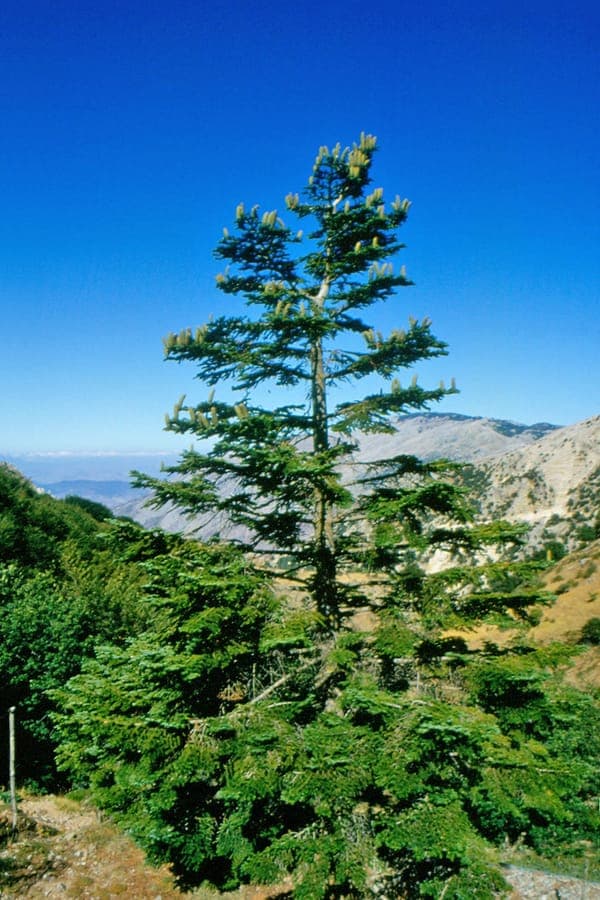
lorca56 on Flickr / CC BY-SA 2.0, via Wikimedia Commons
Sicilian fir (Abies nebrodensis): complete guide
Abies nebrodensis
Want to see Sicilian fir (Abies nebrodensis): complete guide in your garden?
1 minute, no credit card
Overview
The Sicilian fir, Abies nebrodensis, holds the sobering distinction of being the rarest conifer in Europe and one of the most endangered trees on the planet. Roughly thirty wild specimens survive, all clustered in a small area of the Madonie Mountains in northern Sicily. This tree teeters on the very edge of extinction, which makes it not only a botanical curiosity but also an exceptionally worthwhile subject for gardeners who want their planting choices to make a genuine difference for conservation.
For gardeners across the temperate world, from the mild maritime climates of Western Europe to parts of the southeastern United States, coastal Australia, and New Zealand, the Sicilian fir offers a rare opportunity. Hardy in USDA zones 7 through 9, it adapts to a surprisingly wide range of conditions. At a mature height of 15 to 25 meters, it fits into gardens where most other fir species would quickly outgrow the available space. Planting an Abies nebrodensis is more than gardening: it is an act of species preservation. At gardenworld.app you can create a garden design that establishes ideal growing conditions for this extraordinary tree.
Appearance & growth characteristics
Abies nebrodensis is a medium-sized fir that typically reaches 15 to 25 meters in cultivation, considerably smaller than many of its relatives. The crown is broadly conical in young trees and becomes more rounded and irregular with age, giving the tree a characteristically Mediterranean silhouette. The needles are dark green, 1.5 to 2.5 cm long, with two silvery bands on the underside. They are arranged in two ranks along the twigs and have a slightly curved form.
The bark is smooth and grey on young trees, becoming rougher with irregular fissures on older specimens. The cones are cylindrical, 10 to 15 cm long, and stand upright on the branches as is characteristic of all true firs. At maturity they turn brown and the scales fall away while the central axis remains attached to the branch. Growth rate is moderate to slow: expect 20 to 35 cm per year, depending on site conditions and care.
What sets this tree apart in horticultural terms is its compact stature relative to other Abies species. Where an Abies alba or Abies magnifica will quickly dominate a garden, the Sicilian fir remains at a manageable scale, making it suitable for medium-sized residential gardens.
Ideal location: sun, shade, or partial shade
In nature, the Sicilian fir grows on mountain slopes at elevations of 1,400 to 1,600 meters in the Madonie range, where it receives intense Mediterranean sun but also finds shelter among rock formations and other trees. In garden cultivation across temperate climates, the tree performs best in full sun to partial shade.
Full sun is well tolerated, provided the tree does not suffer from extreme heat combined with drought. Some afternoon shade during summer can be welcome, especially for young specimens that are not yet fully established. Choose a sheltered position, protected from persistent cold north winds, but with good air circulation to prevent fungal diseases. The Sicilian fir is naturally adapted to a Mediterranean climate with dry summers and mild, wet winters, so a somewhat sheltered, warm spot in the garden is ideal. A position against a south-facing wall or in the lee of other trees and shrubs works excellently in cooler climates.
Soil & ground requirements
Abies nebrodensis grows naturally on calcareous, rocky soils with excellent drainage. This translates to a garden preference for well-drained, moderately fertile soil with a neutral to slightly alkaline pH (6.5 to 7.5). This distinguishes the Sicilian fir from most other fir species, which generally prefer acidic soils.
Heavy clay is unsuitable and must be amended with coarse sand, fine gravel, and compost to increase permeability. Sandy soils work better but need enrichment with organic matter. Creating a drainage layer at planting is essential: place 15 to 20 cm of gravel or crushed stone at the bottom of the planting hole. The hole itself should be at least three times the width of the root ball.
A particular tip: add some limestone chippings or dolomite to the soil if your ground is naturally acidic. Unlike most other conifers, this fir thrives on calcareous ground. Garden centres will stock suitable lime products and soil amendments for this purpose.
Watering: when and how much
The Sicilian fir is more drought-tolerant than most other European fir species, a trait it owes to its Mediterranean origins. Nevertheless, it needs regular watering during its establishment phase. For the first two to three years after planting, provide 10 to 20 litres of water per week, depending on weather and soil conditions.
From the fourth year onward, the tree is generally self-sufficient and only needs supplemental water during prolonged drought. Unlike many other firs, Abies nebrodensis handles short dry spells reasonably well, but extended drought combined with heat can still cause stress. Check moisture levels by pushing a finger 10 cm into the soil. If it feels dry, give a thorough watering.
More important than the quantity of water is preventing waterlogging. The roots of this fir are extremely sensitive to root rot in persistently wet conditions. Ensure excess water can always drain away and mulch the base with a 5 to 8 cm layer of coarse material such as bark chips or stone chippings.
Free design
Want to see Sicilian fir (Abies nebrodensis): complete guide in your garden? Make a free design now.
Pruning: when and how
The Sicilian fir needs minimal pruning. Its natural growth habit is attractive and regular, requiring no correction. Limit pruning activities to removing dead, damaged, or diseased branches. The best time for this is late winter, in February or early March, before new growth begins.
Avoid shortening the leader. With a tree this rare, it is all the more important not to disturb natural development. Never prune into old wood without green needles, as like all firs, Abies nebrodensis does not regenerate from bare wood. Use clean, sharp pruning tools and disinfect them before and after use.
Given the rarity of the species, it is particularly important to keep the tree healthy. Every unnecessary wound is a potential entry point for pathogens. Prune only when strictly necessary.
Maintenance calendar
- January - February (Winter): Inspect for branch damage after winter storms. Remove dead branches if needed. Check that drainage around the base is functioning. Plan new plantings if the ground is not frozen.
- March - April (Early spring): Prime planting window for new specimens. Apply a light dose of conifer fertilizer. Monitor soil moisture and begin regular watering if dry. Check needles for any winter damage.
- May - June (Late spring): Growth season begins. Check for pests such as aphids or fir gall mites. Ensure adequate watering in dry weather. Renew the mulch layer around the base to a depth of 5-8 cm.
- July - August (Summer): Watering is the primary concern. Provide a thorough soaking weekly during dry spells, but ensure water drains freely. Watch for spider mites. Avoid fertilizing during summer months.
- September - October (Autumn): Cones ripen. Enrich the soil with a thin layer of compost. Good period for planting new trees to allow rooting before winter. Check that drainage is still working well.
- November - December (Winter): Give a final watering before the first hard frost. Protect young trees with a windbreak if they are in an exposed position. Check and top up the mulch layer if needed.
Winter hardiness & protection
Abies nebrodensis is hardy in USDA zones 7 through 9, tolerating temperatures down to approximately -15 degrees Celsius. Across most temperate gardening regions, this is sufficient, but in areas that experience exceptionally harsh winters, young trees may need some protection.
Mature, well-established specimens handle typical maritime and continental winters without difficulty. Young trees in their first two to three winters deserve extra attention. A 10-15 cm mulch layer around the base protects roots from freezing. At temperatures below -10 degrees Celsius combined with sharp wind, a burlap or garden fleece windbreak is advisable to prevent needle desiccation.
An important consideration is wet cold. The Sicilian fir tolerates frost reasonably well, but a combination of frost and waterlogged soil is potentially fatal. Ensure drainage functions optimally, particularly during the wet winter months when rainfall is heaviest. A slightly raised planting position can help enormously in clay-heavy or poorly drained gardens.
Pests, diseases & companion plants
The Sicilian fir is generally not very susceptible to disease in cultivation. The greatest risks are root rot from waterlogging and fungal diseases that occur with poor air circulation. Regularly check for needle discolouration, which can indicate a fungal infection or nutrient deficiency.
Aphids and fir gall mites may occur occasionally. For light infestations, hosing down with water is sufficient. For more serious cases, use a biological control product. Prevent problems by giving the tree adequate space and air flow.
As companion plants, the Sicilian fir works well with Mediterranean and lime-loving species. Consider lavender, rosemary, Cistus (rock rose), and ornamental grasses such as Stipa. Buxus and Taxus provide a handsome evergreen contrast. For underplanting in the partial shade of the canopy, Helleborus, Cyclamen, and ferns are suitable choices. Combining the tree with rock features and gravel mulch creates a Mediterranean atmosphere that perfectly suits this tree's origins.
Closing thoughts
The Sicilian fir is far more than an attractive conifer. It is a living piece of natural history, a tree that with roughly thirty wild specimens teeters on the brink of extinction. By planting an Abies nebrodensis in your garden, you contribute to the survival of a species that has existed on Sicily for millions of years but now faces disappearing forever.
With its compact size, modest maintenance needs, and adaptation to temperate maritime climates, the Sicilian fir is also an excellent garden tree in its own right. Want to discover how this remarkable fir might fit into your garden? At gardenworld.app you can create a garden design that establishes optimal growing conditions for this rare tree. Every Sicilian fir that thrives outside Sicily is a victory for the conservation of this unique species.
Want to see Sicilian fir (Abies nebrodensis): complete guide in your garden? Make a free design now.
Upload a photo, pick a style, and get a photorealistic design with plant list in under a minute.
No credit card required


Similar plants
Abies delavayi: complete guide
Abies delavayi
Delavayi fir is an elegant, medium-sized coniferous tree from the Pinaceae family with dark green needles. This Asian evergreen is perfect for alpine gardens and large landscapes.
Taiwan fir: complete guide
Abies kawakamii
Discover the magnificent Taiwan fir, a rare evergreen conifer from Taiwan's mountain regions. Learn growth requirements, care tips, and why this beautiful tree is perfect for collectors of unique garden specimens.
Farges fir: complete guide
Abies fargesii
Discover the majestic Farges fir, an impressive conifer from China's mountains with elegant foliage and columnar form. Ideal for large gardens.