
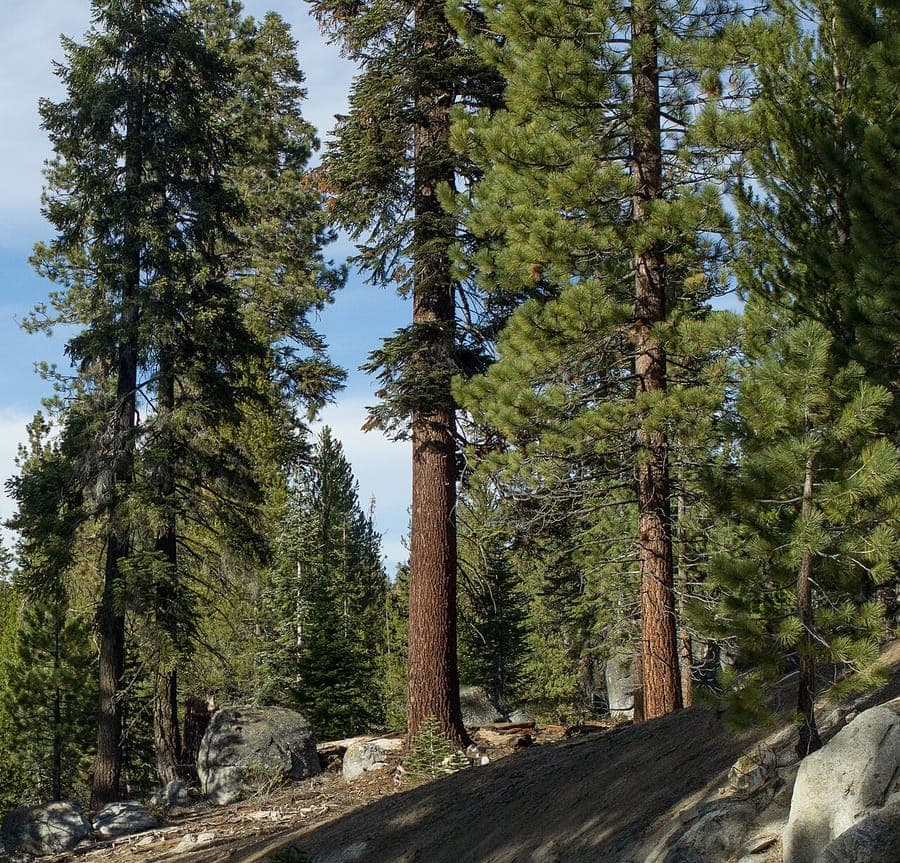
David Prasad from Welches, OR., United States / CC BY-SA 2.0, via Wikimedia Commons
California red fir (Abies magnifica): complete guide
Abies magnifica
Want to see California red fir (Abies magnifica): complete guide in your garden?
1 minute, no credit card
Overview
The California red fir, Abies magnifica, is one of the most spectacular conifers native to North America. Found growing naturally in the Sierra Nevada range of California and into southern Oregon, this tree routinely reaches heights of 40 to 60 meters with trunk diameters exceeding two meters. The species name 'magnifica' could not be more fitting: this is genuinely a magnificent tree.
For gardeners across the world, from the maritime climates of Western Europe to the temperate zones of New Zealand and the Pacific Northwest, Abies magnifica offers a chance to introduce real mountain grandeur into a garden setting. Hardy in USDA zones 5 through 8, it tolerates a surprisingly wide range of conditions. Its striking reddish-brown bark, perfectly symmetrical form, and remarkably large cones make it a standout specimen tree. At gardenworld.app you can create a garden design that accounts for the scale and needs of such an impressive conifer.
Appearance & growth characteristics
Abies magnifica develops a densely branched, symmetrical conical form that is exceptionally neat and regular in younger trees. As the tree matures, the crown becomes slightly more open and irregular, giving it a rugged, weathered character that speaks of mountain origins. The needles are blue-green to silvery-grey, 2 to 4 cm long, and densely packed around the branches in an upward-curving arrangement. They have a four-sided cross-section, distinguishing them from the flat needles of many other fir species.
The bark is the tree's most immediately recognizable feature. Smooth and grey on young trees, it develops into a deeply furrowed, rich reddish-brown surface on mature specimens. This striking coloration is responsible for the common name 'red fir' and makes the trunk a year-round point of interest, particularly dramatic when caught by low winter sunlight.
The cones of Abies magnifica are among the largest produced by any fir species. They measure 15 to 23 cm in length and 7 to 10 cm in width, standing upright on the uppermost branches. Their colour ranges from yellowish-brown to purplish, and like all true firs, the scales disintegrate at maturity while the central axis remains attached to the branch. Growth rate is moderate: expect 30 to 50 cm per year under favourable conditions, slowing somewhat as the tree matures.
Ideal location: sun, shade, or partial shade
In its native range, the California red fir grows at elevations between 1,400 and 2,800 meters, where it receives intense sunlight, cold winters, and relatively dry summers. In garden cultivation, it handles full sun very well, provided the soil retains adequate moisture. Partial shade is also tolerated, particularly by young specimens that benefit from some protection during their establishment years.
Unlike many firs that struggle in dry air, Abies magnifica is well adapted to lower humidity and cold, dry winds. However, a combination of sustained heat and high humidity can stress the tree and invite fungal problems. Choose a site with good air circulation but without persistent hot drafts. The tree's eventual size demands careful placement: allow at least 10 to 15 meters of clearance from buildings, property boundaries, and other large trees. An open position in a larger garden, arboretum, or park is the ideal setting.
Soil & ground requirements
The California red fir strongly prefers deep, well-drained soil with a slightly acidic to neutral pH (5.5 to 7.0). In nature, it grows on volcanic soils that drain freely, and replicating this drainage is the single most important factor for success in cultivation. Heavy clay is unsuitable unless thoroughly amended with coarse sand, perlite, and organic matter to improve structure and water movement.
Sandy soils work better but should be enriched with compost and leaf mould to improve nutrient and moisture retention. The tree tolerates moderately lean soil but grows best in fertile, airy ground. When planting, dig a hole at least three times the width of the root ball and incorporate a drainage layer of gravel or expanded clay at the base. Garden centres typically stock suitable conifer-specific planting mixes and soil amendments that simplify the preparation process.
Watering: when and how much
Despite its origins in relatively dry mountain environments, the California red fir needs consistent watering during its establishment phase. For the first three years after planting, pay close attention to moisture levels. Provide 15 to 25 litres of water per week, depending on weather conditions and tree size. Distribute the water evenly around the root zone and ensure it penetrates deeply rather than running off the surface.
From the fourth year onward, the tree is generally sufficiently rooted to find moisture independently, but supplemental watering during extended summer dry spells remains wise. A reliable check is to push a stick or finger 15 cm into the soil near the root zone. If the soil feels dry at that depth, it is time to water. Avoid waterlogging at all costs. The roots of Abies magnifica are susceptible to root rot in persistently wet conditions. A mulch layer of bark chips or needle compost around the base helps regulate soil moisture and keeps roots cool during hot weather.
Free design
Want to see California red fir (Abies magnifica): complete guide in your garden? Make a free design now.
Pruning: when and how
The California red fir requires virtually no pruning and naturally develops a beautifully symmetrical form. Any pruning should be limited to removing dead, damaged, or diseased branches. The best time for this work is late winter, from February to early March, before the new growing season begins.
Avoid cutting the leader (central top shoot) unless you deliberately want to restrict the tree's height. Removing the leader permanently alters the tree's natural habit and can result in competing leaders that weaken the structure. Never prune into old wood without green needles, as firs do not regenerate from bare wood. Always use clean, sharp tools and disinfect secateurs between trees to prevent the spread of disease.
For most garden situations, the best approach is simply to let the tree maintain its natural form. The symmetrical conical shape is one of the greatest ornamental assets of Abies magnifica and needs no human correction.
Maintenance calendar
- January - February (Winter): Check for heavy snow loads and gently remove accumulated snow from branches to prevent breakage. Remove any dead or damaged branches. Plan transplanting of young specimens if needed.
- March - April (Early spring): Prime planting window for new specimens. Apply a slow-release conifer fertilizer around the root zone. Monitor soil moisture and begin regular watering if conditions are dry.
- May - June (Late spring): New growth begins pushing out. Inspect for pests such as aphids or fir gall mites. Ensure adequate watering in dry spring weather. Apply an 8-10 cm mulch layer around the trunk.
- July - August (Summer): The most critical period for watering. Provide a thorough soaking weekly during dry spells. Watch for spider mites, which thrive in warm, dry conditions. Avoid fertilizing in the height of summer.
- September - October (Autumn): The large cones ripen and begin disintegrating on the tree. Enrich the soil with a layer of compost or leaf mould. This is the last window for planting new trees before winter.
- November - December (Winter): Give a final deep watering before the ground freezes. Protect young trees with a windbreak of burlap if exposed to harsh winds. Check that the mulch layer remains intact.
Winter hardiness & protection
Abies magnifica is reliably hardy to approximately -25 degrees Celsius (USDA zone 5). Across most temperate gardening regions worldwide, including Western Europe, the Pacific Northwest, and parts of Australia and New Zealand, the tree overwinters without difficulty. Mature specimens need no winter protection whatsoever.
Young trees in their first two winters benefit from some care. A 10-15 cm mulch layer around the base insulates roots against freezing. During sustained frost combined with sharp winds, a burlap or garden fleece windbreak prevents needle desiccation. Always ensure the tree has received adequate water before hard frost arrives. Evergreen conifers continue to lose moisture through their needles during winter, and can suffer desiccation damage if the ground is frozen solid and root-zone moisture reserves are low.
Late spring frost is generally not a concern, as Abies magnifica breaks bud relatively late in the season. This is an advantage over earlier-flushing conifers that can lose new growth to unexpected cold snaps.
Pests, diseases & companion plants
The California red fir is generally healthy and not particularly prone to disease. The main threats are root rot caused by waterlogging, spider mites during warm and dry summers, and fir gall mites. Regularly inspect needles for discolouration or distortion. For spider mite infestations, hosing down the foliage with a strong jet of water can reduce populations, or you can introduce biological controls such as predatory mites.
As companion plants, Abies magnifica pairs well with other lovers of acidic, well-drained soils. Rhododendrons, Pieris japonica, Skimmia, and blueberries (Vaccinium) create a naturalistic understorey. Ornamental grasses such as Carex species and ferns provide textural contrast beneath the canopy. For an alpine or mountain-garden atmosphere, combine the tree with rock garden plants, Sedum species, and lavender on the sunnier side of the planting.
Closing thoughts
The California red fir is a tree that commands respect. With its towering stature, striking reddish-brown bark, and impressively large cones, it is a living monument in any garden spacious enough to accommodate it. From the maritime climates of Europe to the temperate zones of the Southern Hemisphere, this American mountain native can thrive beautifully, provided you give it well-drained, slightly acidic soil and some extra attention in the early years.
Want to see how an Abies magnifica might fit into your garden? At gardenworld.app you can create a tailored garden design that takes into account the scale and requirements of this extraordinary tree. The result is a garden with real presence, anchored by the magnificent silhouette of the California red fir.
Want to see California red fir (Abies magnifica): complete guide in your garden? Make a free design now.
Upload a photo, pick a style, and get a photorealistic design with plant list in under a minute.
No credit card required


Similar plants
Abies delavayi: complete guide
Abies delavayi
Delavayi fir is an elegant, medium-sized coniferous tree from the Pinaceae family with dark green needles. This Asian evergreen is perfect for alpine gardens and large landscapes.
Taiwan fir: complete guide
Abies kawakamii
Discover the magnificent Taiwan fir, a rare evergreen conifer from Taiwan's mountain regions. Learn growth requirements, care tips, and why this beautiful tree is perfect for collectors of unique garden specimens.
Farges fir: complete guide
Abies fargesii
Discover the majestic Farges fir, an impressive conifer from China's mountains with elegant foliage and columnar form. Ideal for large gardens.