
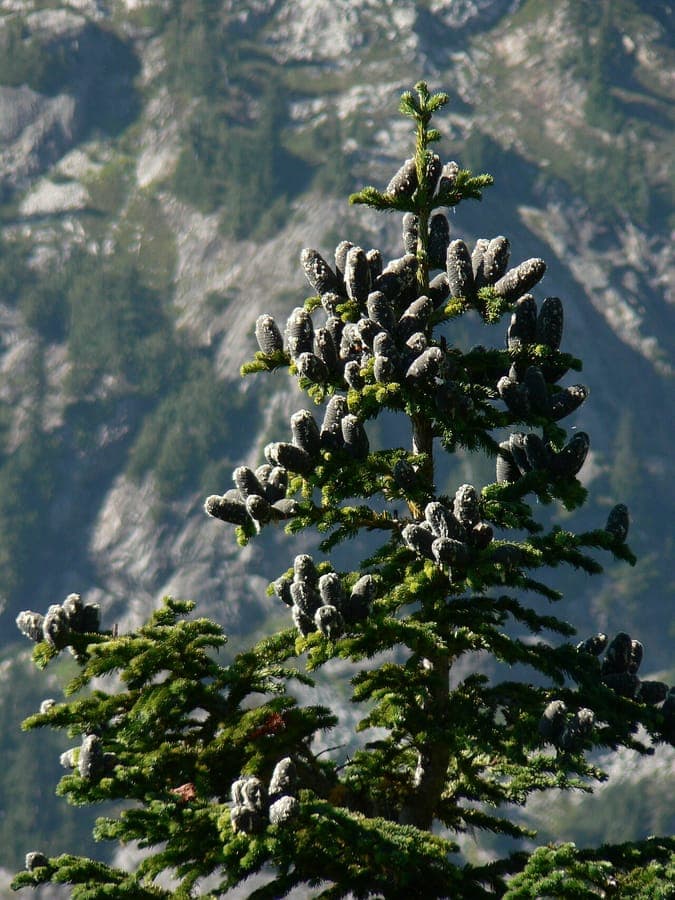
Walter Siegmund / CC BY 2.5, via Wikimedia Commons
Alpine Fir: complete guide
Abies lasiocarpa
Want to see Alpine Fir: complete guide in your garden?
1 minute, no credit card
Overview
The Alpine Fir, Abies lasiocarpa, is a striking conifer native to the mountainous regions of western North America. Its natural range stretches from the Yukon Territory in Canada southward through British Columbia, Washington, Oregon, and into the high mountains of Arizona and New Mexico. This is a tree shaped by extremes: heavy snowpack, fierce winds, short growing seasons, and thin, rocky soils at elevations often exceeding two thousand metres. In the wild, the Alpine Fir can reach twenty to thirty-five metres in height, though trees at the upper limits of their range are frequently stunted and sculpted into dramatic wind-flagged forms.
What makes the Alpine Fir compelling for garden use is its remarkably narrow, spire-like silhouette. While most firs spread broadly with age, Abies lasiocarpa maintains a tight, columnar crown that takes up very little horizontal space. This makes it an excellent choice for gardeners seeking a strong vertical accent without sacrificing ground area. At gardenworld.app, you can explore how this elegant conifer fits into your specific garden layout and discover the ideal placement for this mountain native.
Appearance and ornamental value
Abies lasiocarpa develops a distinctively narrow, tower-like growth habit that immediately sets it apart from broader fir species. The crown tapers to a sharp point, creating an elegant, almost Gothic silhouette that looks particularly dramatic against winter skies or rising above a mixed planting. The branches are relatively short and closely spaced, giving the tree a dense, full appearance despite its narrow profile.
The needles are one and a half to three centimetres long, blue-green to silver-green in colour, with a soft, almost velvety texture. They spiral around the twigs and curve upward, as though reaching for the light. The undersides bear two whitish bands, characteristic of the Abies genus. The bark on young trees is smooth and pale grey, developing shallow furrows and a darker tone with age.
The cones stand upright on the uppermost branches, reach six to ten centimetres in length, and display a deep purple to near-black colour when immature. As they ripen, they turn brown and shed their scales while the central axis remains standing on the branch. The overall effect is subtle yet refined, appreciated most by those with an eye for the quieter beauties of the conifer world.
Ideal growing conditions
The Alpine Fir is naturally adapted to cool, moist mountain climates. It is rated for USDA hardiness zones 4 to 6, making it well suited to cooler regions across North America, northern Europe, and mountainous areas worldwide. The tree handles severe cold with ease, tolerating temperatures far below minus thirty degrees Celsius. Heat, however, is its weakness. In regions with hot, humid summers, the Alpine Fir may struggle, particularly if the soil dries out or air circulation is poor.
A position in partial shade is preferable to full sun, especially in warmer climates. In cooler regions, such as the Pacific Northwest, northern Britain, or Scandinavia, full sun works well provided the soil remains consistently moist. The ideal soil is well-drained, slightly acidic to neutral, with a pH between 5.0 and 6.5. Heavy clay that holds standing water must be improved with compost and coarse sand to prevent root rot. A mulch layer of pine needles or bark chips around the base maintains coolness, moisture, and the slight acidity that this species prefers.
Shelter from drying winds is beneficial, particularly for young trees establishing their root systems. While the Alpine Fir endures extreme winds in its native high-altitude habitat, the growing conditions in lowland gardens are fundamentally different, and a more sheltered position produces a healthier, more attractive tree.
Planting guide
Autumn, from October to November, is the ideal planting season for an Alpine Fir. Early spring in March is a suitable alternative. Avoid planting during hard frost or the heat of summer. Dig a planting hole at least twice the width of the root ball and the same depth. Amend the excavated soil with leaf mould or ericaceous compost to improve structure and acidity.
Set the root ball so that its top is level with the surrounding soil surface. Planting too deeply encourages stem rot, while planting too shallowly leaves roots vulnerable to drying out. Firm the soil gently and water thoroughly immediately after planting. Consistent moisture during the first two to three growing seasons is critical for establishment. The Alpine Fir has a greater need for evenly moist soil than many other garden conifers. Once established, it becomes more resilient, but prolonged drought remains a concern.
A support stake is rarely needed thanks to the tree's narrow, low-wind-resistance profile. Protect the trunks of young trees against rodent damage with a ring of wire mesh, especially in gardens adjacent to farmland or woodland edges.
Ongoing care and pruning
The Alpine Fir demands little maintenance once well established. Pruning is generally inadvisable for Abies species, as they regenerate poorly from old wood. Remove only dead or damaged branches, preferably in late spring when the tree is actively growing. Always cut back to a living side branch or the main trunk and avoid leaving stubs.
Fertilisation is seldom necessary if the soil has adequate organic content. A modest application of slow-release conifer fertiliser in early spring is sufficient to keep the tree healthy. Excessive nitrogen produces soft, disease-prone growth that is also vulnerable to frost damage. Maintain a mulch ring of five to eight centimetres around the trunk throughout the year. This protects the shallow root system, preserves soil moisture, and suppresses competing weeds.
Supplemental watering during prolonged summer dry spells is strongly recommended, even for mature trees. The Alpine Fir evolved in a climate with reliable precipitation and snowmelt, and it tolerates dehydration less well than most other garden firs. Morning irrigation at the base is preferable to overhead watering, which can promote fungal issues.
Free design
Want to see Alpine Fir: complete guide in your garden? Make a free design now.
Cultivars and varieties
The most widely available and garden-worthy form of the Alpine Fir is Abies lasiocarpa var. arizonica, commonly known as the Corkbark Fir. This variety is distinguished by its striking corky, cream-coloured bark and intensely blue-silver needles. It is a genuinely beautiful tree that looks almost ethereal when touched by frost or dusted with snow. In gardens, the Corkbark Fir rarely exceeds eight to twelve metres and grows slowly, making it more manageable than the species itself.
The cultivar 'Compacta' is especially popular among dwarf conifer enthusiasts. This form grows extremely slowly, reaching barely one metre in height after ten years. With its dense, globular to broadly conical habit and intense silver-blue needles, 'Compacta' is an outstanding choice for rock gardens, heather beds, and large containers. Specialist nurseries also offer 'Blue Sphere', an even more compact selection with a near-perfect globular shape that rarely exceeds sixty centimetres.
While the Alpine Fir is less commonly stocked than species like the Korean Fir or Nordmann Fir, specialty nurseries and online growers offer a reasonable selection, particularly of var. arizonica and the dwarf cultivar 'Compacta'.
Pests and diseases
In its native habitat, the Alpine Fir is a tough and resilient tree. In the warmer, more humid lowland climates of many garden settings, however, it can be more susceptible to certain problems. The green spruce aphid (Elatobium abietinum) is the most common pest. Check regularly in spring by tapping branches over white paper. If aphids are present, an organic pyrethrin-based treatment is usually sufficient.
Fungal diseases, particularly root rot caused by Phytophthora species, represent the greatest risk. This condition occurs in poorly drained or waterlogged soils and can be fatal. Prevention through proper drainage at planting time is by far the most effective strategy. Avoid overwatering and ensure the root zone never sits in standing water. Needle rust may appear as orange pustules on the foliage but is rarely life-threatening. Remove affected branches and ensure good air circulation.
In warm, dry summers, spider mites can become problematic. Regular misting of the canopy with water in the early morning helps prevent outbreaks and keeps the foliage looking fresh.
Garden design combinations
The narrow, columnar shape of the Alpine Fir makes it supremely suited as a vertical accent in garden design. It can serve as a specimen on a lawn, where its distinctive silhouette commands attention without dominating the space. But it is equally valuable as a background plant in a mixed border, where its blue-green colour provides a calm counterpoint to the warmer tones of deciduous shrubs and perennials.
The Alpine Fir pairs beautifully with other plants that appreciate similar cool, moist, acidic conditions. Rhododendrons, pieris, heathers, and blueberry bushes make excellent companions. Japanese pieris with its red new growth creates a striking colour contrast against the silver-blue needles. Underplanting with ferns, hostas, or shade-tolerant grasses establishes a naturalistic, woodland character.
Dwarf cultivars such as 'Compacta' and 'Blue Sphere' excel in rock gardens alongside sedums, saxifrages, and dwarf grasses. They also create elegant statements in Japanese-inspired gardens, combined with stones, moss, and low ground covers. In large containers on a patio, these compact forms bring year-round evergreen structure and a touch of mountain atmosphere to even the smallest outdoor space.
Seasonal calendar
Early spring brings pale green growth tips to the branch ends, a subtle but charming marker of the Alpine Fir's annual cycle. This is the time to apply fertiliser and replenish the mulch layer. Check for aphids as soon as new shoots emerge. The flowering structures are modest: small purplish-red female flowers near the crown apex and yellowish-green male pollen clusters lower on the tree.
Summer sees the development of deep purple cones on the uppermost branches. Ensure adequate moisture, as the Alpine Fir tolerates drought poorly. Autumn brings the gradual shedding of cone scales and seed dispersal. This is also the best planting season for new specimens. Winter is when the Alpine Fir is arguably at its most beautiful: draped in snow or rimmed with frost, its blue-green needles create a vision of mountain landscape that transforms any garden into a scene of alpine tranquillity.
Frequently asked questions
Is the Alpine Fir suitable for a small garden? The species itself can become quite large over time, but dwarf cultivars like 'Compacta' remain very compact and are perfectly suited to small spaces. How does the Alpine Fir differ from the Korean Fir? The Alpine Fir grows taller and narrower, has more blue-silver needle colouring, and is less renowned for its cones as an ornamental feature. The Korean Fir stays more compact and produces showier purple cones at a younger age. Can I grow an Alpine Fir in a container? Only the dwarf cultivars are suited to container growing, provided the container holds at least fifty litres and drainage is impeccable.
Visit gardenworld.app to discover how an Alpine Fir can be incorporated into your garden design. Whether you choose the graceful species or a compact dwarf form, thoughtful placement ensures this mountain native becomes a unique feature you will treasure for years to come.
Want to see Alpine Fir: complete guide in your garden? Make a free design now.
Upload a photo, pick a style, and get a photorealistic design with plant list in under a minute.
No credit card required


Similar plants
Abies delavayi: complete guide
Abies delavayi
Delavayi fir is an elegant, medium-sized coniferous tree from the Pinaceae family with dark green needles. This Asian evergreen is perfect for alpine gardens and large landscapes.
Taiwan fir: complete guide
Abies kawakamii
Discover the magnificent Taiwan fir, a rare evergreen conifer from Taiwan's mountain regions. Learn growth requirements, care tips, and why this beautiful tree is perfect for collectors of unique garden specimens.
Farges fir: complete guide
Abies fargesii
Discover the majestic Farges fir, an impressive conifer from China's mountains with elegant foliage and columnar form. Ideal for large gardens.