
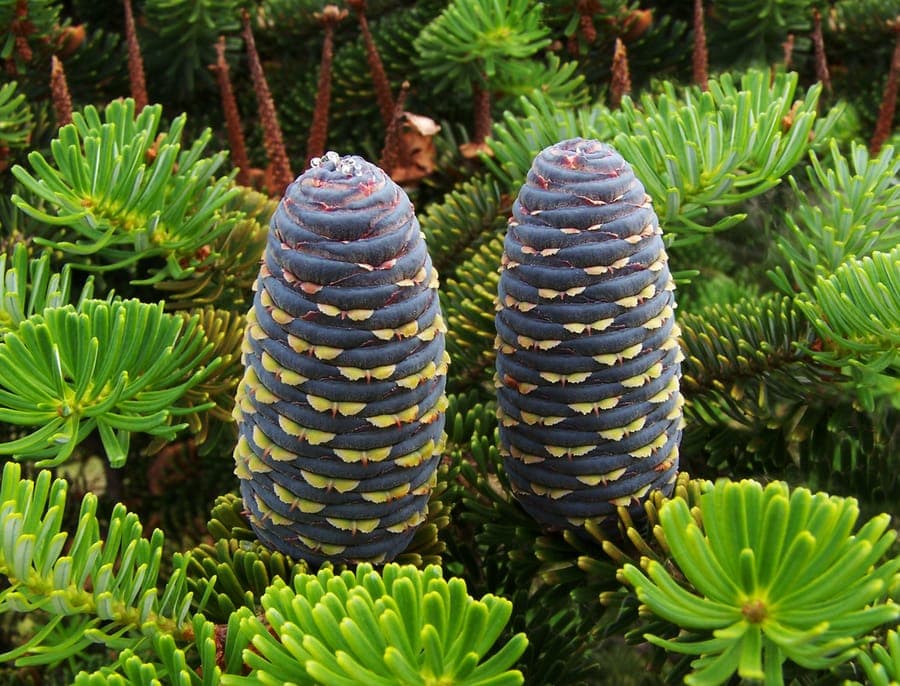
Lestath, (poprawki pl:user:Lcamtuf). / CC BY-SA 3.0, via Wikimedia Commons
Korean Fir: complete guide
Abies koreana
Want to see Korean Fir: complete guide in your garden?
1 minute, no credit card
Overview
The Korean Fir, Abies koreana, has earned its place as one of the most popular ornamental conifers in gardens around the world. Native to the volcanic slopes of Jeju Island and the mountains of southern South Korea, this compact evergreen rarely exceeds three to five metres in cultivation, despite reaching up to eighteen metres in the wild. What truly sets the Korean Fir apart from its larger relatives is its remarkable habit of producing showy purple-blue cones on trees as young as five to eight years old. This combination of manageable size and early ornamental interest has made it a staple in garden centres across Europe, North America, and beyond.
Wondering how a Korean Fir might fit into your garden design? At gardenworld.app you can create a personalised garden plan that takes into account your space, soil type and climate zone, ensuring your Korean Fir finds the perfect spot.
Appearance and ornamental value
Abies koreana develops a compact, broadly conical form that becomes denser and more symmetrical with age. The needles are short, typically one to two centimetres long, glossy dark green on the upper surface and strikingly white to silver on the underside. When a breeze catches the branches, the flashing silver undersides create a shimmering, almost sparkling effect that few other conifers can match. The needles are firmly attached and persist for several years, keeping the tree looking lush throughout every season.
The undisputed highlight of this species is its cones. Unlike many firs that only produce cones once they reach a considerable age, the Korean Fir begins cone production remarkably early. The cones stand upright on the branches, measure five to seven centimetres in length, and display a vivid purple-blue to violet colour that is simply breathtaking. As they mature through late summer and autumn, they gradually turn brown and the scales detach one by one, leaving the central spike standing on the branch. The bark is smooth and grey-brown on young trees, developing shallow fissures with age. Whether viewed up close or from across the garden, the Korean Fir offers year-round visual interest.
Ideal growing conditions
The Korean Fir thrives in full sun to partial shade. It is rated for USDA hardiness zones 5 to 7, making it suitable for a wide range of climates across North America, Europe, and parts of East Asia. In regions with hot summers, afternoon shade helps prevent needle scorch and keeps the tree looking its best. The species is fully winter hardy and tolerates temperatures well below minus twenty degrees Celsius without difficulty.
Soil preferences lean towards well-drained, slightly acidic to neutral ground. A pH between 5.0 and 6.5 is ideal. Heavy clay soils that retain standing water should be improved with generous amounts of compost and coarse sand before planting. Chalky or highly alkaline soils are not suitable. A mulch layer of bark chips or pine needles around the base helps maintain moisture and acidity while suppressing weed growth. Shelter from strong, drying winds is beneficial, particularly for newly planted trees that have not yet established a deep root system.
Planting guide
Autumn, from October to November, is the best time to plant a Korean Fir, although early spring in March also works well. Avoid planting during hard frost or the peak heat of summer. Dig a planting hole at least twice the width of the root ball and the same depth. Mix the excavated soil with leaf mould or ericaceous compost to improve both structure and acidity.
Position the root ball so that its top sits level with the surrounding soil surface. Planting too deeply invites stem rot, while planting too shallowly exposes roots to desiccation. Firm the soil gently around the root ball and water thoroughly immediately after planting. During the first two growing seasons, regular watering is essential, particularly during dry spells. Once established, the Korean Fir is reasonably drought tolerant, though prolonged summer drought may cause some needle loss. A support stake is rarely necessary due to the compact growth habit, but a ring of wire mesh around the trunk can protect against rabbit damage in rural gardens.
Ongoing care and pruning
The Korean Fir is a remarkably low-maintenance tree. Pruning is seldom necessary and is generally discouraged for Abies species, as they do not regenerate well from old wood. If a branch must be removed due to damage or disease, make the cut in late spring when the tree is actively growing, and always cut back to a side branch or the main trunk. Never leave stubs.
Fertilisation is optional if the soil contains adequate organic matter. A handful of slow-release conifer fertiliser applied in early spring gives the tree a gentle boost without encouraging the soft, vulnerable growth that excess nitrogen produces. Keep the area around the trunk clear of competing weeds and maintain a mulch ring of five to eight centimetres depth. This protects the shallow root system, conserves moisture, and gradually adds organic matter to the soil as it decomposes.
Free design
Want to see Korean Fir: complete guide in your garden? Make a free design now.
Popular cultivars
Several outstanding cultivars have been selected from Abies koreana, offering even more compact growth and distinctive features. The most celebrated is undoubtedly 'Silberlocke'. Its needles curve dramatically upward, permanently displaying the silvery-white undersides and creating an effect reminiscent of silver ringlets cascading through the foliage. 'Silberlocke' typically reaches only two to three metres in height and makes a stunning specimen in any garden.
Another sought-after selection is 'Blue Emperor', valued for its intensely blue-green needles and exceptionally compact habit. This dwarf form rarely exceeds one and a half metres, making it ideal for rock gardens, mixed borders, and even large containers on patios and balconies. The cultivar 'Cis' deserves mention as well: a globe-shaped dwarf that stays under one metre in height, perfect as a focal point in a small front garden or as an accent among heathers and grasses. Specialty nurseries carry the widest range of cultivars, while mainstream garden centres typically stock 'Silberlocke' and the straight species.
Pests and diseases
The Korean Fir is fortunately quite resistant to most pests and diseases. The primary concern is the green spruce aphid (Elatobium abietinum), which feeds on the underside of needles and causes yellow mottling. Severe infestations lead to premature needle drop. Check trees regularly in spring by tapping branches over a sheet of white paper. If aphids fall, a treatment with an organic pyrethrin-based spray is usually sufficient.
Adelgids occasionally appear as white woolly patches on the bark and branches. These sap-sucking insects rarely cause serious harm to established trees but can stress young plants. Fungal diseases are most likely where drainage is poor or air circulation is restricted. Ensure good drainage at planting time and avoid crowding the tree with other large plants. If brown or black spots appear on the needles, remove affected branches promptly and improve airflow around the canopy.
Garden design combinations
The Korean Fir is an exceptionally versatile tree in garden design. As a specimen on a lawn, its symmetrical form and colourful cones create a year-round focal point. In mixed borders, it pairs beautifully with acid-loving companions such as rhododendrons, azaleas, camellias, and Japanese maples. Underplanting with ground covers like Pachysandra terminalis, Vinca minor, or low-growing ferns creates a polished, layered effect.
Dwarf cultivars such as 'Blue Emperor' and 'Cis' excel in rock gardens alongside alpine plants, ornamental grasses, and sedums. They also work wonderfully in Japanese-inspired gardens combined with acers, mosses, and carefully placed stones. In containers on a terrace or balcony, dwarf Korean Firs provide evergreen structure and a touch of elegance throughout the seasons.
Seasonal calendar
Early spring brings fresh, bright green growth tips to the branch ends, signalling the start of the active growing season. This is the time to apply any fertiliser and refresh the mulch layer. Check for aphids as soon as new growth appears. In late spring, the flowering structures emerge: small reddish-purple female flowers near the top of the crown and yellowish-green male pollen clusters lower down.
Summer is the season of spectacular cone development. The cones grow rapidly and transition from green to their signature purple-blue within a few weeks. Ensure adequate watering during dry summers, particularly for young trees. Autumn sees the cone scales detach and seeds disperse on the wind. This is also the ideal planting season for new specimens. Winter poses no threat to the Korean Fir, but young trees in rural areas may benefit from a protective wire mesh collar to deter browsing rabbits and deer.
Frequently asked questions
How much space does a Korean Fir need? Plan for an ultimate height of three to five metres and a spread of two to three metres for the species. Dwarf cultivars require considerably less room. Can I grow a Korean Fir in a container? Dwarf cultivars like 'Blue Emperor' and 'Cis' thrive in containers of at least fifty litres, provided drainage is excellent and watering is consistent. The species itself eventually outgrows container culture. Why does my Korean Fir not produce cones? Patience is key. Most trees begin coning after five to eight years. Ensure the tree receives adequate sunlight, as cone production is significantly reduced in heavy shade.
Visit gardenworld.app to discover how a Korean Fir can be incorporated into your specific garden layout. Whether you have a spacious backyard or a compact courtyard, the right design ensures this Korean beauty becomes a centrepiece you will enjoy for decades to come.
Want to see Korean Fir: complete guide in your garden? Make a free design now.
Upload a photo, pick a style, and get a photorealistic design with plant list in under a minute.
No credit card required


Similar plants
Abies delavayi: complete guide
Abies delavayi
Delavayi fir is an elegant, medium-sized coniferous tree from the Pinaceae family with dark green needles. This Asian evergreen is perfect for alpine gardens and large landscapes.
Taiwan fir: complete guide
Abies kawakamii
Discover the magnificent Taiwan fir, a rare evergreen conifer from Taiwan's mountain regions. Learn growth requirements, care tips, and why this beautiful tree is perfect for collectors of unique garden specimens.
Farges fir: complete guide
Abies fargesii
Discover the majestic Farges fir, an impressive conifer from China's mountains with elegant foliage and columnar form. Ideal for large gardens.