
Wikimedia Commons / CC BY-SA 3.0, via Wikimedia Commons
Nikko Fir (Abies homolepis): complete guide
Abies homolepis
Want to see Nikko Fir (Abies homolepis): complete guide in your garden?
1 minute, no credit card
Overview
The Nikko Fir, scientifically known as Abies homolepis, is one of the most dependable and ornamentally rewarding fir species available to gardeners worldwide. Native to the mountainous regions of central Japan, this robust evergreen conifer reaches heights of 25 to 40 metres with a broad, pyramidal crown clothed in glossy dark green needles that flash silvery-white when the wind turns them. Named after the famous Nikko region on Honshu island, where it grows wild at elevations of 1,000 to 2,000 metres, the Nikko Fir combines striking beauty with exceptional toughness. Its hardiness to USDA zone 4 and remarkable tolerance for air pollution make it an outstanding choice for gardens across a wide range of climates and settings.
What sets the Nikko Fir apart from many other Abies species is its adaptability. While most firs demand pristine mountain air and untouched soil, Abies homolepis thrives in suburban gardens, city parks, and even roadside plantings where other conifers would struggle. At gardenworld.app?utm_source=blog&utm_medium=plant-guide&utm_campaign=abies-homolepis you can create a garden design that showcases the impressive presence of the Nikko Fir to its full advantage.
Abies homolepis is endemic to Japan, occurring on the mountain slopes of central and southern Honshu island. Its distribution encompasses the prefectures of Tochigi, Gunma, Nagano, Gifu, and Nara, with the Nikko region being the most celebrated growing area. In these mountainous territories, the Nikko Fir forms extensive forests at elevations between 1,000 and 2,000 metres, thriving in a cool, humid climate characterised by heavy snowfall in winter and cool, moist summers.
In its native habitat, the Nikko Fir grows in mixed forests alongside other Japanese tree species including Tsuga diversifolia (northern Japanese hemlock), Picea jezoensis (Yezo spruce), and various Acer (maple) species. The tree is one of the dominant species in the subalpine zone of the Japanese mountain ecosystem. Japanese forestry has valued this species for centuries for its straight growth habit and durable timber. The Nikko Fir was first introduced to Europe in 1861 and to North America shortly thereafter, and has since proven its worth as an ornamental tree in parks and large gardens across the temperate world.
Appearance and growth habit
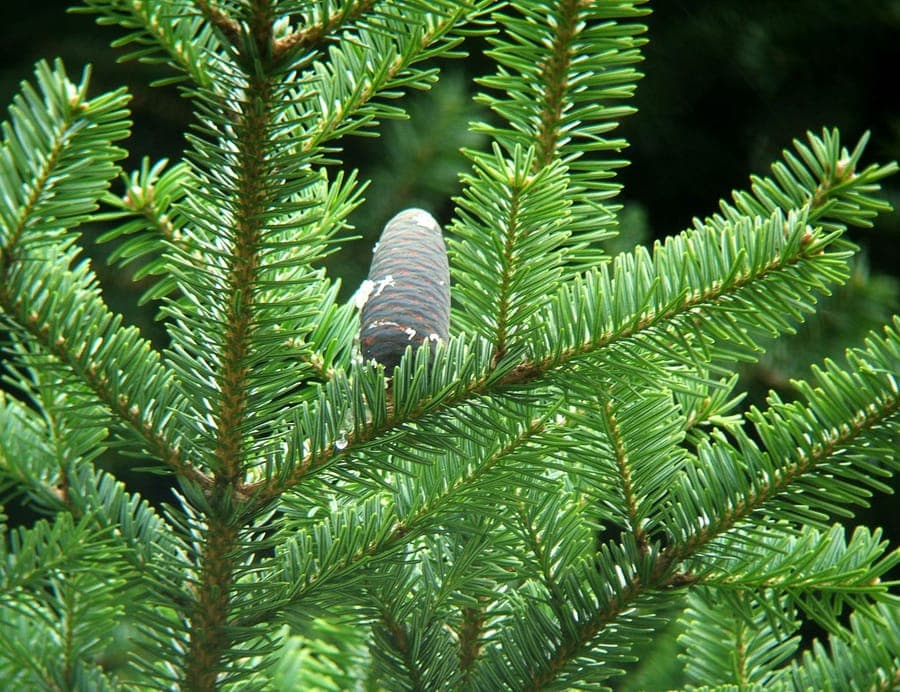
The Nikko Fir is an evergreen conifer with a broad-pyramidal to conical habit that becomes increasingly impressive with age. Its most striking feature is the foliage: the needles are glossy dark green on the upper surface with two broad, chalky-white bands on the underside, creating a distinctive bicoloured effect when the wind ruffles the branches. The needles are 1.5 to 3.5 centimetres long, firm yet pliable, and slightly curved with a blunt tip that makes them pleasant to touch, unlike the sharply pointed needles of many spruce species.
The branches are arranged in regular whorls and grow horizontally to slightly ascending, giving the tree a full, dense crown. Young bark is smooth and greyish with prominent horizontal lenticels. With age, the bark becomes rougher and develops shallow furrows. The cones are a particular ornament: they stand upright on the upper branches, measure 8 to 12 centimetres in length, and are cylindrical in shape, initially violet to purplish before turning brown at maturity. When ripe, the scales fall away while the central axis remains attached to the branch. Growth rate is moderate to fast, with annual increments of 30 to 50 centimetres under good conditions, making it one of the faster-growing fir species.
Climate and hardiness
The Nikko Fir is exceptionally winter hardy, rated for USDA zones 4 to 7, tolerating minimum temperatures down to -34 degrees Celsius. This extraordinary cold tolerance makes it suitable for gardens across an enormous geographical range. In North America, it thrives from southeastern Canada through the northeastern and midwestern United States, and performs well in the Pacific Northwest. In Europe, it is fully hardy throughout the British Isles, Scandinavia south of the Arctic Circle, and all of central and western Europe. In East Asia, it naturally suits the climates of Japan, Korea, and northern China.
Beyond cold hardiness, the Nikko Fir demonstrates remarkable tolerance for summer heat, provided adequate moisture is available. It handles temperatures above 30 degrees Celsius better than most fir species, making it viable in warmer continental climates where other Abies would fail. Its well-documented tolerance for air pollution, including sulphur dioxide and particulate matter, sets it apart as a conifer that genuinely thrives in urban and suburban settings. This combination of cold hardiness, heat tolerance, and pollution resistance makes the Nikko Fir one of the most versatile large conifers available.
Soil requirements and preparation
The Nikko Fir is notably flexible regarding soil conditions, though it has clear preferences. The ideal soil is moist, well-drained, moderately fertile, and slightly acidic to neutral with a pH of 5.5 to 7.0. The tree tolerates both sandy and clay soils, provided reasonable drainage exists. On heavy clay, it is advisable to enlarge the planting hole generously and amend the excavated soil with compost and coarse sand to improve permeability.
Unlike some fir species, the Nikko Fir also tolerates mildly alkaline soils, though it prefers more acidic substrates. Fertilisation during the first few years after planting helps promote a strong start. Apply an organic conifer fertiliser in early spring as the soil begins to warm. A second, lighter application in midsummer supports continued growth. Mature, well-established trees generally require little supplemental feeding. An annual mulch layer of 5 to 8 centimetres of composted bark or wood chips around the trunk improves soil structure and helps retain moisture.
Free design
Want to see Nikko Fir (Abies homolepis): complete guide in your garden? Make a free design now.
Watering and moisture management
The Nikko Fir needs consistent moisture but is less demanding than many other fir species. During the first three to five years after planting, deep weekly watering is essential to allow the root system to develop properly. Provide enough water at each session to moisten the entire root zone thoroughly. A guideline is 15 to 25 litres per watering for a young tree, adjusted according to conditions.
Mature, well-established Nikko Firs are considerably more drought-tolerant than in their youth, but prolonged summer drought can still produce stress symptoms such as needle discolouration or needle drop. During extended dry periods, particularly in July and August, provide supplemental water. A mulch layer of bark chips or wood shavings around the trunk, 5 to 10 centimetres deep, significantly reduces evaporation and helps stabilise soil temperature. Rainwater is preferable to hard tap water, though the Nikko Fir is less particular about water quality than many other fir species.
Pruning and shaping
The Nikko Fir naturally develops a particularly handsome, regular crown form that requires little to no pruning intervention. The broad-pyramidal habit with its tiered branch arrangement is one of the tree's great ornamental strengths. Limit pruning to the removal of dead, broken, or diseased branches, best carried out in late winter or early spring before new growth begins.
Avoid shortening the leader or drastically cutting back lateral branches, as this disrupts the natural growth form and can cause irreparable damage. Conifers, and firs in particular, do not regenerate from old, needle-free wood. If a branch is cut back too far into bare wood, no new growth will appear. Always use clean, sharp tools when pruning. Sterilise secateurs between trees, especially if you have previously pruned a diseased tree, to prevent transmission of pathogens. For larger branches, use the three-cut method to prevent bark tearing.
Pests, diseases and prevention
One of the great advantages of the Nikko Fir is its relatively strong resistance to pests and diseases, supported in part by its tolerance for air pollution and urban stress conditions. Nevertheless, some problems can occur. Phytophthora root rot may develop in poorly drained or chronically waterlogged soils. Good drainage is therefore the single most important preventive measure.
Adelgids (woolly aphids specific to conifers) may occasionally appear, causing white, woolly deposits on needles and twigs. Light infestations require no treatment; heavier cases can be addressed with biological controls. Spider mites may emerge during hot, dry summers. Inspect the undersides of needles regularly and hose the tree down with a strong water jet if infestation is detected. Rust fungi rarely occur but can develop during prolonged wet conditions with poor air circulation. Ensure adequate spacing around the tree and good crown ventilation. The Nikko Fir's inherent vigour means that a well-sited, properly watered tree will naturally resist most problems.
Seasonal care calendar
The Nikko Fir is a relatively low-maintenance tree, but some seasonal attention contributes to optimal growth and health. In January and February, check the tree for any frost damage and remove heavy snow loads from branches if necessary. Although the Nikko Fir is superbly snow-resistant, wet, heavy snow masses can still cause branch breakage on younger specimens.
In March, renew the mulch layer and apply the first fertiliser dose. April and May are the months of active growth, recognisable by the bright green new shoots emerging from the buds. Monitor for pests and provide extra water during dry spells. Apply a second, lighter fertiliser dose in June. The summer months of July and August demand primarily attention to watering during prolonged dry weather. September and October are suitable for enriching the soil with compost and preparing the tree for winter. In November and December, give a thorough deep watering before the ground freezes, ensuring the needles remain hydrated through frosty periods.
Companion planting and garden design
The Nikko Fir is a versatile tree in garden design, performing excellently as a specimen due to its impressive crown form and glossy needles. In larger gardens, it can serve as a structural element or as a backdrop for borders with lower planting. The dark green needle colour creates a stunning contrast with lighter deciduous trees such as Japanese maples (Acer palmatum), which share a preference for slightly acidic soil.
For underplanting, shade-tolerant perennials are ideal. Hostas in various leaf forms and colours create a lush carpet at the base of the fir. Ferns such as Dryopteris and Polystichum enhance the woodland atmosphere. Rhododendrons and azaleas provide spectacular spring flowering beneath the conical crown. Ornamental grasses like Hakonechloa macra or Carex morrowii add textural contrast. For ground cover, Pachysandra terminalis or Epimedium are excellent choices that thrive in the shaded zone beneath the tree. In naturalistic plantings, combine with birches (Betula) and dogwoods (Cornus) for a multi-layered woodland effect that provides year-round interest.
Final thoughts
The Nikko Fir stands as one of the finest conifers available for gardens across the temperate world. Its combination of glossy dark green foliage, stately pyramidal form, exceptional winter hardiness, and genuine tolerance for urban conditions and air pollution places it in a class that few other fir species can match. Whether you have a large landscape garden or a spacious suburban plot, the Nikko Fir deserves serious consideration as a structure-giving tree that provides ornamental value throughout every season. Its Japanese heritage adds an exotic dimension to your garden design, while its toughness ensures it will thrive with minimal fuss for generations. Visit gardenworld.app?utm_source=blog&utm_medium=plant-guide&utm_campaign=abies-homolepis for a professional garden design that gives the Nikko Fir a prominent position and discover how this versatile Japanese conifer can transform your outdoor space.
Want to see Nikko Fir (Abies homolepis): complete guide in your garden? Make a free design now.
Upload a photo, pick a style, and get a photorealistic design with plant list in under a minute.
No credit card required


Similar plants
Abies delavayi: complete guide
Abies delavayi
Delavayi fir is an elegant, medium-sized coniferous tree from the Pinaceae family with dark green needles. This Asian evergreen is perfect for alpine gardens and large landscapes.
Taiwan fir: complete guide
Abies kawakamii
Discover the magnificent Taiwan fir, a rare evergreen conifer from Taiwan's mountain regions. Learn growth requirements, care tips, and why this beautiful tree is perfect for collectors of unique garden specimens.
Farges fir: complete guide
Abies fargesii
Discover the majestic Farges fir, an impressive conifer from China's mountains with elegant foliage and columnar form. Ideal for large gardens.