
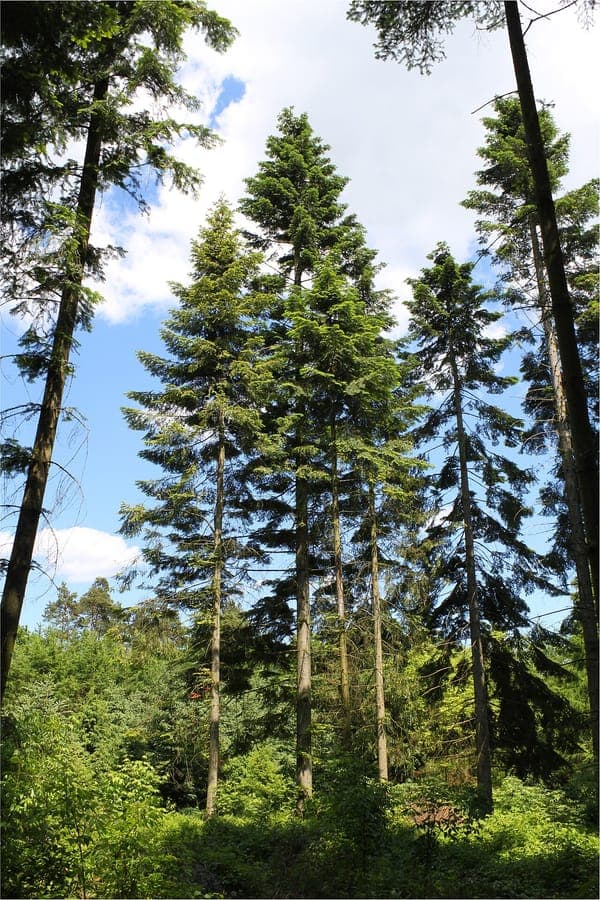
Crusier / CC BY-SA 3.0, via Wikimedia Commons
Giant fir: complete guide
Abies grandis
Want to see Giant fir: complete guide in your garden?
1 minute, no credit card
Overview
The Giant fir, Abies grandis, is one of the most impressive conifers on the planet. Native to the coastal and interior regions of the Pacific Northwest - from southern British Columbia through Washington and Oregon to northern California, and inland through Idaho and Montana - this magnificent tree routinely reaches heights of 40 to 75 metres in its native forests, making it one of the tallest fir species in existence. What sets the Giant fir apart, beyond its staggering dimensions, is its exceptional growth rate. As the fastest-growing true fir, it can add 60 to 100 centimetres of height per year under favourable conditions, a pace that outstrips even many pines and spruces. Perhaps its most delightful surprise is the fresh citrus fragrance released when the needles are crushed between your fingers - a bright, tangerine-like scent that is unmistakable and enchanting. This is emphatically a tree for large gardens, estates, parks, and rural landscapes where it has room to achieve its full potential. Plan ahead and remember that a twenty-year-old specimen will already stand 15 to 25 metres tall. Explore how a Giant fir can serve as the centrepiece of your landscape design at gardenworld.app, where you can generate a complete planting plan scaled to your property.
Appearance & bloom cycle
In its youth, the Giant fir develops a narrow, spire-like pyramidal crown that broadens considerably with age. Mature open-grown specimens often display a majestic, wide-based canopy with branches sweeping nearly to the ground, creating a living cathedral of green. The needles are among the most distinctive of any fir: flat, glossy bright green above with two prominent white stomatal bands beneath, measuring 2.5 to 5 centimetres in length. They are arranged in two distinct, comb-like rows along the twig, giving the branches an elegant, feathered appearance. This flat, horizontal needle arrangement immediately distinguishes the Giant fir from most other fir species and contributes to the tree's lush, layered look.
The female cones appear on the upper portion of the tree and stand upright on the branches, a hallmark shared by all true firs. They measure 6 to 12 centimetres in length, beginning yellow-green and ripening to warm brown in autumn. As with all Abies species, the mature cone disintegrates on the branch, shedding its scales and releasing winged seeds while leaving behind a distinctive central spike. Male pollen structures emerge in spring along the undersides of branches as small, yellowish clusters. The bark of young trees is remarkably smooth, thin, and grey with conspicuous resin blisters that exude aromatic sap when punctured. Older trees develop a thicker, deeply furrowed, dark grey-brown bark that provides textural interest. The overall architecture of a mature Giant fir is breathtaking - a living monument that commands attention in every season.
Ideal location: sun, shade, or partial
One of the Giant fir's most notable characteristics is its outstanding shade tolerance during its juvenile years. Unlike many conifers that demand full sun from the start, Abies grandis can survive for years as an understorey tree in dense forest, then surge upward when a canopy gap provides more light. For optimal garden performance, however, full sun to partial shade is ideal. In cooler maritime climates - the British Isles, the Pacific Northwest, coastal Scandinavia - full sun encourages the fastest and most vigorous growth. In warmer continental zones, light afternoon shade during the hottest months helps prevent needle scorch.
Space is the single most important consideration when siting a Giant fir. A mature specimen can develop a crown spread of 8 to 12 metres, and the root system extends well beyond. Plant this tree at least 10 metres from buildings, utilities, and hard surfaces. Consider that in 20 to 30 years, the tree may already stand 15 to 25 metres tall. The Giant fir prefers sheltered locations with good air circulation; avoid fully exposed, windswept hilltops where the tall trunk can be vulnerable to wind snap. In the southern hemisphere - New Zealand, southern Australia, Chile - this species performs well in cooler, higher-rainfall regions that mimic its native Pacific Northwest conditions.
Soil & underground requirements
The Giant fir is considerably more flexible in its soil requirements than many other fir species. While it shows a mild preference for acidic to neutral soils with a pH between 5.0 and 7.0, it tolerates mildly alkaline conditions as well. This adaptability makes it suitable for a wider range of garden soils than species like the Fraser fir or Balsam fir. The tree thrives in deep, fertile, loamy soil with good moisture retention but also tolerates sandy soils provided sufficient organic matter has been incorporated.
Good drainage remains important, though the Giant fir is less sensitive to brief periods of waterlogging than many firs. In its native range, it frequently grows in alluvial valley bottoms along rivers where the water table can be seasonally high. Nevertheless, prolonged stagnation is undesirable and can lead to root decline. A mulch layer of 10 to 15 centimetres of composted wood chips or leaf mould around the base helps improve soil structure, retain moisture, and keep the root zone cool during hot spells. The Giant fir develops a deep and extensive root system that anchors the tree securely and provides reasonable wind resistance, though extreme storms can damage the crown of tall specimens.
Watering: when and how much
Newly planted Giant firs need regular watering during their first two growing seasons to establish a robust root system. Provide 25 to 40 litres of water per week, adjusting for soil type and weather conditions. The tree benefits from deep watering: apply water slowly through drip irrigation or a soaker hose to ensure penetration into the lower soil layers, encouraging roots to grow downward rather than clustering near the surface.
Once established, the Giant fir is remarkably drought-tolerant for a fir species, thanks to its deep root system. In maritime climates with reliable year-round rainfall, supplemental irrigation is rarely needed after the establishment phase. In drier continental regions or during exceptional drought summers, deep watering every two to three weeks is beneficial. Watch for early signs of drought stress: premature shedding of older needles, yellowing of inner foliage, and reduced terminal growth. Morning watering is most effective, allowing any wet foliage to dry before evening and minimising the risk of fungal infections. The Giant fir is more forgiving of occasional overwatering than most firs, but persistent waterlogging will still cause root decline over time.
Free design
Want to see Giant fir: complete guide in your garden? Make a free design now.
Pruning: when and how
Under normal circumstances, the Giant fir requires little to no pruning. The tree develops a naturally harmonious pyramidal form that broadens gracefully with age. Pruning is largely limited to the removal of dead, damaged, or diseased branches, which can be done at any time of year. Always use sharp, clean tools and sterilise between cuts when working with diseased material.
If the tree threatens to outgrow its allocated space, it is important to understand that drastic size reduction is not an option. The Giant fir does not regenerate growth from old, needleless wood. Removing the terminal leader will slow height growth but also fundamentally alters the tree's natural form. For growth management, focus on shortening the new growth candles annually in late spring by one-third to one-half. This promotes denser, more compact growth and slows the rapid height development. Be realistic, however: any attempt to keep a Giant fir small is a battle you will eventually lose. If space is limited, choose a more compact species from the outset. For lower branch removal to create clearance beneath the canopy, prune in late winter before spring growth begins, cutting just outside the branch collar.
Maintenance calendar
The Giant fir is a low-maintenance tree, befitting a species that grows to enormous size in nature without human intervention. In early spring (March to April), inspect the tree for winter damage, remove any broken branches, and apply a moderate dose of slow-release conifer fertiliser. This is also the time to refresh the mulch layer if it has decomposed over winter. The Giant fir is not a heavy feeder, so avoid excessive fertilisation which can promote soft, vulnerable growth.
During late spring and early summer (May to June), perform candle pruning if growth restraint is desired. Monitor for pests, though the Giant fir is relatively resistant to insect attack. The balsam woolly adelgid (Adelges piceae) can occasionally occur, appearing as white cottony masses on the bark. Fir engraver beetles may target stressed trees. In summer (July to August), maintain watering during prolonged dry spells in drier climates. Watch for fir broom rust (Melampsorella caryophyllacearum), a fungal disease that causes witches' broom deformations. In autumn (September to October), apply fresh mulch, assess the tree's structural stability before storm season, and plant new specimens while the soil retains warmth. Through winter (November to February), established trees need no protection; young trees in exposed locations may benefit from a burlap windscreen.
Winter hardiness & protection
The Giant fir is hardy to approximately -25°C, thriving in USDA zones 6 through 8. This makes it well-suited to most temperate regions worldwide, from the British Isles and western Europe to the Pacific Northwest, New Zealand, and the cooler parts of Australia. Unlike more cold-sensitive firs, the Giant fir also demonstrates good heat tolerance relative to other Abies species, coping with warm lowland summers better than the Fraser fir or Balsam fir.
Young trees in their first winter may benefit from light protection against desiccating east winds. A burlap windscreen on the windward side prevents needle drying when roots in frozen ground cannot yet supply sufficient water. After the second year, winter protection is unnecessary for this robust species. A greater concern is wind vulnerability: due to its rapid height development, a Giant fir in an exposed location can be susceptible to crown breakage or stem snap during severe storms. A somewhat sheltered position with surrounding vegetation that breaks wind force is strongly recommended. If your property experiences regular high winds, consider a more wind-resistant species, or plant the Giant fir within a mixed woodland planting where mutual shelter reduces risk.
Companion plants & combinations
The Giant fir functions best as a background specimen or focal point in larger gardens, parks, and estates where its scale can be appreciated. As a backdrop, it creates an evergreen screen against which deciduous and flowering plants shine beautifully. Rhododendrons, hydrangeas, and Japanese maples (Acer palmatum) benefit from the dappled shade and sheltered microclimate the fir creates as it matures. Beneath the canopy, shade-loving ground covers such as ivy (Hedera helix), barrenwort (Epimedium), and pachysandra thrive.
For a naturalistic woodland edge, combine the Giant fir with native broadleaf trees - beeches, oaks, birches - supplemented with a shrub layer of honeysuckle (Lonicera), viburnum, and hazel (Corylus avellana). Ferns, including the soft shield fern (Polystichum setiferum) and hart's tongue fern (Asplenium scolopendrium), create a lush understorey. In very large landscapes, a group of three to five Giant firs planted at naturalistic spacing creates a truly awe-inspiring grove within a generation. Ornamental grasses like Miscanthus and Calamagrostis work well in the transition zone between the fir planting and open lawn or meadow areas. Avoid planting small, slow-growing specimens directly adjacent to the trunk - the Giant fir's vigorous growth and dense root system will quickly overwhelm them.
Closing paragraph
The Giant fir is a tree for gardeners with vision and space to spare. With its extraordinary growth rate, citrus-scented needles, and commanding presence, Abies grandis makes a landscape statement that endures for generations. In temperate maritime climates, this Pacific Northwest native feels surprisingly at home, provided you give it the room it demands. Choose a sheltered site with deep, fertile soil, water young specimens generously, and then step back and let nature take its course. Within a decade, you will have a tree that not only impresses visually but contributes shade, wind shelter, and biodiversity to your garden ecosystem. From the bright green feathered branches of summer to the snow-laden boughs of winter, the Giant fir is living architecture at its finest. Visit gardenworld.app to explore how a Giant fir can anchor your next landscape project, with professionally designed planting plans matched to your climate, space, and ambitions.
Want to see Giant fir: complete guide in your garden? Make a free design now.
Upload a photo, pick a style, and get a photorealistic design with plant list in under a minute.
No credit card required


Similar plants
Abies delavayi: complete guide
Abies delavayi
Delavayi fir is an elegant, medium-sized coniferous tree from the Pinaceae family with dark green needles. This Asian evergreen is perfect for alpine gardens and large landscapes.
Taiwan fir: complete guide
Abies kawakamii
Discover the magnificent Taiwan fir, a rare evergreen conifer from Taiwan's mountain regions. Learn growth requirements, care tips, and why this beautiful tree is perfect for collectors of unique garden specimens.
Farges fir: complete guide
Abies fargesii
Discover the majestic Farges fir, an impressive conifer from China's mountains with elegant foliage and columnar form. Ideal for large gardens.