
James St. John / CC BY 2.0, via Wikimedia Commons
Fraser fir: complete guide
Abies fraseri
Want to see Fraser fir: complete guide in your garden?
1 minute, no credit card
Overview
The Fraser fir, Abies fraseri, is a compact and graceful conifer native to the high-elevation ridges of the southern Appalachian Mountains in the southeastern United States. Found naturally only in a handful of mountain peaks across Virginia, North Carolina, and Tennessee, this tree has become the single most popular Christmas tree species in North America, prized for its exceptional needle retention, pleasant fragrance, and perfectly symmetrical pyramidal shape. Beyond its holiday fame, the Fraser fir makes an outstanding ornamental garden tree that brings year-round structure and elegance to residential landscapes. Reaching a mature height of 10 to 15 metres, it remains significantly more compact than many other fir species, making it suitable for medium-sized gardens where vertical impact is desired without overwhelming the space. Whether you garden in the cool maritime climates of the British Isles, the temperate regions of the Pacific Northwest, or the varied zones of continental Europe, the Fraser fir can thrive when given the right conditions. Explore how a Fraser fir might anchor your garden design at gardenworld.app, where you can generate a complete planting plan tailored to your space.
Appearance & bloom cycle
The Fraser fir is immediately recognisable by its dense, conical silhouette that maintains its shape throughout the tree's life without any corrective pruning. The needles measure 1.5 to 2.5 centimetres in length and are arranged spirally around the twig, curving slightly upward to expose their silvery-white undersides. This bicoloured effect - dark glossy green above and bright silver beneath - gives the tree a shimmering quality when breezes stir the branches, particularly striking when viewed against a winter sky.
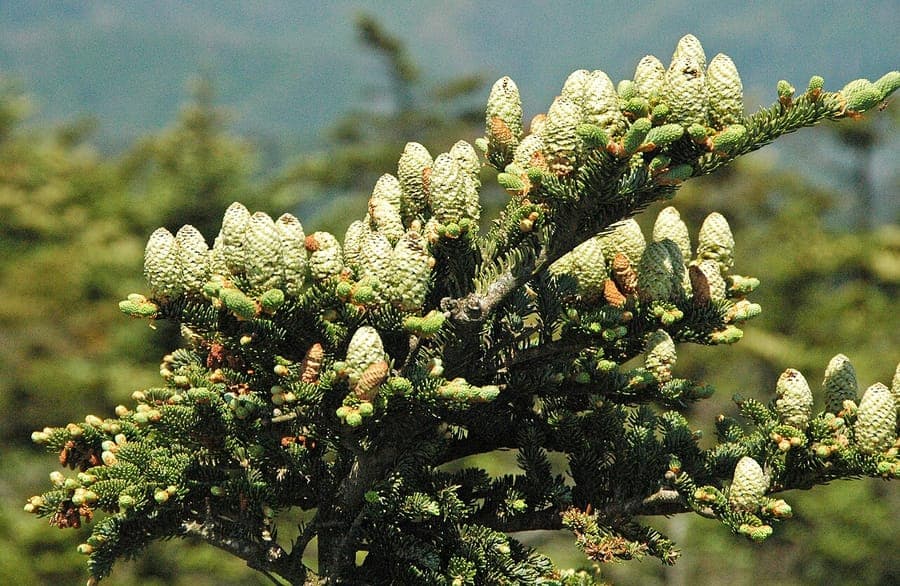
The bark on young trees is smooth, thin, and grey with prominent resin blisters that release a fragrant balsam when broken. As the tree matures, the bark becomes more scaly and furrowed. The cones are one of the Fraser fir's most ornamental features: they emerge deep purple-blue in early summer, standing upright on the uppermost branches like small sentinels. At maturity they reach 5 to 7 centimetres in length and transition to a warm brown before disintegrating on the branch, releasing winged seeds and leaving behind a distinctive central spike. Male pollen cones appear in spring along the lower branches, small and reddish-yellow, and are generally inconspicuous. The overall effect is a tree of refined elegance that looks superb as a specimen, in a mixed border backing, or as part of a conifer collection.
Ideal location: sun, shade, or partial
Fraser firs perform best in full sun to light partial shade. In cooler climates - USDA zones 4 to 6 - full sun is ideal and encourages the densest growth. In warmer areas approaching the upper limits of its range (zone 7), some afternoon shade during the hottest months helps prevent heat stress and needle scorch. This mountain species is accustomed to cool temperatures, high humidity, and frequent cloud cover, so replicating those conditions as closely as possible leads to the healthiest specimens.
Allow a mature spread of 4 to 6 metres in diameter when choosing a planting site. Avoid locations with reflected heat from walls or pavement, as the Fraser fir is less tolerant of heat accumulation than lowland species. Good air circulation is important for disease prevention, so avoid planting in enclosed, stagnant corners. Exposed hilltops with strong prevailing winds can cause desiccation, so a moderately sheltered site strikes the best balance. In southern hemisphere gardens - Australia, New Zealand, South Africa - this species struggles in warm lowland areas but can succeed in cooler highland regions with reliable rainfall.
Soil & underground requirements
The Fraser fir demands acidic, well-drained soil with a pH between 4.5 and 6.0. This is non-negotiable: alkaline or neutral soils will cause chlorosis, stunted growth, and eventual decline. If your native soil is alkaline, you can amend the planting area with sulphur, composted pine bark, and acid peat, but maintaining the acidity long-term requires ongoing effort. A raised bed filled with acidic growing medium can be a practical solution in chalky areas.
Drainage is the other critical factor. In its native habitat, the Fraser fir grows on steep, rocky slopes where water moves through the root zone quickly. Waterlogged soils invite Phytophthora root rot, which is the single greatest threat to cultivated Fraser firs worldwide. Incorporate coarse sand, perlite, or fine gravel into heavy clay soils to improve percolation. A mulch layer of 8 to 12 centimetres of composted pine needles or conifer bark chips helps maintain soil acidity, conserves moisture during dry spells, and keeps roots cool. Avoid piling mulch directly against the trunk, leaving a gap of 10 centimetres to prevent bark decay.
Watering: when and how much
Newly planted Fraser firs need consistent moisture during their first two growing seasons while the root system establishes. Provide approximately 20 to 30 litres of water per week, applied slowly at the base of the tree through drip irrigation or a soaker hose to ensure deep penetration. Once established, the tree is moderately drought-tolerant but performs best when the soil remains evenly moist without becoming saturated.
During extended dry periods in summer, supplemental watering every 10 to 14 days is beneficial. Watch for early signs of drought stress: a dulling of the needle colour, premature needle drop from inner branches, and a general lack of vigour. Morning watering is preferable, allowing any wet foliage to dry before evening and reducing the risk of fungal infections. In winter, irrigation is rarely necessary unless you experience a prolonged dry frost period with no precipitation. The cardinal rule with Fraser firs is to err on the side of slightly dry rather than too wet - soggy roots will kill this tree faster than drought.
Free design
Want to see Fraser fir: complete guide in your garden? Make a free design now.
Pruning: when and how
One of the Fraser fir's greatest advantages is its naturally symmetrical growth habit, which requires minimal corrective pruning. If you wish to increase density or control size, the best time to prune is in late spring when the new growth candles have extended to about half their final length. Shorten these candles by one-third to one-half using sharp hand pruners or hedge shears for a uniform finish. This technique stimulates lateral bud development and produces a thicker, more compact canopy.
Remove dead, damaged, or diseased branches at any time of year, making cuts just outside the branch collar to promote proper healing. Never cut back into old, bare wood - Fraser firs, like most true firs, will not regenerate growth from brown, needleless branches. If you need to limit the tree's ultimate height, you can remove the terminal leader and train a lateral branch upward as a replacement using a bamboo stake and soft ties. Sterilise all pruning tools with rubbing alcohol between cuts, especially when working with diseased material, to prevent spreading pathogens.
Maintenance calendar
A seasonal approach to Fraser fir care keeps the tree healthy and vigorous year after year. In early spring (March to April), inspect the tree for winter damage, remove any broken branches, and apply a slow-release acidifying fertiliser formulated for conifers or ericaceous plants. This is also the time to refresh the mulch layer if it has decomposed over winter.
During late spring and early summer (May to June), monitor new growth and perform candle pruning if a denser habit is desired. Watch for the balsam woolly adelgid (Adelges piceae), the Fraser fir's most serious pest. These tiny insects appear as white, cottony masses on the bark and can weaken or kill trees if left unchecked. Treat early infestations with horticultural oil or insecticidal soap. In summer (July to August), maintain consistent watering during dry spells and inspect for spider mites, which thrive in hot, dry conditions. Autumn (September to October) is the time to apply fresh mulch, check drainage channels before the wet season, and plant new specimens while the soil is still warm. Through winter (November to February), protect young trees from desiccating winds with burlap screens if necessary, and avoid placing them near roads where de-icing salt spray can damage foliage.
Winter hardiness & protection
The Fraser fir is exceptionally cold-hardy, tolerating temperatures down to -35°C and thriving across USDA zones 4 through 7. Cold is never a concern for this mountain species; heat is the real challenge. In regions where summer temperatures regularly exceed 30°C, the Fraser fir may show signs of stress including needle browning, reduced growth, and increased susceptibility to root rot. In such climates, site selection becomes paramount: choose the coolest, most shaded afternoon position available, and ensure excellent drainage and mulching to keep root temperatures down.
Young trees in their first two winters benefit from a burlap windscreen on the prevailing wind side, especially in exposed locations. This prevents winter desiccation, which occurs when cold, dry winds pull moisture from the needles faster than frozen roots can replace it. Established trees rarely need winter protection. Be mindful of road salt: the Fraser fir has poor salt tolerance, and branches exposed to salt spray will develop brown, scorched needles. If your tree is near a salted road or path, consider erecting a temporary barrier during the salting season.
Companion plants & combinations
The Fraser fir pairs beautifully with other acid-loving plants that share its preference for well-drained, humus-rich soil. Rhododendrons and azaleas are classic companions, their vibrant spring blooms creating a striking contrast against the dark evergreen backdrop. Japanese pieris (Pieris japonica) offers cascading clusters of white or pink flowers in early spring, along with attractive red-tinged new growth that complements the fir's silver-green palette.
At ground level, heathers (Erica and Calluna) provide year-round ground cover with seasonal flower colour, while ferns such as the ostrich fern (Matteuccia struthiopteris) add textural softness. For a woodland garden feel, combine the Fraser fir with hostas, bleeding hearts (Dicentra spectabilis), and native woodland wildflowers. Ornamental grasses like Japanese forest grass (Hakonechloa macra) offer a flowing, luminous contrast to the rigid conifer silhouette. Blueberry bushes (Vaccinium) thrive in the same acidic conditions and add autumn leaf colour plus edible fruit. In larger landscapes, grouping Fraser firs with other conifers of contrasting form - columnar junipers, spreading yews, or weeping spruces - creates a compelling evergreen tapestry.
Closing paragraph
The Fraser fir transcends its fame as a holiday tree to become a genuinely valuable garden conifer that rewards thoughtful placement with decades of structural beauty. Its compact form, bicoloured needles, and minimal pruning requirements make it an accessible choice for gardeners at every experience level. Prioritise acidic, well-drained soil, protect against root rot, and provide supplemental water during dry spells - these three fundamentals will carry your Fraser fir through the seasons in excellent health. From the purple-blue cones of summer to the snow-dusted boughs of winter, this Appalachian native brings quiet elegance to every garden it graces. Visit gardenworld.app to discover how a Fraser fir can anchor your next garden design and explore professionally curated planting plans matched to your climate and space.
Want to see Fraser fir: complete guide in your garden? Make a free design now.
Upload a photo, pick a style, and get a photorealistic design with plant list in under a minute.
No credit card required


Similar plants
Abies delavayi: complete guide
Abies delavayi
Delavayi fir is an elegant, medium-sized coniferous tree from the Pinaceae family with dark green needles. This Asian evergreen is perfect for alpine gardens and large landscapes.
Taiwan fir: complete guide
Abies kawakamii
Discover the magnificent Taiwan fir, a rare evergreen conifer from Taiwan's mountain regions. Learn growth requirements, care tips, and why this beautiful tree is perfect for collectors of unique garden specimens.
Farges fir: complete guide
Abies fargesii
Discover the majestic Farges fir, an impressive conifer from China's mountains with elegant foliage and columnar form. Ideal for large gardens.