
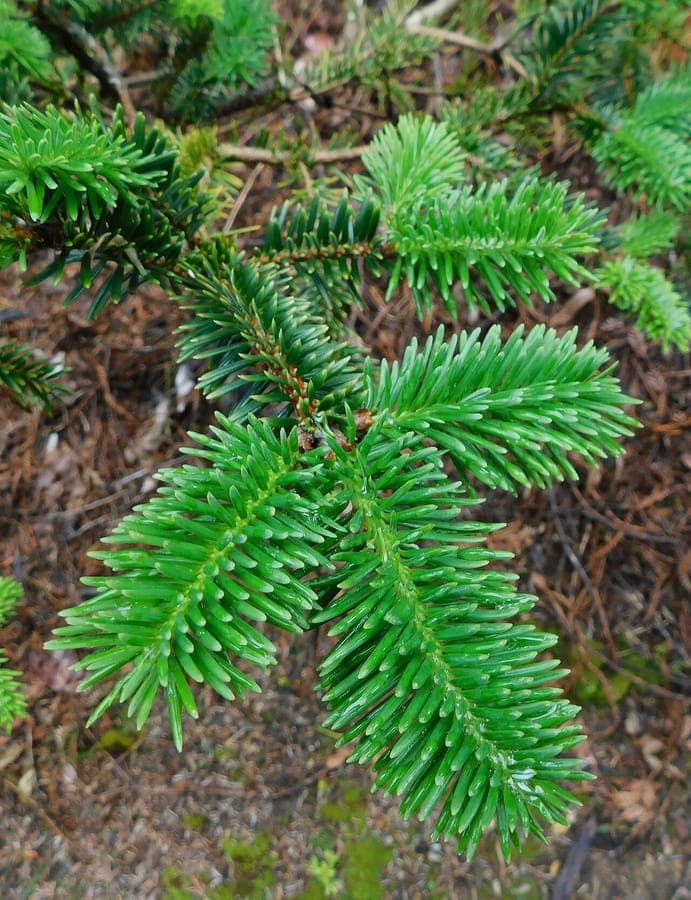
Ruff tuff cream puff / CC0, via Wikimedia Commons
Forrest Fir (Abies forrestii): complete guide
Abies forrestii
Want to see Forrest Fir (Abies forrestii): complete guide in your garden?
1 minute, no credit card
Overview
The Forrest Fir, known botanically as Abies forrestii, is a striking evergreen conifer native to the high mountain forests of Yunnan and Sichuan provinces in southwestern China. Named after the legendary Scottish plant hunter George Forrest, who discovered it during one of his many expeditions to the region in the early twentieth century, this tree has earned a devoted following among conifer enthusiasts worldwide. Growing to 20 to 30 metres in its native habitat, it is more compact than many silver firs, making it a realistic choice for medium to large gardens rather than only the grandest estates.
The crowning glory of this species, quite literally, is its cones. Standing upright on the upper branches like small candles, the cones of Abies forrestii are a deep, rich purple to violet-blue, a colour so striking that it stops visitors in their tracks during autumn. Combined with dark green needles that flash silver-white when the wind lifts them, the Forrest Fir delivers ornamental impact that few conifers can rival. At gardenworld.app you can create a garden design that showcases this extraordinary Chinese fir as the centrepiece it deserves to be.
Appearance & growth habit
Abies forrestii develops a regular, broadly conical crown that becomes slightly more rounded with age. The needles are flat, 1.5 to 3 centimetres long, glossy dark green on the upper surface and marked with two broad, conspicuously white to silvery stomatal bands on the underside. This silver undersurface is particularly decorative when the wind moves through the branches, creating a shimmering effect that catches the light. The needles are densely packed, arranged spirally around the twig but often spreading into two flat ranks.
The bark starts smooth and dark grey on young trees, becoming rough and cracked into irregular plates on older specimens. Growth rate is moderate, with annual increments of 20 to 40 centimetres under favourable conditions. Young trees may take a year or two to settle in after planting before growth accelerates.
The highlight of the year comes in September and October when the cones reach their full colour. Cylindrical in shape, 7 to 12 centimetres long, they are a deep purple to violet-blue that is unlike almost anything else in the conifer world. They stand proudly upright on the upper branches, creating a dramatic contrast with the dark foliage below. As with all true firs, the cone scales disintegrate at maturity while the slender central axis remains on the branch. Male flowers are inconspicuous, yellowish to reddish, appearing in spring on the undersides of the branches.
Location & positioning
In its natural habitat, the Forrest Fir grows at altitudes of 2,500 to 4,000 metres in the mountains of Yunnan and Sichuan. This means it is accustomed to cool, moist conditions with abundant rainfall and a degree of shelter from extremes. In gardens across the UK, temperate Australia, and North America, this translates to a preference for a semi-sheltered to sunny position with reasonable humidity.
In the UK, the Forrest Fir thrives in the wetter western regions, Scotland, Wales, the Lake District, and the southwest, where rainfall is higher and the air naturally more humid. Gardens in the drier southeast of England can still grow this tree successfully, but will need to pay closer attention to watering during summer droughts. A position that receives morning sun with some afternoon shade works well, or a spot sheltered by taller trees on the south or west side.
For North American growers, the Pacific Northwest offers the closest match to the tree's native conditions. It performs well from British Columbia south through Oregon and Washington, and in the cooler, moister areas of northern California. East of the Cascades and in the continental interior, the drier air and hotter summers make it a more challenging prospect. In the northeastern states, from New England through the mid-Atlantic, it can succeed in sheltered, well-watered garden settings.
Australian gardeners in Tasmania, the Victorian highlands, and the cooler parts of New South Wales will find the Forrest Fir a rewarding specimen. It struggles in the drier, hotter parts of the continent where humidity is consistently low. Plant at least 5 metres from buildings and boundaries to allow the crown to develop fully, with a mature spread of 6 to 10 metres.
Soil requirements
Abies forrestii prefers a humus-rich, well-drained, slightly acidic to neutral soil with a pH between 5.0 and 6.5. In its homeland it grows on volcanic mountain soils rich in organic matter with excellent drainage. Heavy clay soils need improvement with generous additions of coarse grit, perlite, and leaf mould or composted bark. Waterlogging is fatal to this mountain fir, which receives heavy rainfall in nature but always grows on slopes where water drains away rapidly.
Sandy soils common in coastal areas need enriching with organic matter to improve moisture retention. Work in plenty of well-rotted compost, aged manure, or leaf mould to a depth of at least 30 centimetres around the planting area. On alkaline soils, such as those found over chalk and limestone in southern England or parts of the Australian interior, add ericaceous compost or composted pine bark to lower the pH. The Forrest Fir will show signs of chlorosis, a yellowing of the needles, if grown in soil that is too alkaline.
When planting, dig a hole at least twice the width of the root ball and the same depth. Mix the excavated soil with a third by volume of leaf mould or composted bark. Set the tree at the same depth it sat in its nursery container, firm the soil gently, and water thoroughly. Mycorrhizal inoculant applied at planting time can give the root system a significant head start.
Watering
The Forrest Fir has a relatively high water requirement, which is understandable given its origins in the rain-drenched mountain forests of southwest China. During the first three to five years after planting, regular watering is essential. Give the tree 20 to 25 litres of water once a week during dry periods in spring and summer, delivered slowly at the base of the trunk so that moisture soaks deep into the root zone. A soaker hose or drip ring is the most efficient method.
Even once established, Abies forrestii remains more sensitive to drought than many other fir species. During hot, dry summers, which are becoming increasingly common across the UK, northern Europe, and southeastern Australia, supplementary watering of mature trees is advisable. The earliest sign of water stress is browning of the needle tips, followed by needle drop from the interior of the crown. If you notice these symptoms, increase watering immediately and check that the mulch layer is intact.
Mulching is essential for maintaining soil moisture. Apply a layer of 6 to 10 centimetres of bark chips, pine needles, or wood shavings around the root zone, keeping the mulch at least 10 centimetres from the trunk to prevent bark rot. In summer, a light misting of the crown during the evening can temporarily raise the humidity around the tree, bringing conditions closer to its natural mountain habitat. This practice is particularly beneficial in drier inland areas.
Free design
Want to see Forrest Fir (Abies forrestii): complete guide in your garden? Make a free design now.
Pruning
Like most silver firs, the Forrest Fir requires very little pruning. The tree naturally develops a balanced, symmetrical crown that seldom needs correction. Restrict pruning to the removal of dead, damaged, or crossing branches. Carry out pruning work in late autumn or winter when the tree is dormant and the risk of fungal infection is lowest.
Always use clean, sharp tools. Disinfect secateurs or saws with rubbing alcohol before and after use to prevent the spread of disease. Cut branches back to the branch collar and leave no stubs. Avoid damaging the leader, the central growing tip, as injury to this will result in multiple leaders developing and a less attractive silhouette.
If you wish to maintain a more compact form, you can shorten new season growth by a third in June. Do this sparingly, however, as the charm of the Forrest Fir lies in its natural, somewhat open growth habit that allows the spectacular purple cones to be seen and admired. Never remove more than a quarter of the living needle volume in any single year, as over-pruning weakens the tree and reduces its ability to produce the cones that make it so special.
Maintenance calendar
January and February are the months to inspect the tree for frost damage and any breakage caused by snow or ice. Remove damaged branches with clean cuts. In March, apply a fresh layer of compost around the base as an annual feed. Check that the mulch layer is still sufficiently deep and top up where necessary.
April is the time to gently rake the soil around the tree, taking care not to damage the shallow root system. In May, check for emerging shoots and any signs of adelgid infestation or woolly aphid. Look for small white woolly patches on the undersides of the needles. June is the window for shortening new growth if you want a more compact shape.
July and August demand extra attention to watering, especially during heatwaves. Check regularly that the soil is moist to depth. September and October bring the cone spectacle: enjoy the deep purple cones adorning the crown. This is also an excellent period for planting new specimens, as the soil is warm but evaporation rates are declining.
In November, carry out a final pruning check and remove any dead wood. December is a quiet month for the tree, but during heavy snowfalls it is wise to gently brush excess snow from the branches to prevent breakage.
Winter hardiness
Abies forrestii is hardy across USDA zones 6 to 8, tolerating minimum temperatures of approximately minus 23 to minus 12 degrees Celsius. Across the UK, this means it will grow comfortably throughout England, Wales, Scotland, and Ireland. In North America it performs well from the Pacific Northwest through the northern tier of states and into southern Canada.
What the Forrest Fir tolerates less well than some other firs is prolonged summer heat combined with low humidity. Its origins in cool, wet mountain forests make it more sensitive to hot, dry summers than species adapted to lower-elevation habitats. In years with extreme heatwaves, some needle discolouration may occur, but the tree typically recovers well the following autumn, provided it received adequate water during the stress period.
In Australian gardens, it is best suited to the cooler southern states and highland areas where summer temperatures are moderated and winter chill is sufficient. It will struggle in subtropical and tropical zones and in areas where summer humidity drops to consistently low levels.
Young trees benefit from trunk protection with hessian or a tree guard during their first winter to prevent frost cracks. A thick mulch layer of 10 to 15 centimetres over the root zone provides additional insulation. After the third growing season, these precautions are generally no longer required.
Companion planting
The Forrest Fir pairs beautifully with plants that share its preference for semi-shade, humus-rich soil, and consistent moisture. Ferns such as Dryopteris filix-mas and Asplenium scolopendrium form a natural understorey. Ground covers like Pachysandra, Waldsteinia, and moss create a woodland atmosphere that complements the tree's Chinese mountain origins.
Rhododendrons and azaleas are outstanding companions, sharing the same preference for acidic, humus-rich soil. Their colourful spring blooms provide a magnificent contrast with the dark needles above. For additional height variation, combine the Forrest Fir with smaller conifers such as Chamaecyparis obtusa or Tsuga canadensis, or with ornamental grasses like Carex oshimensis.
Spring bulbs such as bluebells, snowdrops, Anemone nemorosa, and winter aconite thrive in the dappled zone around the tree. They take advantage of the light available in early spring before the canopy is fully dense, and are finished flowering by the time shade deepens. Hostas and astilbes offer summer colour in the semi-shade. For year-round interest, Helleborus, Epimedium, and Cyclamen hederifolium are excellent choices for the area beneath and around the canopy.
In Australian gardens, native ferns such as Blechnum and shade-loving grasses like Lomandra can serve as companion plants, while in the UK, a carpet of Galium odoratum beneath the tree provides both fragrance and ground cover.
Final thoughts
The Forrest Fir is a tree for the connoisseur. Its spectacular purple cones, silver-flashing needles, and elegant growth form make it one of the most ornamental fir species you can plant in a temperate garden. It asks a little more of its gardener than some other conifers, particularly when it comes to moisture, but those who provide that care are rewarded with a tree of genuine distinction.
The story of this tree, entwined with the adventurous expeditions of George Forrest through the remote mountain valleys of Yunnan, gives it a narrative depth that adds another layer of interest to your garden. It is not merely a tree but a living tribute to one of the greatest plant hunters in history. Visit gardenworld.app to create a personalised garden design that gives this remarkable fir the setting it deserves, surrounded by plants that enhance its beauty and share its needs.
Want to see Forrest Fir (Abies forrestii): complete guide in your garden? Make a free design now.
Upload a photo, pick a style, and get a photorealistic design with plant list in under a minute.
No credit card required


Similar plants
Abies delavayi: complete guide
Abies delavayi
Delavayi fir is an elegant, medium-sized coniferous tree from the Pinaceae family with dark green needles. This Asian evergreen is perfect for alpine gardens and large landscapes.
Taiwan fir: complete guide
Abies kawakamii
Discover the magnificent Taiwan fir, a rare evergreen conifer from Taiwan's mountain regions. Learn growth requirements, care tips, and why this beautiful tree is perfect for collectors of unique garden specimens.
Farges fir: complete guide
Abies fargesii
Discover the majestic Farges fir, an impressive conifer from China's mountains with elegant foliage and columnar form. Ideal for large gardens.