
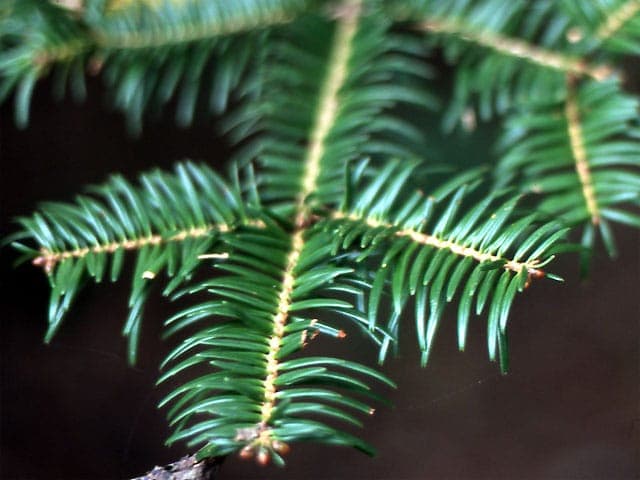
No machine-readable author provided. Inti-sol~commonswiki assumed (based on copyright claims). / CC BY-SA 3.0, via Wikimedia Commons
Japanese Fir (Abies firma): complete guide
Abies firma
Want to see Japanese Fir (Abies firma): complete guide in your garden?
1 minute, no credit card
Overview
The Japanese Fir, known botanically as Abies firma and often called the Momi Fir, is a stately evergreen conifer native to the mountain forests of central and southern Japan. Growing to heights of 30 to 50 metres in its homeland, it ranks among the tallest species in the Abies genus. What sets this fir apart from its relatives is a remarkable tolerance for heat and humidity, a trait that makes it far more adaptable than most firs to warm-summer climates. While many silver firs struggle once temperatures climb above 30 degrees Celsius, the Momi Fir continues to thrive, an adaptation forged over millennia in the lower-elevation forests of Honshu, Shikoku, and Kyushu.
For gardeners in the UK, coastal Australia, the Pacific Northwest of North America, or the milder parts of continental Europe, the Japanese Fir offers a rare combination of grandeur and resilience. At gardenworld.app you can create a garden design that accounts for the mature size and particular needs of specimen trees like the Abies firma, helping you plan a landscape that looks stunning decades from now.
Appearance & growth habit
The most immediately distinctive feature of Abies firma is its needles. Unlike the soft, pliable foliage of most firs, the Momi Fir produces stiff, almost leathery needles that are hard to the touch, ending in a notched or sometimes slightly pointed tip. Each needle is 2 to 3.5 centimetres long, dark glossy green on the upper surface and marked with two pale greyish-white stomatal bands underneath. They are arranged in two flat ranks along the branches, creating a full, layered appearance that gives the tree excellent density even in youth.
The crown starts narrowly conical in young trees and gradually broadens with age into a more rounded, spreading shape. Mature specimens in open settings can develop a crown width of 8 to 12 metres. The bark progresses from smooth pale grey on young trees to a thick, deeply furrowed greyish-brown on older trunks, adding textural interest in winter when deciduous neighbours are bare.
The cones are a feature worth watching for. They stand upright on the upper branches, cylindrical in shape, 8 to 15 centimetres long, starting yellowish-green and maturing to brown. As with all true firs, the cone scales disintegrate at maturity while the central axis remains on the branch, a characteristic that distinguishes Abies from Picea spruces. Growth rate is moderate, typically 30 to 50 centimetres per year under favourable conditions, though newly planted trees may take a year or two to establish before putting on significant height.
Location & positioning
Selecting the right site is the single most important decision you will make for your Japanese Fir. The tree needs space, both above and around it, to develop its natural form. Plant it at least 6 metres from buildings, boundary fences, and other large trees. In a garden setting it works best as a specimen tree on a lawn, at the edge of a woodland garden, or as a backdrop to a large mixed border.
Full sun is the preferred aspect, though the Momi Fir tolerates partial shade, particularly in warmer climates such as southern Australia or the Mediterranean coast where afternoon shade can actually benefit the tree during summer. In the UK, a south- or west-facing position with shelter from cold northerly and easterly winds will give the best results. Gardeners in Melbourne, Sydney, or Adelaide should consider positions that receive morning sun but are shaded from the harshest afternoon heat during peak summer.
For North American growers, the Japanese Fir performs well across USDA zones 6 to 9. It thrives in the Pacific Northwest, the mid-Atlantic states, and the upper South. In areas with hot, humid summers such as Georgia or the Carolinas, it outperforms almost every other fir species. In cooler mountain areas of British Columbia or the Scottish Highlands, it will grow well but may not develop quite as quickly as in milder locations.
Shelter from strong, persistent winds is important in the first few years after planting. A temporary windbreak of hessian or mesh can protect young trees while they establish a root system capable of anchoring them against gusts.
Soil requirements
Abies firma prefers a well-drained, slightly acidic to neutral soil with a pH between 5.5 and 7.0. Heavy clay soils need to be improved with generous additions of coarse grit and organic matter such as composted bark or leaf mould. Waterlogging is the single greatest threat to this tree, as saturated roots quickly succumb to fungal rot.
Sandy soils, common in coastal areas of the UK, the Netherlands, and parts of Australia, will need enriching with organic matter to improve moisture retention. Work in plenty of well-rotted compost or aged manure to a depth of at least 30 centimetres around the planting area.
When planting, dig a hole at least twice the width of the root ball and the same depth. Mix the excavated soil with a third by volume of compost or leaf mould. Set the tree at the same level it sat in its nursery pot, firm the soil gently, and water thoroughly. A light application of mycorrhizal fungi at planting can help the root system establish more quickly, a trick used by many professional arborists for conifers.
Watering
During the first three to five years after planting, regular watering is essential for the Japanese Fir. Give the tree 15 to 20 litres of water once a week during dry spells in spring and summer. Water slowly at the base of the trunk, allowing the moisture to soak deep into the root zone rather than running off across the surface. A soaker hose or drip irrigation ring placed around the tree is an efficient method that delivers water where it is most needed.
Once established, Abies firma is moderately drought-tolerant compared to other firs, thanks to its adaptation to the warmer, drier low-altitude forests of Japan. Nevertheless, extended drought combined with high temperatures will stress even a mature specimen. The earliest sign of water stress is a slight drooping of the youngest needles at the branch tips, followed by a dulling of the needle colour from glossy green to a muted grey-green.
Mulching is your greatest ally in managing soil moisture. Apply a layer of 5 to 8 centimetres of bark chips, wood shavings, or pine needles around the root zone, keeping the mulch at least 10 centimetres away from the trunk to prevent bark rot. This layer insulates the soil, reduces evaporation, and suppresses competing weeds. In Australian gardens where summer heat can be extreme, a thicker mulch layer of up to 10 centimetres provides extra insulation.
Free design
Want to see Japanese Fir (Abies firma): complete guide in your garden? Make a free design now.
Pruning
One of the great advantages of the Japanese Fir is that it requires very little pruning. The tree naturally forms a balanced, symmetrical crown. Restrict pruning to the removal of dead, damaged, or diseased branches, carrying out this work in late autumn or winter when the tree is dormant. Always use clean, sharp tools to make smooth cuts, reducing the risk of tearing the bark.
If you want to encourage denser growth, you can shorten the new season's growth candles by half in June. This technique works well for trees in more formal settings but does alter the natural open habit that many gardeners find so appealing. Never remove more than a third of the living crown in any single year, as severe pruning can seriously weaken the tree and leave it vulnerable to disease.
Lower branches that sweep the ground can be removed if you wish to raise the canopy for practical reasons, such as mowing beneath the tree or underplanting with shade-loving perennials. Cut branches back to the branch collar, the slight swelling where the branch meets the trunk, and avoid leaving stubs.
Maintenance calendar
January and February are the months to inspect the tree for frost damage and snow breakage. Remove any broken branches cleanly. In March, apply a 3 to 5 centimetre layer of compost around the root zone as both a feed and a mulch top-up. April is the time to lightly rake the soil around the tree and clear away any accumulated debris.
May and June are the window for candle pruning if you wish to control the shape. This is also the period to monitor for pests such as adelgids or spider mites. Look for tiny white woolly patches on the undersides of needles or fine webbing between branch tips. July and August demand attention to watering during dry spells, and a midseason check that the mulch layer is still intact.
September and October are excellent months for planting new specimens, as the soil is still warm but evaporation rates are dropping. In November, carry out any structural pruning of dead or damaged wood before winter sets in. December is a quiet month for the tree, but if heavy snow falls, gently brush it from the branches to prevent breakage.
Winter hardiness
Abies firma is hardy across USDA zones 6 to 9, tolerating temperatures down to approximately minus 23 degrees Celsius. In the UK, this means it will grow comfortably throughout England, Wales, lowland Scotland, and all of Ireland. Gardeners in colder highland or inland areas may see occasional needle scorch after particularly severe cold snaps, but the tree will recover once spring arrives.
In Australia, the Japanese Fir performs best in the cooler southern states: Victoria, Tasmania, the Australian Capital Territory, and the higher-elevation areas of New South Wales and South Australia. It will struggle in tropical and subtropical zones where winter chill is insufficient.
What makes this tree especially valuable for future-proofing your garden is its superior heat tolerance. As summers grow warmer across the Northern Hemisphere and southern Australia, many traditional fir species are declining. The Momi Fir, evolved in the warm, humid forests of lowland Japan, is far better equipped to handle rising temperatures while still providing the classic fir silhouette that so many gardeners love.
Young trees benefit from a wrap of hessian or tree guard around the trunk during their first winter to prevent frost cracks. A thick layer of mulch over the root zone provides additional insulation. After the second or third growing season, these precautions are no longer necessary.
Companion planting
The Japanese Fir pairs beautifully with shade-tolerant underplanting. Ferns such as Dryopteris and Polystichum, along with ground covers like Pachysandra terminalis and Vinca minor, thrive in the dappled, slightly acidic conditions beneath the canopy. Rhododendrons and azaleas are natural companions, sharing a preference for acidic soil and providing vibrant spring colour against the dark green needles.
For a Japanese-inspired design, combine the Abies firma with Japanese maples (Acer palmatum), ornamental grasses such as Hakonechloa macra, and moss ground cover. Larger shrubs like Pieris japonica, Camellia japonica, and Skimmia complement the fir both aesthetically and culturally.
Spring bulbs such as bluebells, snowdrops, and crocuses work wonderfully at a moderate distance from the trunk, taking advantage of the light that reaches the ground before the canopy thickens. In Australian gardens, native shade-lovers like Blechnum ferns or Liriope muscari can serve as underplanting. UK gardeners might consider Helleborus, Epimedium, or Cyclamen hederifolium for year-round interest beneath the canopy.
Final thoughts
The Japanese Fir is a tree that rewards patience and planning. Its moderate growth rate means you will not see instant results, but over the years it builds into a specimen of genuine presence, a tree that anchors a garden and provides year-round structure. Its unusual heat tolerance makes it one of the most climate-resilient firs available, a quality that will only become more valuable as weather patterns continue to shift.
Whether you garden on a sweeping country estate in the English Midlands, a suburban block in Melbourne, or a sheltered plot in the Pacific Northwest, the Abies firma deserves a place on your shortlist of specimen conifers. Visit gardenworld.app to create a personalised garden design that places this magnificent Japanese fir at the heart of your landscape, ensuring every plant around it is chosen to complement its character and needs.
Want to see Japanese Fir (Abies firma): complete guide in your garden? Make a free design now.
Upload a photo, pick a style, and get a photorealistic design with plant list in under a minute.
No credit card required


Similar plants
Abies delavayi: complete guide
Abies delavayi
Delavayi fir is an elegant, medium-sized coniferous tree from the Pinaceae family with dark green needles. This Asian evergreen is perfect for alpine gardens and large landscapes.
Taiwan fir: complete guide
Abies kawakamii
Discover the magnificent Taiwan fir, a rare evergreen conifer from Taiwan's mountain regions. Learn growth requirements, care tips, and why this beautiful tree is perfect for collectors of unique garden specimens.
Farges fir: complete guide
Abies fargesii
Discover the majestic Farges fir, an impressive conifer from China's mountains with elegant foliage and columnar form. Ideal for large gardens.