
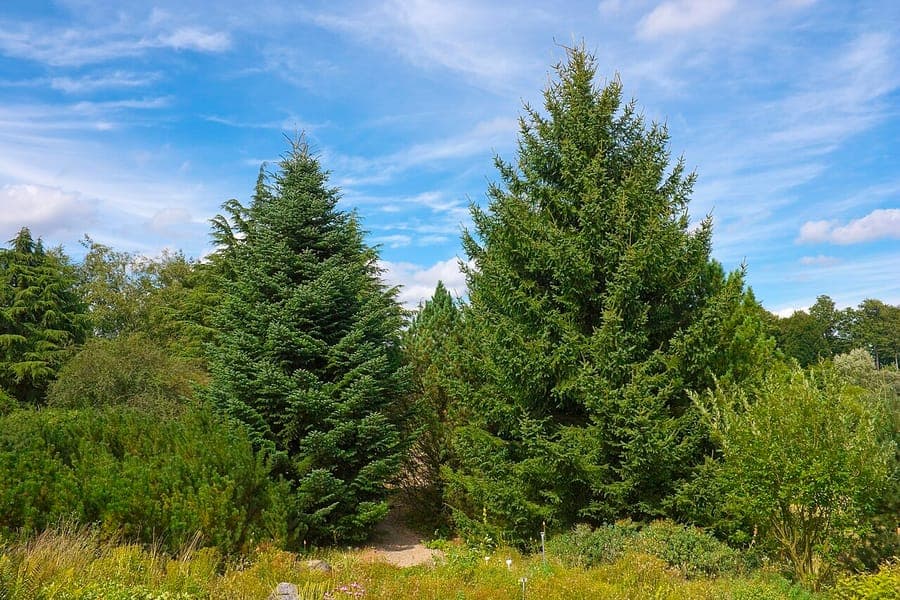
Willow / CC BY 2.5, via Wikimedia Commons
Grecian Fir: complete guide
Abies cephalonica
Want to see Grecian Fir: complete guide in your garden?
1 minute, no credit card
Overview
The Grecian Fir, botanically known as Abies cephalonica, is an impressive conifer native to the mountainous regions of Greece. This majestic tree is renowned for its stately, pyramidal form and its glossy, dark green needles. It's an excellent choice for larger gardens and parks where it can reach its full potential. Abies cephalonica is an evergreen tree that offers structure and color year-round, even during the colder months, making it a valuable addition to any landscape seeking a robust, long-lived specimen.
Planning a garden with such imposing trees requires careful consideration. At gardenworld.app, you can create a garden design that perfectly accommodates the scale and needs of a Grecian Fir, ensuring it thrives and becomes a focal point in your landscape for decades to come.
Appearance & bloom cycle
The Grecian Fir can reach heights of 25 to 35 meters at maturity, with some specimens exceeding 40 meters. Its trunk can achieve a diameter of over 1 meter. The crown is typically conical to pyramidal, especially in younger trees, becoming broader and denser with age. Its needles are distinctive: stiff, pointed, 1.5 to 3.5 cm long, and glossy dark green on the upper surface, with two silvery bands of stomata on the underside. They are arranged spirally around the twigs, often pointing upwards.
The flowering of Abies cephalonica is relatively inconspicuous. The tree is monoecious, meaning both male and female cones appear on the same tree. The male 'flowers' are small, yellowish catkins that emerge in spring, typically in April or May, and produce pollen. They are small and clustered. The female cones are initially greenish, developing into cylindrical, upright cones measuring 10 to 18 cm long and 4 to 5 cm wide. These mature to a brown color in autumn (September-October) and then disintegrate on the branches, unlike pine cones which fall as a whole unit.
Ideal location: sun, shade, or partial
The Grecian Fir thrives best in a sunny location. A light requirement of 8 on a scale of 10 indicates that it needs a minimum of 6 hours of direct sunlight per day to grow properly and develop its characteristic dense crown. While young trees can tolerate some light shade, full sun is essential for optimal growth and overall health. Too much shade can lead to a looser growth habit, less dense foliage, and reduced resistance to diseases. Ensure the tree has ample space, not just in height but also in width, so it isn't overshadowed by other, faster-growing trees.
Soil & underground requirements
Regarding soil, Abies cephalonica is not overly demanding, but it prefers well-draining, moist but not waterlogged soil. The ideal pH range is between 6.5 and 7, meaning a slightly acidic to neutral soil is perfect. Heavy clay soils that retain water are less suitable, as this can lead to root rot. When planting, it's advisable to amend the soil with organic matter such as compost to improve its structure and promote drainage. Ensure a deep root zone; the roots of this tree can spread considerably and penetrate deeply, contributing to the tree's stability.
Watering: when and how much
Especially in the first few years after planting, regular watering is crucial for the establishment of the Grecian Fir. Ensure the soil remains consistently lightly moist, but avoid waterlogging. A good rule of thumb is to water deeply, encouraging the roots to grow deeper. This makes the tree more drought-resistant in the long run. Once the tree is well-established (after 3-5 years), it is reasonably drought-tolerant, particularly in its natural Mediterranean climate. However, during prolonged dry periods, especially in summer, supplementary watering is still recommended, particularly for younger specimens. Check soil moisture regularly by sticking a finger 5-10 cm deep into the soil; if it feels dry, it's time to water.
Free design
Want to see Grecian Fir: complete guide in your garden? Make a free design now.
Pruning: when and how
Abies cephalonica naturally develops a beautiful, pyramidal shape and generally requires little pruning. It is not a tree that responds well to heavy pruning, as this can often lead to the loss of the leader and disrupt its natural form. Pruning is usually limited to removing dead, damaged, or diseased branches. This is best done in late winter or early spring, before new growth begins. Avoid pruning in late summer or autumn, as this can make the tree vulnerable to frost damage. When pruning, always use sharp and clean tools to prevent diseases. Any double leaders can be removed to encourage a single strong central leader.
Maintenance calendar
- January-February (Winter): Check for frost damage. Gently remove heavy snow from branches to prevent breakage.
- March (Early Spring): Light pruning of dead or damaged branches. Apply a layer of mulch (10-15 cm thick) around the base of the tree to retain moisture and suppress weeds.
- April-May (Spring): Monitor for pests and diseases. Ensure young trees receive adequate water.
- June-August (Summer): Provide supplemental water during dry spells, especially for young trees. Observe for signs of heat or drought stress.
- September-October (Autumn): Check soil moisture. Give young trees a final deep watering before the first hard frosts.
- November-December (Late Autumn/Early Winter): No specific tasks unless extreme weather conditions are present. Protect young trees if necessary from harsh winds or late frosts.
Winter hardiness & protection
The Grecian Fir is a hardy tree, suitable for USDA zones 6 to 8. This means it can tolerate temperatures down to approximately -23°C, depending on the specific cultivar and local conditions. In the UK and similar climates, it is generally winter-hardy, but young specimens can benefit from some protection during severe frost periods, especially for the first few winters after planting. This can involve applying a layer of mulch around the trunk or, in extreme cold, wrapping the young tree with horticultural fleece. Good drainage is crucial for winter hardiness, as 'wet feet' in winter are often more damaging than the cold itself.
Companion plants & combinations
Due to its size and prominent presence, the Grecian Fir often serves as the centerpiece of a garden design. It pairs well with other evergreen conifers that offer contrasting texture or color, such as Blue Spruce (Picea pungens 'Glauca') or Japanese Cedar (Cryptomeria japonica). Deciduous trees with beautiful autumn foliage, like maples (Acer spp.) or oaks (Quercus spp.), can also create a striking contrast. At the base of the tree, shade-loving perennials or groundcovers can be planted, provided they can compete for water and nutrients, such as ferns, hostas, or periwinkle (Vinca minor).
Local garden centres throughout the UK often offer a selection of conifers and suitable companion plants. It's always wise to seek advice on specific growing conditions in your region.
Closing paragraph
The Grecian Fir is a tree of character and a magnificent addition to any larger garden or park. With the right care and attention, this majestic conifer will provide an impressive display for decades. It's an investment in the future of your garden, and the reward is a beautiful, evergreen structure that can be admired year-round. For further inspiration and assistance in integrating Abies cephalonica into your garden design, you can always visit gardenworld.app, where the possibilities are endless.
Want to see Grecian Fir: complete guide in your garden? Make a free design now.
Upload a photo, pick a style, and get a photorealistic design with plant list in under a minute.
No credit card required


Similar plants
Abies delavayi: complete guide
Abies delavayi
Delavayi fir is an elegant, medium-sized coniferous tree from the Pinaceae family with dark green needles. This Asian evergreen is perfect for alpine gardens and large landscapes.
Taiwan fir: complete guide
Abies kawakamii
Discover the magnificent Taiwan fir, a rare evergreen conifer from Taiwan's mountain regions. Learn growth requirements, care tips, and why this beautiful tree is perfect for collectors of unique garden specimens.
Farges fir: complete guide
Abies fargesii
Discover the majestic Farges fir, an impressive conifer from China's mountains with elegant foliage and columnar form. Ideal for large gardens.