
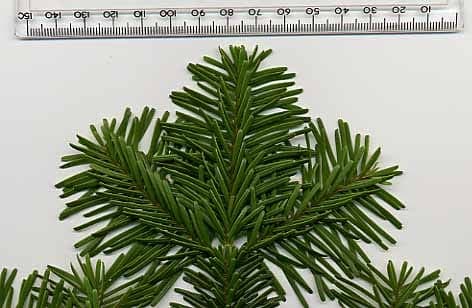
No machine-readable author provided. MPF assumed (based on copyright claims). / CC BY 2.5, via Wikimedia Commons
Cascade Fir: complete guide
Abies amabilis
Want to see Cascade Fir: complete guide in your garden?
1 minute, no credit card
Overview
The Cascade Fir, botanically known as Abies amabilis, is a majestic conifer native to the Pacific Northwest of North America. This tree, also sometimes referred to as the lovely fir, is an impressive sight with its dense, dark green needles and distinctive purplish-blue cones. It is a slow-growing, but ultimately very large tree that can occupy a prominent place in any spacious garden or park. Its robust nature and attractive appearance make it a favored choice for landscape architects and serious gardeners seeking a structural, evergreen addition. The Cascade Fir contributes to biodiversity by providing shelter and food for various animal species, and its presence enriches any ecologically conscious garden design. It's a tree that lasts for generations, growing more beautiful with age, a true investment in the future of your garden.
Before embarking on planting a Cascade Fir, it is advisable to consider the specific requirements of your garden. On gardenworld.app, you can create a garden design that perfectly matches the scale and growth habit of Abies amabilis. This ensures the tree has ample space to develop fully and integrates harmoniously into your outdoor area. A well-thought-out plan prevents long-term problems and maximizes the aesthetic potential of this beautiful fir.
Appearance & bloom cycle
Abies amabilis is a tree of stately elegance. Young trees exhibit a narrow, pyramidal shape, which broadens and becomes more conical with age. The bark is initially smooth and gray with resin blisters, but becomes rougher and deeply furrowed on older specimens. The needles are characteristic: flat, glossy dark green on the upper side and with two prominent white bands on the underside. They are approximately 2-4 cm long, soft to the touch, and densely arranged on the branches, often in two rows, giving a full and lush appearance. What truly sets the Cascade Fir apart are its cones. These stand upright on the branches (a characteristic of Abies species, in contrast to Picea species where they hang) and are strikingly purplish-blue to deep purple when young, later turning brown. They appear in late summer and early autumn, often in large numbers, and disintegrate in the autumn while still on the tree, with the scales falling off and only the central axis remaining. The 'bloom', or rather the development of male and female cones, occurs in spring. Male cones are small and yellowish, producing pollen, while female cones are larger and develop into the distinctive purple structures. It is a tree that is visually interesting year-round, but especially in autumn, when the cones are at their most beautiful, it is a true eye-catcher.
Ideal location: sun, shade, or partial
The Cascade Fir thrives best in a location with full sun to light partial shade. In its natural habitat, it is accustomed to full sun in open forest areas, but it can also tolerate some shade, especially in warmer climates where intense midday sun might be too much. However, too much shade can lead to less dense growth and reduced cone production. When choosing the location, ensure the tree has sufficient space, both in width and height. A mature specimen can reach 30-50 meters in height in its natural environment, although in gardens it typically reaches 15-25 meters, with a width of 5-8 meters. Do not plant it too close to buildings or other large trees, so it can develop unhindered and maintain its natural form. The tree is reasonably tolerant of wind, but young specimens benefit from some protection against harsh, drying winds, especially in winter.
Soil & underground requirements
For optimal growth, Abies amabilis requires well-drained, moist, but not waterlogged, soil. It prefers acidic to slightly acidic soil (pH 5.0-6.5), rich in organic matter. Clay soil, if well-drained, can work, but sandy or loamy soil with sufficient humus is ideal. Avoid areas where water tends to collect, as this can cause root rot. When planting, it is advisable to prepare the planting site thoroughly by loosening the soil deeply and adding compost or well-rotted manure to improve soil structure and moisture retention. Dig a planting hole that is at least twice as wide as the root ball and just as deep. The top of the root ball should be level with the ground. After planting, it is recommended to apply a layer of mulch, such as bark chips or wood chips, around the base of the tree. This helps keep the soil moist, suppresses weeds, and regulates soil temperature. However, avoid mulch directly touching the trunk to prevent rot.
Watering: when and how much
Especially during the first two to three years after planting, regular watering is crucial for the establishment of Abies amabilis. The soil should be kept consistently moist, but never soggy. In dry weather, especially during summer months, water deeply so that the water reaches the deeper roots. A good rule of thumb is to allow the top 5-10 cm of soil to dry out before watering again. Use the finger test to check soil moisture. Once well-established, the Cascade Fir is reasonably drought-tolerant, but it will always perform better with sufficient moisture. During prolonged dry periods, particularly in late summer and autumn, supplemental watering is recommended to help the tree through winter. The best time to water is early morning or late evening to minimize evaporation. Consider a drip irrigation system for larger trees to water efficiently.
Free design
Want to see Cascade Fir: complete guide in your garden? Make a free design now.
Pruning: when and how
Abies amabilis naturally develops a beautiful, pyramidal shape and generally requires little pruning. Pruning is primarily limited to removing dead, damaged, or diseased branches. This is best done in late winter or early spring, before new growth begins. Avoid pruning the top of the tree unless you intend to limit its height, which will drastically alter the tree's natural form and can detract from its aesthetic. If you must prune to maintain or correct the shape, do so sparingly and remove branches back to the main trunk or a lateral branch, avoiding leaving stubs. Always use sharp and clean tools to prevent diseases. Since conifers do not regrow well from old wood, it is important not to prune too deeply into wood where there are no green needles. For larger pruning jobs, consider hiring a professional arborist to ensure the health and aesthetic appeal of your tree.
Maintenance calendar
- January - February (Winter): Check for snow load that could break branches. Gently remove heavy snow. Last chance for any corrective pruning of dead or damaged branches.
- March - April (Early Spring): Begin fertilization with a slow-release conifer fertilizer as the soil starts to warm up. This is also the ideal time to plant young trees.
- May - June (Spring): Check for pests and diseases. Ensure sufficient water during dry spells, especially for young, establishing trees.
- July - August (Summer): Monitor for prolonged drought and water deeply if necessary. Maintain mulch layer to retain moisture and suppress weeds.
- September - October (Autumn): Check soil moisture and water if needed to prepare the tree for winter. A final light fertilization can be considered if the tree appears weak.
- November - December (Late Autumn/Early Winter): Apply a fresh layer of mulch if needed. Protect young trees from severe frost and drying winds with burlap or fleece, especially if in an exposed location. Ensure the soil does not dry out before the onset of freezing temperatures.
Winter hardiness & protection
Abies amabilis is a very winter-hardy tree, suitable for USDA zones 5-8. This means it will generally tolerate winters in much of the UK and other temperate regions without issue. Mature specimens can withstand temperatures down to -29°C (-20°F). However, young trees may benefit from some extra protection in their first few years, especially during severe frosts combined with drying easterly winds. You can wrap the trunk of young trees with burlap or fleece to protect them from frost damage. A thick layer of mulch around the base also helps to insulate the roots and moderate temperature fluctuations. Furthermore, ensure the tree is well-hydrated going into winter; winter desiccation is a common problem for conifers. During prolonged frost-free periods in winter, check if the soil is too dry and water if necessary. Protection against heavy snowfall might also be needed to prevent branch breakage, especially for young, not yet fully developed trees.
Companion plants & combinations
Due to its stately size and dark green, evergreen nature, the Cascade Fir makes an excellent specimen tree or an impressive component of a woodland edge or larger planting. For underplanting, choose shade-loving, acid-loving plants that help maintain soil moisture. Consider ferns such as Dryopteris filix-mas or Polystichum setiferum, rhododendrons (Rhododendron) and azaleas, which also prefer acidic soil and offer a beautiful contrast with their blooms. Groundcovers like Waldsteinia ternata or Vinca minor can help suppress weeds and cover the soil. For a more natural look, add shrubs such as Gaultheria procumbens (wintergreen) or Leucothoe. For a playful effect, combine with deciduous trees with beautiful autumn color, such as Acer palmatum (Japanese maple), whose red and orange hues contrast wonderfully with the dark green of the fir. In larger landscapes, Abies amabilis can form an impressive backdrop for lower conifers with differing forms or colors, such as a blue cypress (Chamaecyparis lawsoniana 'Columnaris') or a dwarf spruce (Picea abies 'Nidiformis').
The Cascade Fir is a magnificent, robust tree that, with proper care and attention, will last a lifetime. It is an investment in the future of your garden landscape, one that adds more beauty and grandeur with each passing year. Whether you are a beginner gardener or an experienced landscape architect, Abies amabilis offers unparalleled aesthetic value and ecological benefits. For advice on proper placement and integration into your garden design, gardenworld.app provides comprehensive tools and inspiration. Visit your local garden centre to find young specimens and start creating your own green paradise today.
Want to see Cascade Fir: complete guide in your garden? Make a free design now.
Upload a photo, pick a style, and get a photorealistic design with plant list in under a minute.
No credit card required


Similar plants
Abies delavayi: complete guide
Abies delavayi
Delavayi fir is an elegant, medium-sized coniferous tree from the Pinaceae family with dark green needles. This Asian evergreen is perfect for alpine gardens and large landscapes.
Taiwan fir: complete guide
Abies kawakamii
Discover the magnificent Taiwan fir, a rare evergreen conifer from Taiwan's mountain regions. Learn growth requirements, care tips, and why this beautiful tree is perfect for collectors of unique garden specimens.
Farges fir: complete guide
Abies fargesii
Discover the majestic Farges fir, an impressive conifer from China's mountains with elegant foliage and columnar form. Ideal for large gardens.