
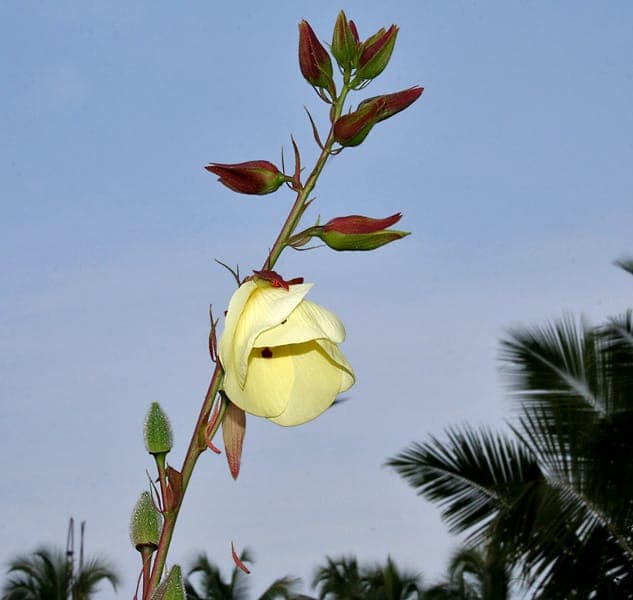
J.M.Garg / CC BY 3.0, via Wikimedia Commons
Manioc-Hibiscus: complete guide
Abelmoschus manihot
Want to see Manioc-Hibiscus: complete guide in your garden?
1 minute, no credit card
Overview
Abelmoschus manihot, commonly known as Manioc-Hibiscus or Aibika, is a fascinating plant that offers both ornamental beauty and culinary uses. While it's a relative of okra and hibiscus, this species stands out with its striking flowers and edible leaves. Originally from Southeast Asia, where it has been cultivated for centuries as a leafy vegetable, it is now gaining popularity in Western gardens, both as an annual and in containers. It's a fast-growing plant that can reach a significant size in a single season, making it ideal for quickly filling gaps in the garden or on the patio.
For those seeking a unique addition to their edible garden or simply a striking bloomer, Abelmoschus manihot is an excellent choice. On gardenworld.app, you can create a garden design that perfectly integrates this exotic plant, ensuring it thrives in your outdoor space. The plant is relatively easy to care for, provided the right conditions are met, and it rewards the gardener with an abundance of flowers and a continuous harvest of tender leaves.
Appearance & bloom cycle
Abelmoschus manihot is a robust, upright plant that can reach a height of 150 to 250 cm (5 to 8 feet) and a width of approximately 90 to 120 cm (3 to 4 feet). The stems are sturdy and often slightly hairy. The most distinctive feature of the plant is its large, deeply lobed leaves that resemble a hand's palm, hence the name 'manihot' (referring to cassava). These leaves are bright green, sometimes with a subtle purple tint on the underside, and are edible. They have a mild, spinach-like flavor and are rich in nutrients.
The flowers are truly spectacular. They appear from early summer until the first frost and are typically pale yellow to creamy with a prominent dark purple or red center. Each flower can reach a diameter of 10 to 15 cm (4 to 6 inches) and resembles a large hibiscus bloom. Although individual flowers last only one day, the plant continuously produces new buds, ensuring a long and continuous flowering period. After blooming, elongated seed pods similar to those of okra develop.
Ideal location: sun, shade, or partial
Abelmoschus manihot is a true sun-lover. For optimal growth, flowering, and leaf production, the plant needs at least 6 to 8 hours of direct sunlight per day. A south or southwest-facing location is ideal. While the plant can tolerate light partial shade, flowering will be less abundant and growth less vigorous. Too much shade will result in leggy growth and reduced flower and leaf production. The plant thrives best in a warm, sheltered environment, for example, against a sunny wall or fence that radiates heat.
Ensure that the chosen location also has sufficient air circulation to prevent fungal diseases, but avoid windy spots, as the tall stems can topple in strong winds. In pots, the plant can be easily moved to the sunniest spot on the patio or balcony. In the open ground, a location near other tall plants or a sturdy stake for support can be beneficial.
Soil & underground requirements
Well-draining, fertile soil is crucial for Abelmoschus manihot. The plant prefers a slightly acidic to neutral pH, between 6.0 and 7.0. Heavy clay soils should be amended with plenty of organic matter such as compost, leaf mold, or well-rotted manure to improve drainage and loosen the soil structure. Sandy soils also benefit from compost to increase water retention and nutrient holding capacity.
For planting in the open ground, dig a generous planting hole twice as wide as the root ball and just as deep. Mix the excavated soil with a liberal amount of compost. When planting in pots, choose a large container with drainage holes (at least 30-40 cm / 12-16 inches diameter for a single plant) and use a high-quality potting mix rich in organic matter with good drainage. A mixture of potting soil with perlite or coarse sand can help further optimize drainage. The plant does not have specific deep root systems, but good soil structure promotes healthy, strong growth above ground.
Watering: when and how much
Abelmoschus manihot requires consistent and even moisture, especially during warm periods and flowering. The soil should not dry out, but it should also not be waterlogged, as this can lead to root rot. Check the soil moisture regularly by sticking a finger about 5 cm (2 inches) deep into the soil. If the soil feels dry, it's time to water.
Water deeply so that the roots are thoroughly soaked. This encourages the development of a deeper root system, which makes the plant more resilient to drought. During summer, this might mean watering daily, especially for plants in pots that dry out faster. In cooler periods or cloudy weather, the frequency can be reduced. Avoid watering the foliage to prevent fungal diseases; preferably water directly at the base of the plant. A layer of organic mulch around the base of the plant can help retain soil moisture and suppress weed growth.
Free design
Want to see Manioc-Hibiscus: complete guide in your garden? Make a free design now.
Pruning: when and how
Pruning Abelmoschus manihot is primarily aimed at promoting bushier growth, encouraging more flowers, and harvesting leaves. Start by pinching back young plants when they are about 30 cm (12 inches) tall. Pinch out the growing tips of the stems to encourage branching. This results in a denser plant with more flower buds and leaves.
Continuous pruning for harvesting leaves can also stimulate the plant to produce new shoots. Cut the leaves from the stem with sharp scissors or a knife. Also, regularly remove spent flowers (deadheading) to encourage the plant to produce more blooms instead of putting energy into seed formation. Towards the end of the growing season, before the first frost, the plant can be significantly cut back if you plan to overwinter it indoors, or completely removed if grown as an annual.
Maintenance calendar
- March - April: Start seeds indoors in pots at a temperature of 20-25°C (68-77°F), approximately 6-8 weeks before the last expected frost. Ensure sufficient light.
- May: After the last frost and when soil temperatures have warmed sufficiently, young plants can be transplanted into the open ground or larger pots. Begin fertilizing with a balanced fertilizer.
- June - August: This is the peak growing and flowering period. Water regularly (daily in warm periods), apply liquid fertilizer weekly, and harvest leaves. Pinch back plants as needed for bushier growth. Remove spent flowers.
- September - October: Flowering continues until the first frost. Continue watering and harvesting leaves. If you wish to try overwintering the plant, prepare for moving it indoors before frost.
- November - February: In most temperate climates, Abelmoschus manihot is typically grown as an annual and will die back with the first frost. In frost-free greenhouses or indoors, it can overwinter as a perennial with plenty of light and reduced watering. Prune the plant back significantly at this time.
Winter hardiness & protection
Abelmoschus manihot is inherently a tropical plant and is not winter hardy in temperate climates (USDA zones 8-11). This means it will not survive the winter outdoors. In most regions outside of its native tropical range, it is therefore grown as an annual. As soon as temperatures drop below 5°C (41°F) or the first night frost is predicted, the plant will perish.
If you wish to attempt to overwinter the plant, you can grow it in a pot and bring it indoors before the first frost. Prune the plant back significantly to about 30-40 cm (12-16 inches) in height and place it in a bright, frost-free location with a temperature between 10-15°C (50-59°F). Reduce watering significantly, but do not let the root ball dry out completely. The plant will likely lose leaves in winter but will sprout again in spring. Ensure sufficient light, possibly with grow lights, to stimulate new growth. Successfully overwintering the plant in an average home can be challenging due to dry air and often limited light intensity. You can often find seeds or young plants at local garden centres like those found across the UK.
Companion plants & combinations
Abelmoschus manihot is a versatile plant that combines well with other plants, both in ornamental and edible gardens. Due to its height and striking flowers, it can serve as a background plant or a prominent solitary element. Combine it with lower, more compact plants that prefer similar growing conditions.
Good combinations include:
- Edible garden: Basil, bell peppers, eggplants, Swiss chard, and other warm-season vegetables. The leaves of Abelmoschus manihot can provide some shade to less sun-tolerant plants during the hottest hours of the day.
- Ornamental garden: Lower-growing annuals such as Petunias, Verbenas, Marigolds (Tagetes), or Salvias that add color to the foreground. Ornamental grasses like Pennisetum can also create a beautiful contrast. Plants with dark foliage, such as Coleus, can accentuate the bright green leaves of the Manioc-Hibiscus. For a tropical theme, combine it with Cannas or Banana plants.
Ensure all companion plants have sufficient space and do not compete for nutrients and water. Abelmoschus manihot often tends to be dominant, so choose robust partners or keep its growth in check with regular pruning.
Closing paragraph
Abelmoschus manihot is a plant that undoubtedly captures attention, both for its impressive flowers and its edible leaves. Whether you are a beginner gardener or an experienced green thumb, this plant offers a unique combination of beauty and functionality. With the right care and attention, it will enrich your garden, patio, or balcony with a touch of exoticism. Experiment with different locations and combinations to find the perfect spot for this plant. For further inspiration and detailed garden designs, visit gardenworld.app and discover how you can optimally integrate Abelmoschus manihot into your dream garden. Happy gardening with this beautiful and useful plant!
Want to see Manioc-Hibiscus: complete guide in your garden? Make a free design now.
Upload a photo, pick a style, and get a photorealistic design with plant list in under a minute.
No credit card required


Similar plants
Crimean linden: complete guide
Tilia × euchlora
Crimean linden is an elegant, fast-growing shade tree ideal for large gardens. Discover cultivars, spacing, maintenance tips and winter hardiness.
California flannelbush: complete guide
Fremontodendron californicum
Everything about California flannelbush (Fremontodendron californicum): sunny placement, drainage, pruning and care for this spectacular yellow-flowering shrub.
Hairy rose mallow: complete guide
Hibiscus moscheutos subsp. lasiocarpos
Full growing guide for hairy rose mallow (Hibiscus moscheutos subsp. lasiocarpos): location, soil, watering, winter hardiness and garden design tips.