

Dividing perennial plants in autumn: rejuvenate your borders
By the GardenWorld editorial team, updated on
Want to see this in your garden?
Full design in HD: €7.99
Why divide perennials in autumn?
Autumn is the perfect time to shrink and rejuvenate your perennial groupings. A dense clump of Aster, overgrown Lychnis or exhausted Achillea suddenly becomes two to four healthy young plants through division. That feels like free garden expansion, and it is: a plant you have had for twelve years suddenly gives you three healthy younger clones.
Dividing in autumn (September through November) gives the fragments two to three months to form new roots before harsh winter arrives. They will not grow much, but they will root. That is sufficient. By April you will have three blooming plants where one was. This is cheaper than seed, faster than cuttings, and far more satisfying than watching your border thin out year after year. Not sure which combination will look best in your border? At gardenworld.app you can preview it first in a picture of your own garden.
Which perennials can you divide?
Common varieties that love division
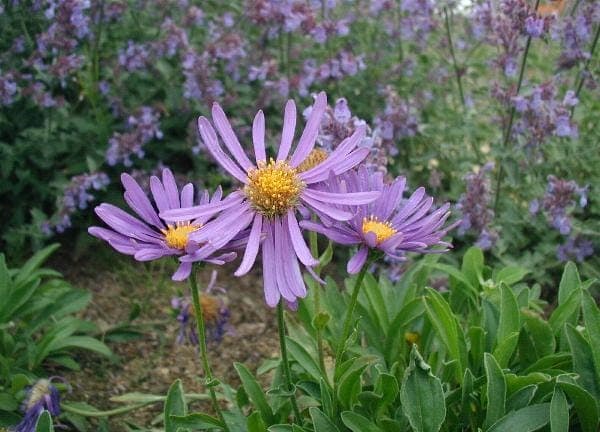
Aster (Aster novi-belgii, Aster novae-angliae): The classic autumn-blooming perennial. Three or four years old and they become hollow in the middle, with thick outer edges and dead leaf in the centre. Dig, break, replant. Every piece regrows.
Achillea (pink, yellow, white): Spreads wide and grows like moss. Very easy to break by hand, even without a spade. One plant becomes four.
Alchemilla mollis (lady's mantle): Self-seeds too, but division is faster. Dig, cut through with spade into 3 to 4 chunks, replant at 30 cm spacing.
Rudbeckia (coneflower): Forms a slow thick clump. After five years dividing gives you space for more.
Phlox (garden phlox): After four to five years the wild clump becomes compact and weak. Division provides rejuvenation.
Astilbe: Sits tight in the ground, but the rhizomes are broad and easy to split down the middle.
Hosta (plantain lily): A large clump can be hacked in two to four equal parts with a spade.
Coreopsis: Very easy to break, sometimes even hackable into centimetre chunks that all grow.
Geranium (cranesbill): Many varieties you can divide into four to eight small pieces.
Plants that HATE division
Lupine (lupinus): Has long tap roots that go deep. Only propagate from seed.
Delphiniums: Same story, long taproot. Never divide.
Adonis: Very delicate. Better not touched.
Anything with a deep taproot (Dictamnus, Poppy), forget it. Division kills the plant.
Trendy newcomers that are only one or two years old: wait until bigger, do not divide until year four to six.
Why divide? Reasons and benefits
Division is the best maintenance you can give a perennial border. After ten to twelve years many clumps develop a hollow heart: good foliage on the rim, dead wood in the middle. A spade through the centre removes that dead interior. You replant three healthy chunks instead of one worn-out plant.
Division is also free propagation. With one Achillea 'Terracotta' you can fill ten corners of your garden in three years, without spending anything. Division is also rejuvenation: the chunks grow faster than the mother plant in its exhausted third decade.
Finally: division prevents disease. Some hostas and phloxes become prone to fungus around year eight or nine. Division and removal of dead material helps prevent that.
The right time: autumn is ideal
September through October are peak months. The soil is still soft after summer rains, not yet frozen. Temperatures are mild, so replants do not stress. After division the fragments get six to ten weeks of growth before everything goes dormant. Enough time to form new roots.
November can work, but it is tight. Soil is harder, night temperatures drop fast. Plantlets then have only two to four weeks of growth before winter comes.
Do NOT do this in March-April. Those clumps are already sprouting, sap is rising, and moving is a shock. They will bloom, not grow.
Tools and preparation
For the work itself you need very little. A strong garden spade (not the small tool spade, the full size). A hoe or chopping block. Two buckets of water. Optionally gloves.
For replanting: compost or rich garden soil, a rake, a watering can with water.
Choose a dry day. Dug plantlets dry out fast. Work early in the morning, not in full sun. If you have many plantlets to divide, do not divide them all on the same day; spread that over two days.
Free preview
Create your own garden design
Technique: digging, splitting and replanting
Step 1: Dig the full plant
Place your spade around the plant, about 20 cm from the centre. Dig deep, well under the root system. Pull slowly upward. If it does not come loose, keep digging rather than yanking.
Step 2: Clean
Shake and tease the soil from the roots. Much soil can come off, keep everything clean.
Step 3: Split
Have a large clump (football-sized or bigger), place the spade through the middle. Push down. Sometimes it just breaks, sometimes you need two or three strokes. Small clumps you can tease apart by hand if they are rosette-like.
For stubborn groups (Astilbe, Hosta): use a thin axe or chopping tool, carefully through the middle and a few strokes. Never brute force.
Step 4: Inspection
Remove dead wood, broken roots, slugs or other pests. Keep only healthy green-white root wood.
Step 5: Return to place
Not everything has to go back where it was. Return one chunk to the original hole, place the second several metres away in a new hole, the third somewhere else. This spreads your collection.
Mix rich compost with excavated soil (50/50). Set the plant at the right height (growth point just at soil level).
Step 6: Water
Water well immediately after planting. Generous watering, not stingy. The soil must settle and roots must contact moist earth. This one moment determines whether the plant takes.
Watering after division: no stress, plenty of moisture
Perennials are tough, but right after division they are sensitive. Water regularly for four weeks (every two to three days). No drying out. No waterlogging.
Set new plantlets, if you want to pre-grow them in pots, in a half-shaded spot, not in full midday sun. Two weeks acclimatizing, then they can go to their final border spot.
When to divide: by season and type
August-September: Aster, Rudbeckia, Coreopsis. Early dividers that have new flowers by October.
September-October: Alchemilla, Achillea, Geranium, Phlox, Hosta, Astilbe. Standard window.
October-November (risky): Only late varieties if weather allows. Soil must not be frozen.
Never March-May. Too much growth already underway.
Step by step
Step 1: Dig out the plant
Place spade 20 cm from centre, dig deep, pull slowly up until loose. Shake soil off.
Step 2: Clean thoroughly
Remove soil from roots. Discard dead wood.
Step 3: Spade through the middle
For large clumps through the heart, push down. May need two or three strokes. Small rosette clumps tease apart by hand.
Step 4: Dig holes
For each chunk dig a new hole, 30 cm spacing between holes. Mix in compost.
Step 5: Set plantlets
Growth point at right height. Not too deep. Firm tread down.
Step 6: Water
Water thoroughly immediately after planting. Water regularly for four weeks.
Frequently asked questions
Can I divide in spring?
No. March-May plants are in full growth, sap is rising, and moving is shock. They might still flower but they will not grow. Autumn is infinitely better.
My divided plantlets are very small after I chop them into pieces. Will they grow back?
Yes, absolutely. Even small fragments grow out. They will be full-sized in two to four months. Small is better than large; large fragments survive better but many do not grow before March-April.
Can I divide directly into pots instead of into the border?
Absolutely. Pre-grow them two weeks in half-shade, pot soil, then ground. Handy for divisions you want to give or sell.
Do I need to give divided plantlets special feeding?
No. Rich compost-filled soil is all that is needed. Fertilizer after four weeks, but not immediately after division.
See it in your own garden first
Wondering how your perennial border will look after dividing? Upload a photo of your garden to gardenworld.app and preview a new design with these plants for free. Want the sharp image with the full plant list afterwards, that costs 7.99 euros once, no subscription.
With this simple technique you transform every aging border again and again, year after year.
Create your own garden design
Upload a photo, pick a style, and get a photorealistic design with plant list in under a minute.
Full design in HD: €7.99


Related articles
How to prune Alchemilla mollis (Lady's mantle): complete guide
Pruning lady's mantle keeps the plant compact and encourages fresh growth. Learn when and how to trim this elegant perennial.
Japanese anemone pruning: how and when
Japanese anemones flower in autumn. Prune them back in spring and support with stakes for strong growth.
 Planting
How to prune Aster Novae-Angliae (New England aster)
Aster novae-angliae grows tall and falls over easily. Learn how to keep this autumn bloomer compact and full without collapse.