
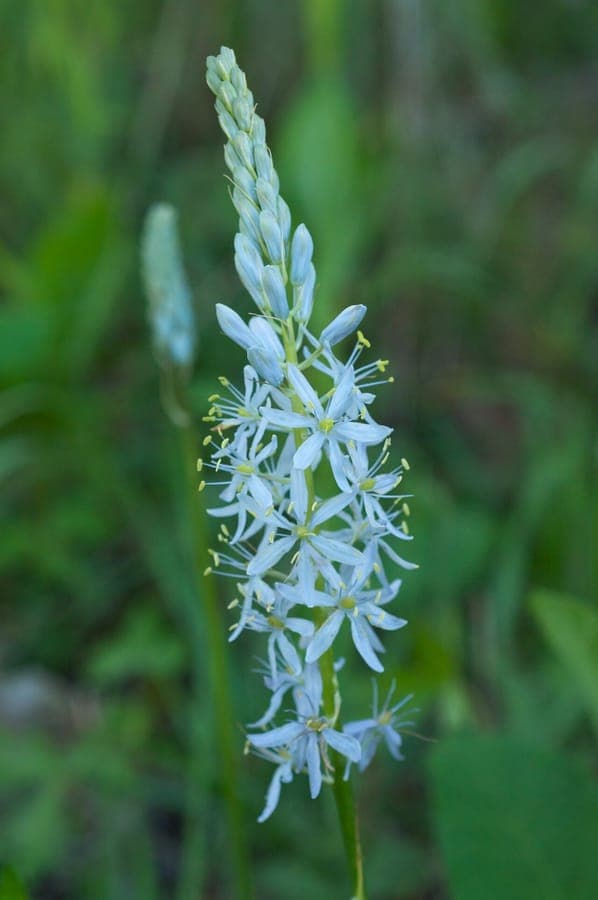
Eric in SF / CC BY-SA 3.0, via Wikimedia Commons
Camassia scilloides: complete gids
Camassia scilloides
Wil je Camassia scilloides: complete gids in jouw tuin zien?
1 minuut, geen creditcard
Overview
Camassia scilloides, commonly known as wild hyacinth or Atlantic camas, is a charming spring-blooming bulb native to North America. This elegant plant holds its blue flowers proudly aloft when blooming arrives in May, creating a landscape of quiet beauty. It's a forgiving plant that returns year after year, making it ideal for gardeners seeking minimal maintenance. In the wild, these blooms thrive in moist meadows and woodlands from Ontario to Texas, creating a natural tapestry of color.
Appearance and bloom
Camassia scilloides reaches heights of 45 to 75 cm, bearing narrow, linear green leaves that form dense clumps. The flowers are genuine beauties: they grow in a dense, elongated spike completely filled with star-shaped blue florets. These blooms attract bees, bumblebees, and other pollinators, launching the season with exuberant color. The flowering period spans April to May, depending on your climate.
Ideal location
This plant flourishes in full sun to partial shade. A location receiving at least six hours of direct sunlight daily yields the most blooms. However, in warmer climates, some afternoon shade can help extend the flower display.
Soil
Well-draining soil is essential. Camassia scilloides prefer moister conditions than many other bulbs, but waterlogging is absolutely fatal. They grow best in neutral to slightly acidic soil (pH 4.2 to 6.5). Work organic matter in if you have heavy clay soil.
Watering
This plant needs regular water, especially during growth and bloom periods. Keep soil consistently moist but never soggy. During dry spells in spring and summer, water regularly. After blooming, soil can be slightly drier, but complete drying must be avoided until foliage naturally dies.
Gratis ontwerp
Wil je Camassia scilloides: complete gids in jouw tuin zien? Maak nu een gratis ontwerp.
Pruning
Camassia scilloides requires minimal pruning. Remove spent flower heads to prevent seed formation and maintain a neater appearance. However, leave foliage intact until it naturally dies back, as this returns energy reserves to the bulb.
Maintenance calendar
In autumn (September-October), plant bulbs at a depth of 8 cm. Apply a 5 cm layer of organic mulch. In spring, foliage emerges and April-May brings blooms. After flowering, leaves remain until they die (around June). During summer, keep soil moderately moist.
Winter hardiness
This plant is extremely hardy and tolerates temperatures to -20 degrees Celsius. In temperate climates, bulbs easily survive outdoors without protection. They're suitable for USDA zones 3 to 8.
Companion plants
Camassia scilloides looks stunning paired with other spring bloomers like crocuses, snowdrops, and daffodils. Beautiful combinations also emerge with hostas, brunnera, and primrose, creating a natural woodland effect. For a bolder look, combine it with red or white tulips.
Closing
Camassia scilloides is a probably underrated plant with many advantages. Requiring minimal maintenance, offering reliable returns year after year, and displaying beautiful blue spring flowers, this wild hyacinth truly deserves more space in contemporary gardens. Seeking another bulb for your spring borders? This is definitely a must-have. Available at standard garden centers and full design support through gardenworld.app for planning and installation.
Wil je Camassia scilloides: complete gids in jouw tuin zien? Maak nu een gratis ontwerp.
Upload een foto, kies je stijl en ontvang binnen 1 minuut een fotorealistisch ontwerp inclusief plantenlijst.
Geen creditcard nodig


Vergelijkbare planten
Smalbladige drakenboom: complete gids
Dracaena angustifolia
Alles over Dracaena angustifolia - smalbladige drakenboom: standplaats, verzorging, overwintering en gebruik als kamerplant of tuinplant.
Chaparral yucca: complete gids voor Hesperoyucca whipplei
Hesperoyucca whipplei
Hesperoyucca whipplei is een dramatische rozetvormende plant uit Californie met indrukwekkende bloempieken, perfect voor droge, zonnige tuinen en grindtuinen.
Breedbladig dalkruid: complete gids
Maianthemum dilatatum
Alles over Maianthemum dilatatum, het breedbladige dalkruid. Verzorging, schaduwstandplaats, snoei en tuincombinaties voor deze populaire bodembedekker.