
Franz Eugen Köhler, Köhler's Medizinal-Pflanzen / Public domain, via Wikimedia Commons
Corn: complete guide
Zea mays
¿Quieres ver Corn: complete guide en tu jardín?
1 minuto, sin tarjeta de crédito
Overview
Corn (Zea mays) is one of the world's most important food crops and an excellent addition to the home garden. This stately grain, originating from Central America, reaches impressive heights whilst producing golden ears packed with nutritious kernels. For home gardeners, corn offers practical harvest and ornamental value with its tall stature and dramatic foliage.
Appearance & Growth
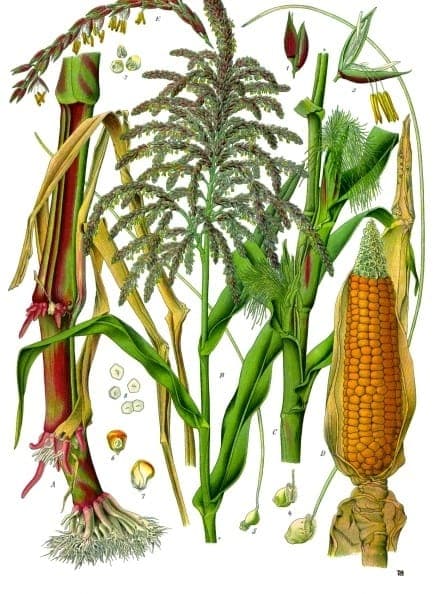
Corn plants reach 180-250 centimeters tall depending on cultivar and conditions. Strong, rigidly upright stems bear long, linear leaves featuring characteristic midribs. Male flowers form atop as tassels; female flowers emerge at leaf axils, developing into ears. Each plant typically produces two ears per season. Mature ears display rows of golden, cream, or purple kernels depending on cultivar.
Ideal Location
Corn demands full sun: minimum six to eight hours daily direct sunlight. Choose locations with unrestricted air circulation preventing fungal issues. North-south oriented rows maximize light absorption. Ensure corn avoids shading from taller crops or structures. Avoid low-lying areas accumulating water after rainfall, which promotes root disease.
Soil
Corn grows optimally in well-draining, fertile soil pH 6.0-7.0. Incorporate abundant organic matter (compost, leaf mold) before planting. The plant requires high nitrogen, so enrich soil with nitrogen-rich amendments. For small gardens: plant in quality soil blended with minimum 10 centimeters compost. Excellent drainage prevents root rot.
Watering
Corn requires consistently moist soil, especially during flowering and kernel development. Water deeply and regularly, targeting minimum 2-3 centimeters per week. Drip irrigation ensures uniform water delivery. Avoid overhead watering promoting fungal disease. Complete drying between waterings causes scorch and reduced yield.
Diseño gratis
¿Quieres ver Corn: complete guide en tu jardín? Crea un diseño gratis ahora.
Maintenance
Remove male flowers (tassels) after pollen dispersal to direct energy to ear development. During strong winds, hill soil around stems for stability. Remove weak sprouts ('suckers') emerging from stem base. Regularly inspect for disease and pests. During dry, hot periods, mulch around plants.
Maintenance Calendar
Spring (April-May): Direct sow seeds after last frost, create ridges, thin to 25-30 centimeter spacing. Summer (June-August): Regular watering, provide support during wind, apply feeding at flowering start. Autumn (September-October): Harvest as kernels turn dull yellow, dry for storage. Winter: Soil preparation, compost incorporation.
Winter Hardiness
Corn is a warm-season crop, sensitive to frost. Plant only after final frost date. Optimal growth requires temperatures 21-29 degrees Celsius. Cooler temperatures substantially slow germination and development.
Companion Plants
Corn pairs excellently with runner beans (stems provide support) and pumpkins. Traditional Three Sisters: plant corn, beans, and squash together. For home gardens: broccoli, lettuce, and carrots grow well around corn bed edges where shade benefits them.
Closing
Home-grown corn delivers unparalleled flavour and satisfaction. With proper timing, feeding, and moisture, harvest abundant ears August through October. For impressive garden design combining nutrition with aesthetics, visit gardenworld.app/en. Need help planning productive vegetable gardens? Consult gardenworld.app/en for expert guidance.
¿Quieres ver Corn: complete guide en tu jardín? Crea un diseño gratis ahora.
Sube una foto, elige un estilo y obtén un diseño fotorrealista con lista de plantas en menos de un minuto.
Más de 10.000 jardines diseñados
Sin tarjeta de crédito


Plantas similares
Sporobolus pungens: complete guide
Sporobolus pungens
Sporobolus pungens is a stoloniferous Mediterranean coastal grass with outstanding salt and drought tolerance, perfect for seaside and dry gardens.
Mediterranean aegilops: complete guide
Aegilops biuncialis
Everything about Aegilops biuncialis, a Mediterranean annual grass with ornamental spikes and outstanding drought tolerance for dry gardens.
Silver bluestem: complete guide
Bothriochloa saccharoides
Full guide to Bothriochloa saccharoides (silver bluestem): site, soil, watering, winter hardiness, pruning, and garden companions.