
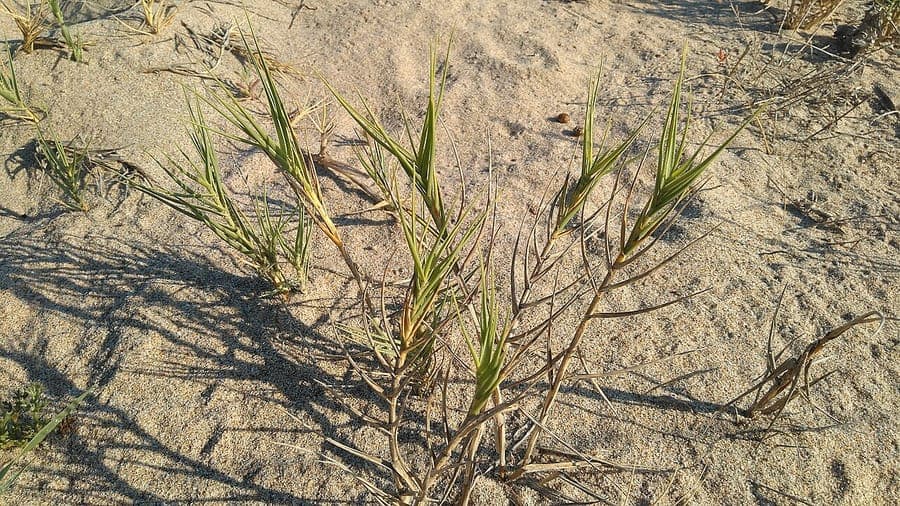
Josep Gesti / CC BY-SA 4.0, via Wikimedia Commons
Sporobolus pungens: complete guide
Sporobolus pungens
¿Quieres ver Sporobolus pungens: complete guide en tu jardín?
1 minuto, sin tarjeta de crédito
Overview
Sporobolus pungens, known in French as the Sporobole piquant or prickly dropseed, is a robust, perennial grass belonging to the family Poaceae. It is native to the coastal margins of the Mediterranean and the adjacent Atlantic coast extending south to Mauritania. The species occurs naturally in France, Spain, Italy, Greece, Turkey, Portugal, Morocco, Algeria, Tunisia, and across the Mediterranean islands including the Balearics. The species name 'pungens' is Latin for 'prickly' or 'piercing', a direct reference to the sharp-tipped narrow blades that genuinely prick the skin when handled carelessly. Earlier botanical synonyms include Agrostis arenaria and Vilfa arenaria - names that reflect its preferred habitat on sandy soils. Formally described by Kunth in 1829, the plant has a stable taxonomic position within the large and cosmopolitan Sporobolus genus. This grass is superbly adapted to coastal conditions: salt-laden soil and air, fierce wind exposure, extreme summer drought, and mobile sand present no obstacle to its vigorous growth. The stoloniferous spreading habit - above-ground runners that root at intervals - allows it to colonise wide areas and bind loose sand into stable mats, making it ecologically important as a dune pioneer. At gardenworld.app, garden designs use salt-tolerant coastal grasses like Sporobolus pungens to create authentic seaside and Mediterranean-inspired planting schemes for front yards and exposed gardens.
Appearance and bloom
Sporobolus pungens forms dense, compact tufts of stiff, upright, narrow blades with pointed tips that give the clump a firm, slightly aggressive texture. Blade colour ranges from fresh green to grey-green depending on soil moisture availability, shifting toward straw-yellow or pale grey during extended dry summer periods - a colour change that is entirely natural and does not indicate stress beyond normal seasonal adjustment. The stoloniferous growth habit is distinctive: above-ground runners extend horizontally from established clumps, rooting at nodes and producing new tufts that link together over time into a continuous groundcover mat. This spreading tendency is an asset for erosion control and dune stabilisation, though it should be considered in smaller garden settings where spreading may need occasional management. Flower panicles emerge from July through October as narrow, compressed, spike-like structures rising above the foliage. Their colour shifts from green to purple as they mature. The inflorescences are subtle rather than showy but contribute graceful movement and texture in autumn and winter breezes. The plant is wind-pollinated, suited to the open, exposed coastal habitats it favours.
Ideal location
Full sun is essential for Sporobolus pungens. Botanical reference databases rate the species at 9 out of 10 for light requirements, indicating it needs maximum solar exposure to perform at its best. In its natural habitat it grows in open, unobstructed coastal positions bathed in full Mediterranean sunlight throughout the day, exposed to salt wind and heat without shelter. In the garden, an equally open, sunny position with no significant shading is ideal. The plant excels in coastal gardens where other ornamental grasses often struggle with salt spray and wind exposure, but it performs equally well in inland dry, sunny settings as long as the drainage is sharp. Avoid positions near walls or structures that cast shade, as this reduces vigour and the characteristic compact, upright form of the foliage. Good air circulation prevents the occasional fungal issues that can occur in persistently damp conditions. At gardenworld.app you can browse coastal and Mediterranean garden designs that use this grass effectively as a structural groundcover or border edging plant.
Soil
Sporobolus pungens is adapted to poor, sandy, well-drained soil with a pH between 5 and 7.5 - slightly acid to neutral. Its salt tolerance rating of 6 out of 7 in botanical reference databases reflects an exceptional ability to grow in substrates with elevated salt content from sea spray, coastal flooding, or road salt applications - a quality that sets it apart from most ornamental grasses. Rich, heavy soil produces lush but atypical growth that lacks the firm, upright character the plant is valued for. On clay soils, work in generous quantities of coarse sand and fine grit to improve drainage, or construct a raised bed filled with a lean, sandy mix. A surface gravel mulch further improves drainage, suppresses weeds, and gives the planting a naturalistic coastal character. No fertiliser is required on poor soils; applying fertiliser to established plants may make them rank and less resilient to drought and cold.
Diseño gratis
¿Quieres ver Sporobolus pungens: complete guide en tu jardín? Crea un diseño gratis ahora.
Watering
Once established, Sporobolus pungens requires minimal supplementary watering and is well suited to gardens where irrigation is limited or unavailable. The plant is adapted to the dry Mediterranean summer, during which it may receive no meaningful rainfall for two to four months. Its root system and stoloniferous growth pattern allow efficient use of whatever soil moisture is available. In the first growing season, water moderately to encourage rooting and establishment, always allowing the soil to dry out between waterings. From the second year onward, natural rainfall is sufficient in most northwestern European climates - annual precipitation in the Netherlands and Belgium easily meets the plant's needs. In gardens near the sea or in genuinely dry inland regions, the plant is essentially self-sufficient year-round once established. Overwatering leads to lush, floppy, untypical growth and can cause root rot in containers without adequate drainage holes. Water early in the morning if irrigation is used, to avoid extended leaf wetness.
Pruning
Minimal maintenance is required. In early spring, once the first signs of new growth appear at the base, cut back the previous year's dead and brown foliage to a few centimetres above ground level using clean, sharp shears or scissors. This allows the fresh new growth to emerge cleanly and gives the clump a tidy, revitalised appearance. No pruning is needed in autumn: the dried flower panicles and buff-coloured foliage provide winter ornament and help insulate the crown of the plant against hard frost. When clumps outgrow their allotted space or become too dense and lose vigour at the centre, divide them in early spring by cutting through the rootstock with a sharp, clean spade. The separated sections can be replanted directly at the new location. Tools for grass maintenance are widely available at garden centres.
Maintenance calendar
January and February: leave existing foliage in place as frost protection for the crown. No action required. March and April: cut back dead and brown foliage to a few centimetres above ground level as new growth begins. Divide overcrowded clumps now if needed. May and June: active growing season; no supplementary watering needed under normal rainfall conditions. July, August, and September: flowering period; enjoy the decorative narrow panicles. Water deeply only if dry spells extend beyond three weeks. October: panicles dry and remain ornamental through the coming months. November and December: leave dried foliage in place for winter interest and crown protection; no pruning during this period.
Winter hardiness
Sporobolus pungens is reliably hardy in the milder coastal areas of northwestern Europe. It tolerates light to moderate frost without difficulty; brief drops to -10 degrees Celsius present no significant risk. During unusually cold winters with sustained temperatures below -10 degrees Celsius, some superficial foliage damage may occur, but recovery from the roots and stolons is typical once temperatures moderate. In coastal areas, where maritime air prevents extreme cold, the plant overwinters without any protection. In inland continental climates, leaving the dried foliage on the plant through winter provides useful insulation for the crown. Visit gardenworld.app for coastal garden design inspiration featuring grasses as structural groundcover and border elements.
Companion plants
Ideal companions include other coastal and drought-tolerant plants that share Sporobolus pungens' preferred conditions. Ammophila arenaria (marram grass) is its natural neighbour on European dunes. Leymus arenarius (blue lyme grass) provides a contrasting blue-grey colour. Festuca glauca adds fine texture and blue tones. Armeria maritima (sea thrift) brings cheerful pink pompon flowers in late spring. Eryngium maritimum (sea holly) contributes bold, spiky blue-green structure. In broader dry borders, Stipa tenuissima, Pennisetum alopecuroides, and compact Miscanthus varieties share similar textural and seasonal qualities. Avoid pairing with moisture-demanding plants such as hostas, ferns, astilbes, or shade-loving groundcovers that require radically different soil and water conditions.
Closing thoughts
Sporobolus pungens is a tough, characterful grass that brings authentic coastal texture, movement, and ecological value to gardens in a wide range of conditions. Its sharp-tipped foliage, stoloniferous mat-forming habit, exceptional salt tolerance, drought resistance, and low maintenance requirements make it a reliable workhorse for exposed coastal gardens, dry gravel borders, xeriscape schemes, and naturalistic dune-inspired plantings. The seasonal shift from green to straw-gold adds year-round interest, and the winter panicles extend its ornamental value well into the cold months. For those planning a seaside-inspired or water-wise front garden, this grass earns its place. Explore tailored garden design ideas featuring Sporobolus pungens and its coastal companions at gardenworld.app, where every design is personalised to your site, climate, and style.
¿Quieres ver Sporobolus pungens: complete guide en tu jardín? Crea un diseño gratis ahora.
Sube una foto, elige un estilo y obtén un diseño fotorrealista con lista de plantas en menos de un minuto.
Más de 10.000 jardines diseñados
Sin tarjeta de crédito


Plantas similares
Mediterranean aegilops: complete guide
Aegilops biuncialis
Everything about Aegilops biuncialis, a Mediterranean annual grass with ornamental spikes and outstanding drought tolerance for dry gardens.
Silver bluestem: complete guide
Bothriochloa saccharoides
Full guide to Bothriochloa saccharoides (silver bluestem): site, soil, watering, winter hardiness, pruning, and garden companions.
Cutandia maritima: complete guide
Cutandia maritima
Cutandia maritima is a Mediterranean coastal annual grass thriving in dry, salty, nutrient-poor soils - a tough pioneer of sun-baked shorelines.