
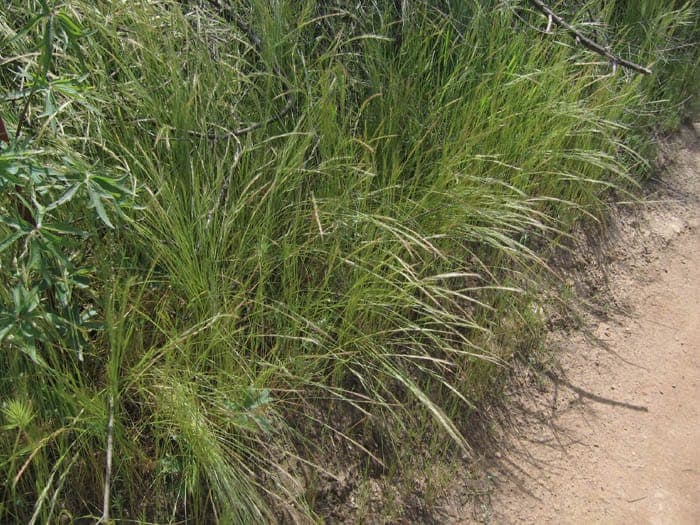
Anthony Valois and the National Park Service / Public domain, via Wikimedia Commons
Vulpia myuros: complete guide
Vulpia myuros
¿Quieres ver Vulpia myuros: complete guide en tu jardín?
1 minuto, sin tarjeta de crédito
Overview
Vulpia myuros, commonly known as rat-tail fescue or foxtail fescue, is a graceful annual ornamental grass native to the Mediterranean region. This fine-textured beauty is celebrated for its distinctive tail-like seedheads that dance elegantly in the slightest breeze. With rapid growth, prolific self-seeding capability, and minimal maintenance demands, Vulpia myuros excels in naturalistic, wildlife-friendly gardens and contemporary landscape schemes.
Appearance & Bloom
Rat-tail fescue forms compact plants 25 to 50 cm tall with exceptionally fine, soft green foliage. The characteristic tail-like seedheads appear in pale yellow to warm brown tones from May through September. These delicate, elongated panicles are slightly curved, lending the grass a distinctive personality. Massed in groups, the effect is ethereal and meadow-like, evoking wild grasslands and naturalistic planting design.
Ideal Location
This species thrives in full sun but tolerates partial shade reasonably well. Unlike many fine ornamental grasses, rat-tail fescue actually tolerates slightly moist soils, making it suitable for gardens with seasonal moisture or higher water tables. It is fully hardy throughout Europe and provides valuable seed resources for goldfinches and other seed-eating birds.
Soil
Vulpia myuros adapts to varied soil conditions, from dry to moderately moist (pH 5.9-7.6). The grass prefers well-drained, moderately fertile soil but tolerates less favorable conditions gracefully. This exceptional flexibility makes it an excellent choice for challenging garden sites and varied microclimates within larger landscapes.
Diseño gratis
¿Quieres ver Vulpia myuros: complete guide en tu jardín? Crea un diseño gratis ahora.
Watering
Once established, rat-tail fescue is quite drought-tolerant, though it appreciates slightly more moisture than sibling Vulpia species. Young seedlings should be kept consistently moist until well-rooted. Mature plants require supplemental watering only during extended dry spells or severe drought.
Pruning
This grass requires minimal pruning. Spent seedheads may be removed in late October to November for aesthetic tidiness. For effortless self-seeding, allow seedheads to persist on the plant through winter. In early spring (March), old material can be cut back entirely in preparation for vigorous fresh growth.
Maintenance Calendar
March-April: spring tidy-up and preparation May: sow seed directly or start in containers June-September: growth and flowering period October: seed ripening November-December: harvest seed or remove seedheads January-February: dormancy
Winter Hardiness
Rat-tail fescue is fully cold-hardy to -20 degrees Celsius and thrives throughout European zones. As an annual grass, it invests energy in abundant seed production; prolific self-seeding ensures renewal without additional effort or cost.
Companion Plants
Rat-tail fescue pairs beautifully with other short-lived grasses and flowering perennials. The soft golden seedhead tones complement purple Salvia, red Papaver, and yellow Coreopsis perfectly. In meadow gardens, it adds vital texture, movement, and sustenance for overwintering birds.
Closing
Vulpia myuros is the perfect choice for self-sowing, low-maintenance gardens where wild charm is celebrated. Allow this grass to self-seed for years of abundant, effortless renewal. Discover seeds at major UK and European suppliers specializing in ornamental grasses.
¿Quieres ver Vulpia myuros: complete guide en tu jardín? Crea un diseño gratis ahora.
Sube una foto, elige un estilo y obtén un diseño fotorrealista con lista de plantas en menos de un minuto.
Más de 10.000 jardines diseñados
Sin tarjeta de crédito


Plantas similares
Sporobolus pungens: complete guide
Sporobolus pungens
Sporobolus pungens is a stoloniferous Mediterranean coastal grass with outstanding salt and drought tolerance, perfect for seaside and dry gardens.
Mediterranean aegilops: complete guide
Aegilops biuncialis
Everything about Aegilops biuncialis, a Mediterranean annual grass with ornamental spikes and outstanding drought tolerance for dry gardens.
Silver bluestem: complete guide
Bothriochloa saccharoides
Full guide to Bothriochloa saccharoides (silver bluestem): site, soil, watering, winter hardiness, pruning, and garden companions.