
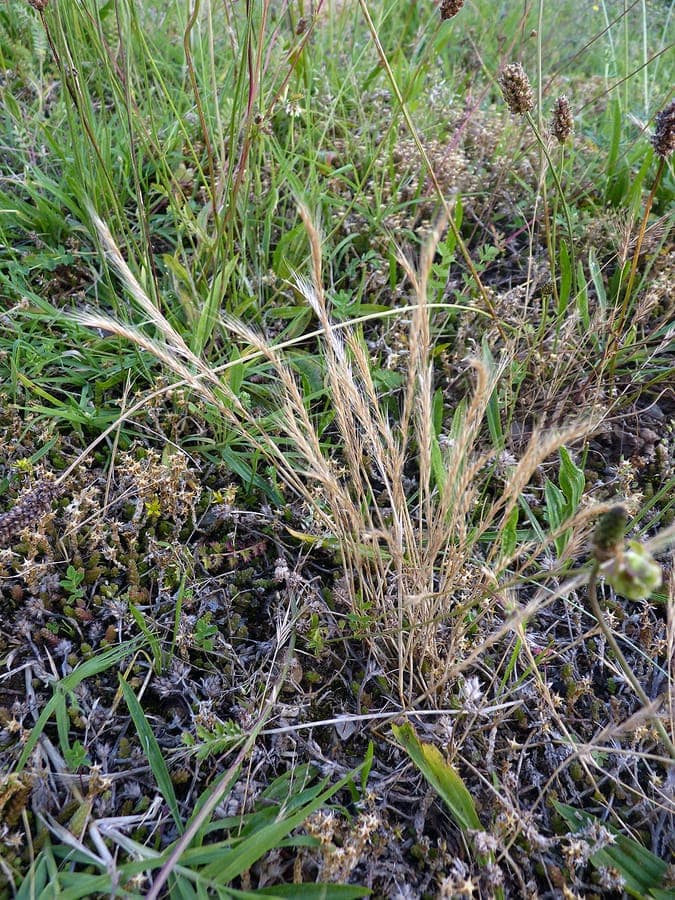
Emmanuel Stratmains / CC BY-SA 2.0 fr, via Wikimedia Commons
Bearded fescue: complete guide
Vulpia ciliata
¿Quieres ver Bearded fescue: complete guide en tu jardín?
1 minuto, sin tarjeta de crédito
Overview
Bearded fescue (Vulpia ciliata), also known as fringed fescue, is a soft and fine-textured ornamental grass that offers special charm to garden designs. This grass is valued for its slender, hairy seed heads that from May to July create fine, elegant structures. With a low growth pattern, Vulpia ciliata forms attractive tufted clumps.
Bearded fescue is popular in modern garden design because it is frost-hardy and requires minimal care. At gardenworld.app, this grass can be effectively placed in borders for texture contrast and attractive light effects. It creates movement and lightness in garden compositions.
Appearance and bloom
The characteristic, hairy seed heads of Vulpia ciliata are exceptionally fine and elegant. The seed heads can be dark purple to green and reach 5-10 centimeters in length. Each seed head is furnished with long, projecting hairs which gives indication of the scientific name.
The foliage is extremely narrow, almost thread-like, dark green to grey-green. The overall plant forms dense, neat little tufts. This elegance and fineness makes Vulpia ciliata desirable as an accent grass in garden compositions.
Ideal location
Bearded fescue thrives best in sunny to partially shaded locations. The plant tolerates dry sites well and grows even on impoverished soils. In very wet, shaded places, growth will be disappointing.
The plant is excellent for Mediterranean gardens, gravel underplantings, and xeric borders. In gardenworld.app design, this grass is recommended for texture accents in sparse environments.
Soil requirements
Vulpia ciliata is highly tolerant of soil types and grows well in poor, dry, sandy or gravelly soils. A pH of 5.5 to 8.0 is acceptable. The plant tolerates salt to some extent, making it suitable for coastal landscapes.
However, soils must be well-drained. In wet clay soils, the plant will not thrive. No soil improvement is usually needed.
Diseño gratis
¿Quieres ver Bearded fescue: complete guide en tu jardín? Crea un diseño gratis ahora.
Watering
Bearded fescue is highly drought-tolerant once established. Regular watering in the first growing season promotes faster establishment. Once established, minimal water is needed.
Excessive water can promote leggy growth and disease susceptibility. The plant is much better suited to dry conditions. In very wet years, drainage problems can occur.
Pruning
Bearded fescue requires minimal maintenance pruning. In early spring, overgrown plants can be combed back to remove dead material. Spent seed heads can be cut off for neatness, but birds appreciate the seed.
Heavy pruning is not needed. In fact, plants can naturally maintain their shape. Old remnants can be removed in early spring.
Maintenance calendar
MAY-JUNE: Seed head development; minimal water requirement. JULY: Peak flowering period; observe for seed setting. AUGUST-SEPTEMBER: Seed ripening; no pruning. OCTOBER-APRIL: Winter dormancy; minimal activity. MARCH: Early spring maintenance; remove dead material. APRIL: Growth restart; minimal preparation.
Winter hardiness
Bearded fescue is highly winter-hardy and tolerates temperatures far below -20 degrees Celsius. It grows best in temperate climates and can grow outdoors year-round. Wet winter conditions pose more problems than cold.
The plant is suitable for all temperate regions without winter protection.
Companion plants
Bearded fescue combines beautifully with other ornamental grasses. Persistent blue-green perennials contrast nicely with this fine grass. Gravel and rocks form natural companions.
In gardenworld.app designs, this grass works well in xeric borders, dry gardens, and as an accent beside larger perennials.
Closing
Bearded fescue offers subtle elegance and practical drought tolerance that makes it valuable for sustainable garden design. Its minimal maintenance requirements and winter-hardiness make it suitable for low-maintenance managed gardens. Through gardenworld.app, this fine grass can be strategically used for texture accents and structure.
¿Quieres ver Bearded fescue: complete guide en tu jardín? Crea un diseño gratis ahora.
Sube una foto, elige un estilo y obtén un diseño fotorrealista con lista de plantas en menos de un minuto.
Más de 10.000 jardines diseñados
Sin tarjeta de crédito


Plantas similares
Sporobolus pungens: complete guide
Sporobolus pungens
Sporobolus pungens is a stoloniferous Mediterranean coastal grass with outstanding salt and drought tolerance, perfect for seaside and dry gardens.
Mediterranean aegilops: complete guide
Aegilops biuncialis
Everything about Aegilops biuncialis, a Mediterranean annual grass with ornamental spikes and outstanding drought tolerance for dry gardens.
Silver bluestem: complete guide
Bothriochloa saccharoides
Full guide to Bothriochloa saccharoides (silver bluestem): site, soil, watering, winter hardiness, pruning, and garden companions.