
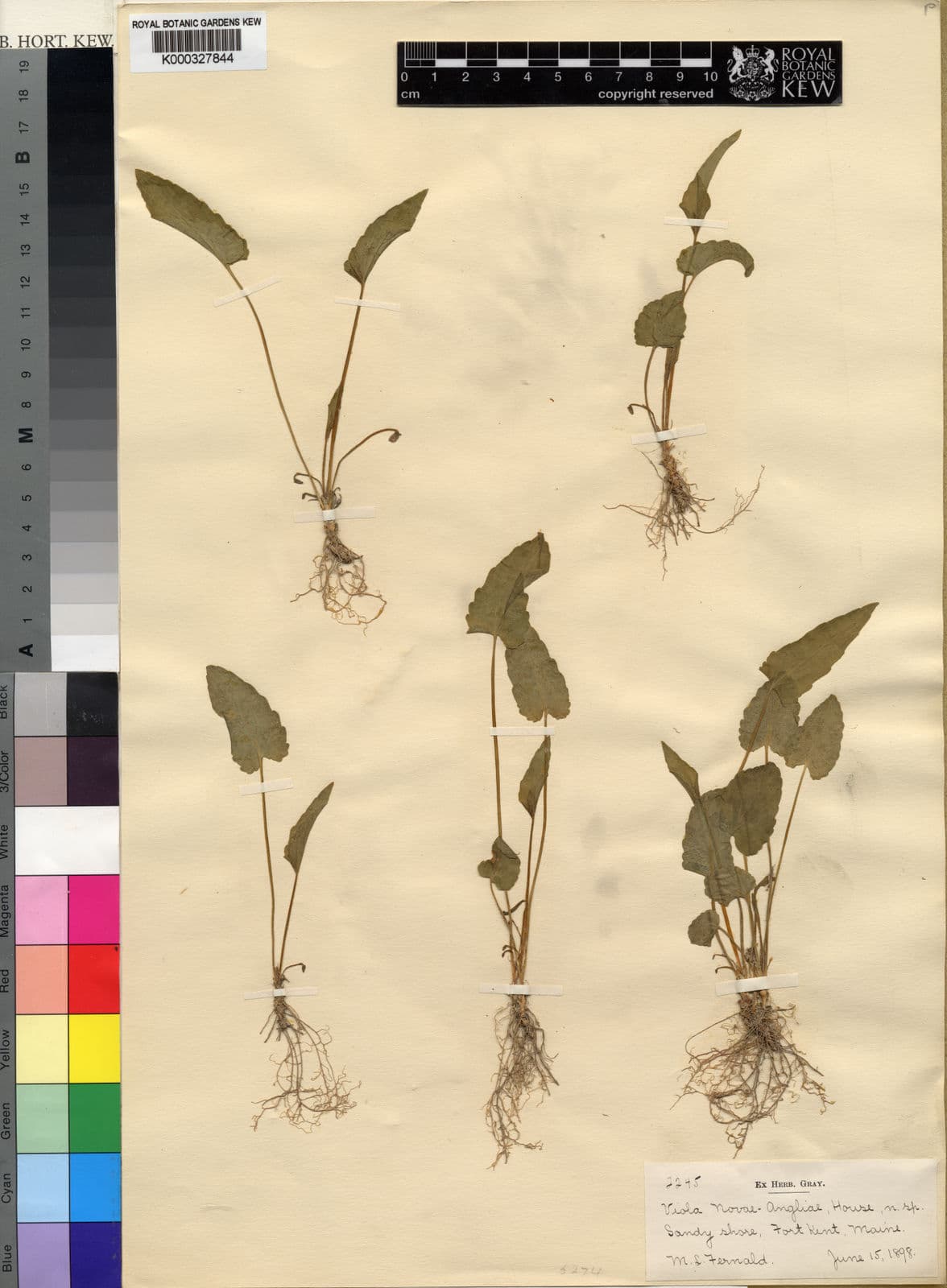
Viola novae-angliae: complete guide
Viola novae-angliae
¿Quieres ver Viola novae-angliae: complete guide en tu jardín?
1 minuto, sin tarjeta de crédito
Overview
Viola novae-angliae, known in English as the New England violet or New England blue violet, was described in 1904 by American botanist Homer Doliver House. The species belongs to the family Violaceae and takes its name from northeastern North America, where it grows natively: from Quebec, Ontario, and Manitoba in Canada down through Maine, New York, Michigan, Minnesota, and Wisconsin.
What sets this violet apart from the closely related Viola sororia is its dense, soft pubescence on both leaf surfaces, giving the foliage a velvety texture. The species typically grows on rocky riverbanks and calcareous ledges subject to periodic flooding, a niche few other plants tolerate. On gardenworld.app, we cover this cold-hardy North American species as a rugged alternative for rock garden and streamside enthusiasts looking beyond the classic European woodland violet. Gardeners in the UK, Ireland, and similar temperate climates can add an authentic North American accent to a rock garden without sacrificing winter hardiness or ease of care.
Appearance and bloom
Viola novae-angliae forms a stemless rosette 8 to 15 centimeters tall. The leaves are broadly heart-shaped with a coarsely toothed margin and, unlike many other violets, densely hairy on both upper and lower surfaces, giving the plant a grayish-green, soft appearance.
Flowers appear from April to June and measure 2 to 2.5 centimeters across, in a vivid blue-violet color with a white, bearded throat and dark veining on the lower petals. Each flower sits on a separate, leafless stalk that rises just above the leaf rosette. After flowering, three-valved capsules develop that split open when dry and fling seeds a considerable distance, gradually seeding the plant along riverbanks and shorelines.
Ideal location
In the wild, this species grows on rocky riverbanks, calcium-rich ledges, and periodically flooded floodplains, often in spots where winter ice scour strips vegetation clean. That makes Viola novae-angliae particularly suited to rock gardens, dry-stacked walls, and streamside plantings around ponds or brooks in the garden.
The plant performs well in full sun to light partial shade; at least four hours of sun daily gives the best floral display. Choose a spot with good air circulation, such as a raised rock bed or the edge of a pond, where roots occasionally contact water but do not sit permanently submerged. A raised bed lined with natural stone along a driveway or patio also suits this species well, as long as roots do not sit in a basin of standing rainwater.
Soil
This species prefers neutral to slightly alkaline soil, unlike many other American violets that favor acidic growing media. A well-drained soil with some loam and gravel, amended with garden lime if the native soil is naturally acidic, mimics the calcareous ledges of its native range.
When planting, mix coarse sand and gravel into the bed for extra drainage; these materials are available at Intratuin and Gamma. Avoid heavy, compacted clay that holds water: Viola novae-angliae tolerates brief flooding but not permanently waterlogged conditions during summer. Test soil pH before planting with a simple soil test kit; if the reading falls below 6.5, adding garden lime at planting time is advisable.
Diseño gratis
¿Quieres ver Viola novae-angliae: complete guide en tu jardín? Crea un diseño gratis ahora.
Watering
During the first growing season after planting, water regularly to help the rosette root well, roughly twice a week in dry weather. Once established, the plant is fairly tolerant of short dry spells, thanks to its origin on well-drained rocky ledges.
During the flowering period from April to June, consistent moisture is beneficial for the best floral display. A watering of 2 to 3 centimeters per week during dry spring periods keeps the rosette healthy. Avoid overwatering in summer when the plant prefers to stay on the drier side.
Pruning
Maintenance of Viola novae-angliae stays limited to removing spent flower stalks after the main bloom, which can encourage a second, lighter flush in early summer. Use clean snips or pinch the stalks off with your fingers close to the leaf rosette.
At season's end, discolored or damaged foliage can be trimmed away to keep the plant tidy and reduce the risk of fungal disease within the dense, hairy leaf mass. Heavy pruning is not needed; the plant regenerates naturally from the rosette each year.
Maintenance calendar
Spring (March-May): main flowering period, check moisture during dry spells, remove spent blooms to encourage possible reflowering, light organic feeding.
Summer (June-August): moderate watering, the plant tolerates drought well, watch for leaf spot disease during humid periods, remove discolored foliage.
Autumn (September-November): allow seed capsules to ripen for natural self-seeding if desired, clear dying leaves, no more feeding needed.
Winter (December-February): the rosette often stays semi-evergreen under snow cover, remove only heavily damaged leaves, no further intervention required.
Winter hardiness
Thanks to its origin in the cold northeastern reaches of North America, with populations as far north as Manitoba and Quebec, Viola novae-angliae is hardy in USDA zones 3 to 7, corresponding to winter lows down to -35 degrees Celsius. This makes it one of the most cold-tolerant violets found in northern European gardens.
No extra winter protection is typically needed; the plant survives hard frost without trouble, requiring no mulch or covering. Only in raised containers or pots, where the root ball freezes faster, is a protective layer of straw advisable.
Companion plants
Pair Viola novae-angliae with other rock-garden and streamside dwellers that tolerate similarly well-drained conditions. Saxifrage, stonecrop (Sedum), and ferns such as rock spleenwort suit the rocky, calcareous setting this species favors.
Along a pond or stream edge it combines beautifully with sedges (Carex) and meadowsweet, which fill in the transition toward wetter zones. Avoid pairing it with acid-loving woodland plants such as rhododendrons, which demand the opposite, acidic soil and do not thrive alongside the lime-tolerant Viola novae-angliae. Lungwort and sweet woodruff also tolerate the partially shaded transition zones between rock bed and border, filling in naturally around the rosettes of Viola novae-angliae.
Closing
Viola novae-angliae proves that not every American violet needs a damp woodland climate: this cold-hardy, lime-tolerant species fits beautifully into rock gardens and streamside plantings across northern Europe. Its soft, hairy leaves and vivid blue-violet flowers make it a worthwhile addition for anyone seeking rugged, low-maintenance perennials.
More information on cold-hardy North American perennials and rock garden planting can be found on gardenworld.app, where plant profiles are highlighted by site and climate zone. Once gardeners gain experience with this species, they quickly discover it returns reliably for years with little fuss, ideal for a garden that wants character without heavy upkeep.
¿Quieres ver Viola novae-angliae: complete guide en tu jardín? Crea un diseño gratis ahora.
Sube una foto, elige un estilo y obtén un diseño fotorrealista con lista de plantas en menos de un minuto.
Más de 10.000 jardines diseñados
Sin tarjeta de crédito


Plantas similares
Viola melissifolia: complete guide
Viola melissifolia
Rare American wetland violet with pale blue flowers and lemon-balm-like leaves. Needs permanently moist, acidic soil in partial shade.
Viola nuttallii: complete guide
Viola nuttallii
Bright yellow prairie violet from western North America, drought tolerant and early blooming. Ideal for gravel gardens and xeriscapes on lean, well-drained soil.
Viola sororia: complete guide
Viola sororia
Discover the common blue violet, a robust woodland violet with blue flowers. Perfect for natural gardens and shaded areas in many climates.