
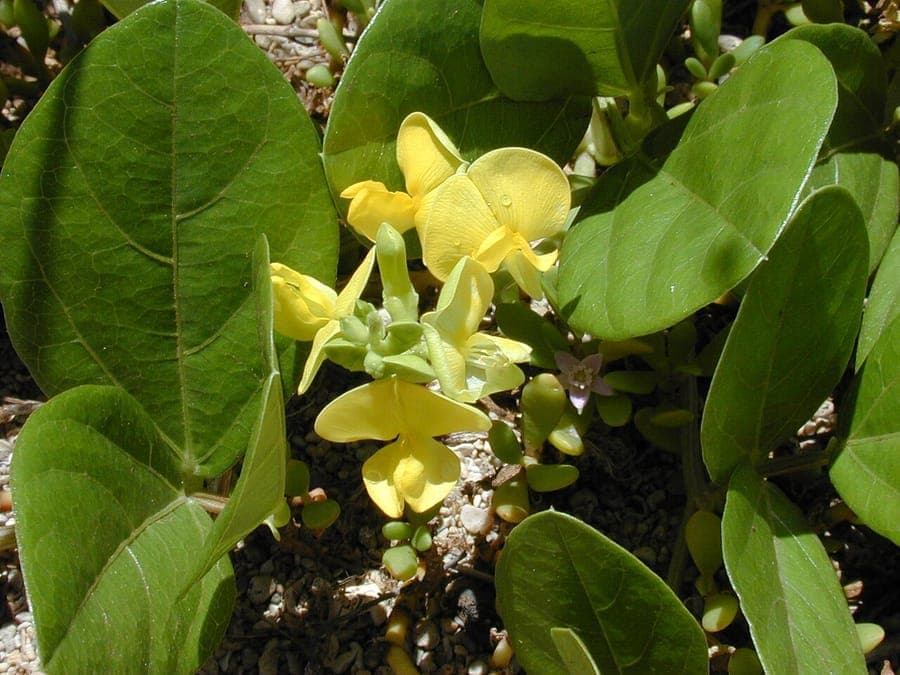
Forest & Kim Starr / CC BY 3.0, via Wikimedia Commons
Vigna marina: complete guide
Vigna marina
¿Quieres ver Vigna marina: complete guide en tu jardín?
1 minuto, sin tarjeta de crédito
Overview
Vigna marina, commonly known as beach bean, notched cowpea, or shore bean, is a robust climbing plant from tropical and subtropical coastal regions worldwide. This distinctive plant belongs to the Fabaceae family and is adapted to the challenging conditions of sea-beaten coasts with saltwater, wind, and sand. With its purple to lilac flowers and remarkable salt tolerance, it is an unforgettable choice for beach landscaping.
Appearance and Bloom
Vigna marina grows as a sprawling vine with fine, trifoliate leaves that give a smooth, graceful appearance. The stems are often reddish-purple in color. From June to September, plants produce charming purple to lilac flowers in dense clusters - a delicate color expression against the blue sea background.
After flowering, elongated seed pods develop containing seeds, completing the seed dispersal mechanism.
Ideal Location
Vigna marina thrives best in fully sunny locations with salt-air tolerance. This plant is exceptionally salt-resistant and can be exposed directly to sea spray. Place it where other plants might not survive - on sea walls, dunes, or protected coastal flats. It tolerates wind and salt exceptionally well.
Soil
The plant grows in virtually all soils, including sandy, poor coastal conditions. It prefers well-draining sand or sand-soil mixture. This is absolutely not a plant requiring rich soil; it is adapted to poor soils. pH can vary, as it is salt-tolerant.
Diseño gratis
¿Quieres ver Vigna marina: complete guide en tu jardín? Crea un diseño gratis ahora.
Watering
Once established, Vigna marina is very drought-resistant and needs minimal supplemental water. Young plants should be watered until rooted, typically after 2-3 weeks. After that, gradually reduce watering. In very dry periods, supplemental water can help, but it is not always necessary.
Pruning
Vigna marina requires virtually no pruning. This is a low-maintenance plant that continuously renews itself. Only dead or broken branches should be removed when they occur. The plant can be shaped for form, but this is optional.
Maintenance Calendar
- Spring: Ensure good surface water; check condition
- Summer: Water only during extreme drought; enjoy blooms
- Autumn: Plant continues growing; minimal maintenance
- Winter: Plant may grow depending on climate; no winter concerns
Winter Hardiness
Vigna marina is not winter-hardy in temperate climates outside tropical range. However, it is highly resistant to sea spray and extreme conditions. In subtropical zones, it can survive with some protection.
Companion Plants
Combine with other salt-tolerant coastal plants such as dusty miller (Senecio), matrimony vine (Lycium), or other dune plants for an authentic beach landscape.
Closing
Vigna marina is an extraordinary choice for coasts and beaches where standard garden plants fail. With its elegant flowers and remarkable salt resistance, it is a valuable addition. For advice on coastal specialization, consult gardenworld.app.
¿Quieres ver Vigna marina: complete guide en tu jardín? Crea un diseño gratis ahora.
Sube una foto, elige un estilo y obtén un diseño fotorrealista con lista de plantas en menos de un minuto.
Más de 10.000 jardines diseñados
Sin tarjeta de crédito


Plantas similares
Tall Silky Lupine: complete guide
Lupinus elatus
Tall silky lupine is a fast-growing Californian perennial with silvery foliage and blue-purple flower spikes, ideal for a prairie-style garden.
Garfield Lupine: complete guide
Lupinus garfieldensis
The Garfield lupine is a rare, fast-growing American perennial for alkaline, dry grassland gardens, with striking blue flower spikes.
Lupinus elegans: complete guide
Lupinus elegans
Lupinus elegans, the elegant lupine, is a spectacular blooming plant from Mexico with blue flower spikes. Care, cultivation and garden use.