
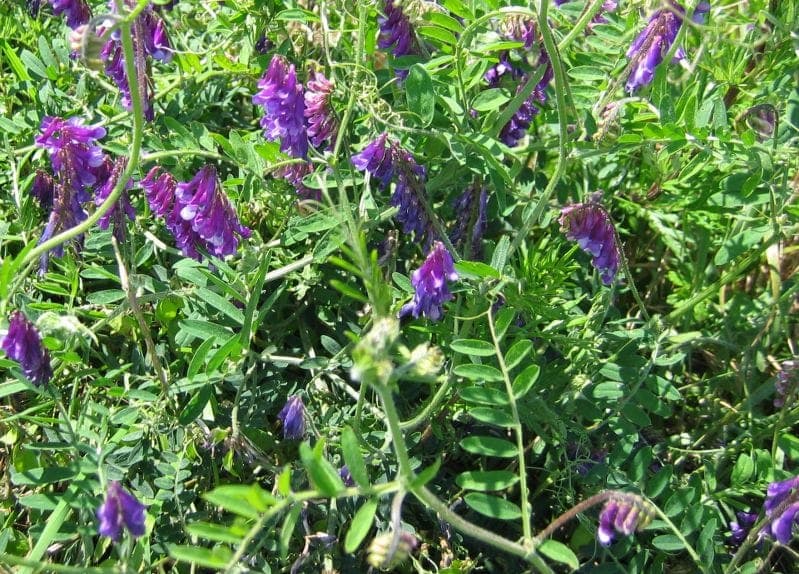
No machine-readable author provided. Fabelfroh assumed (based on copyright claims). / CC BY-SA 3.0, via Wikimedia Commons
Vicia villosa: complete guide
Vicia villosa
¿Quieres ver Vicia villosa: complete guide en tu jardín?
1 minuto, sin tarjeta de crédito
Overview
Vicia villosa, commonly known as hairy vetch or woolly vetch, is a treasured green manure crop in organic gardening and small-scale farming. This climbing legume enriches soil with nitrogen thanks to its root nodules. In ornamental gardens, it serves as a winter filler for borders, offering attractive growth and valuable food for insects and birds.
Unlike many cover crops, hairy vetch is quite ornamental and flowers attractively. Hairy foliage provides texture, and from April through June, purple and white flowers bloom in dense spikes. Birds eagerly consume the seeds, making it a valuable addition to wildlife gardens.
Hairy vetch is remarkably hardy and survives winters in temperate climates. It grows faster than many other cover crops, making it ideal for gardeners wanting substantial green manure without waiting half a year.
Appearance and bloom cycle
Hairy vetch grows upright to semi-climbing, reaching 60 to 120 cm in good conditions depending on support. The stems are distinctly hairy, giving a velvety appearance. Compound leaves consist of twelve to sixteen leaflets, also hairy.
Flowers appear April through June in dense, elongated spikes. Individual flowers are small but numerous, coloured purple and white striped, sometimes nearly white, occasionally darker purple. Following pollination, narrow seed pods develop, turning brown and eventually drying and splitting.
Ideal location
Hairy vetch thrives in full sun to partial shade, performing best in full sun. At least four hours direct daily sunlight ensures robust growth. In partial shade, growth slows but remains acceptable.
The plant is flexible regarding location. It tolerates cooler spots, though it prefers sheltered positions. A windless spot against a wall or garden building is ideal.
Soil requirements
Hairy vetch is tolerant regarding soil quality. It grows in poor soil, average soil and even slightly richer soil. The plant supplies its own nitrogen via root nodules, so extra fertilisation isn't necessary. In overly rich soil, foliage dominates at the expense of flowers.
Whatever your soil type - sandy, clay or loam - provided it doesn't waterlog, hairy vetch accepts it. Moisture retention matters, so in sandy or poor soil, work in compost for better performance.
Watering
Once hairy vetch establishes, water needs are moderate. In normal autumns and winters, little extra water is needed beyond rainfall. In dry spring months, water moderately to support growth.
Once full growth is reached (February-March), the plant becomes more drought-tolerant. Later in the season, extra water is needed only during extreme dryness. Water at the base, avoiding foliage to prevent fungal issues.
Diseño gratis
¿Quieres ver Vicia villosa: complete guide en tu jardín? Crea un diseño gratis ahora.
Pruning
When used as a cover crop, hairy vetch needs minimal pruning. Let it grow freely and tangle - that's the whole point. If you want it tidier in borders, gently pinch growing tips in early spring (January-February) for neater appearance.
After flowering (June), you can cut back if replacing with other plantings. Or let it fully mature for maximum organic matter incorporation.
Maintenance calendar
May-June: Sow directly outdoors just after last frost. Press lightly into soil, maintain moisture. Seedlings emerge within two to three weeks.
July-August: Growth accelerates. Water during dry spells. Plant establishes well.
September-October: Growth continues toward flowering. Little additional water needed. Plant works nitrogen into soil for following seasons.
November-March: Winter growth. In mild winters, it grows continuously. Enjoy flowers April-May.
April-June: Full bloom. Seeds mature. Early June you can dig in as green manure or harvest for seed.
Winter hardiness
Hairy vetch is frost-hardy to about -10 degrees Celsius. In temperate regions of northern Europe, it usually overwinters without issue. In very severe winters (below -15 degrees), damage may occur, but plants typically regrow from the base.
It grows as a winter annual: sow in May, grow through autumn and winter, flower and set seed in spring, ready to dig in by June. It can grow as a spring annual, but this provides less effective soil enrichment.
Companion plants
Hairy vetch combines well with other cover crops like clover and other legumes. In ornamental gardens, it partners nicely with winter-green plants like ivy, evergreen shrubs and other winter-flowering species.
For pollinator-friendly combinations, pair with flowering winter plants to attract bees and other beneficial insects.
Closing thoughts
Hairy vetch is a practical and beautiful addition to sustainable gardens. Sow in May, enjoy spring flowers and work nitrogen-rich biomass into soil for next season. It feeds birds, provides flowers for bees and other insects, and enriches your soil at no cost. Source seeds from garden centres and embrace green manuring. Visit gardenworld.app for more sustainable gardening ideas and design solutions.
Want ideas for planting your entire front yard sustainably with green manures and wildflowers? Explore gardenworld.app for plans and practical advice.
¿Quieres ver Vicia villosa: complete guide en tu jardín? Crea un diseño gratis ahora.
Sube una foto, elige un estilo y obtén un diseño fotorrealista con lista de plantas en menos de un minuto.
Más de 10.000 jardines diseñados
Sin tarjeta de crédito


Plantas similares
Tall Silky Lupine: complete guide
Lupinus elatus
Tall silky lupine is a fast-growing Californian perennial with silvery foliage and blue-purple flower spikes, ideal for a prairie-style garden.
Garfield Lupine: complete guide
Lupinus garfieldensis
The Garfield lupine is a rare, fast-growing American perennial for alkaline, dry grassland gardens, with striking blue flower spikes.
Lupinus elegans: complete guide
Lupinus elegans
Lupinus elegans, the elegant lupine, is a spectacular blooming plant from Mexico with blue flower spikes. Care, cultivation and garden use.