
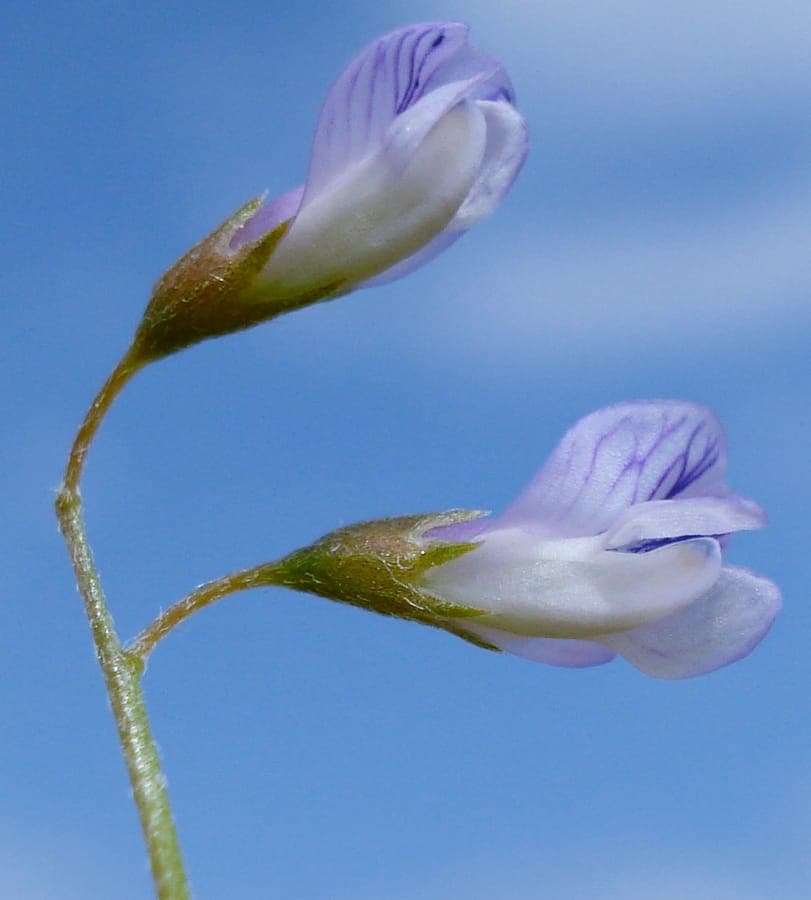
Fornax / CC BY-SA 3.0, via Wikimedia Commons
Vicia tetrasperma: complete guide
Vicia tetrasperma
¿Quieres ver Vicia tetrasperma: complete guide en tu jardín?
1 minuto, sin tarjeta de crédito
Overview
Vicia tetrasperma, commonly known as four-seed vetch or slender vetch, is a charming climbing plant from the pea family that thrives in borders, wildflower meadows and garden edges. Originally found across Europe and Asia, it earned its name from the distinctive seed pods containing just four seeds. It's a garden asset in two ways: it provides food for birds through its seeds, and the flowers attract bees and other pollinators.
In the garden, four-seed vetch works as either an annual or self-seeding perennial. When grown as an annual, it completes its life cycle in a single season. But once established, it readily self-seeds, returning year after year without effort. This makes it perfect for gardeners seeking natural results with minimal maintenance.
From May through August, delicate purple flowers appear in loose clusters along the climbing stems. These flowers are a magnet for bumblebees and other beneficial insects, making four-seed vetch an excellent choice for wildlife-friendly gardens.
Appearance and bloom cycle
Four-seed vetch grows as a slender climbing plant reaching 30 to 60 cm tall, though it prefers to scramble higher with support. The fine, finely-divided leaves appear feathery due to their light green color and delicate structure. Each leaf contains six to twelve pairs of small leaflets arranged alternately along the stem.
The flowering period spans May through August. Tiny purple or lavender-blue flowers appear in clusters of two to six blooms arranged along the stem. After pollination, narrow seed pods develop, each containing exactly four seeds - hence the botanical name tetrasperma.
Ideal location
Four-seed vetch performs best in full sun to partial shade. At minimum, six hours of direct sunlight daily encourages abundant flowering. In warmer regions, afternoon shade in August helps extend the bloom season.
The plant is adaptable and grows in lightly shaded borders too. It tolerates semi-shade, though you'll notice fewer flowers and slower growth. Dense shade will disappoint - flowering becomes minimal.
Soil requirements
This vetch carries nitrogen-fixing root nodules, meaning you needn't add much fertiliser. Even in poor, lean soil it thrives beautifully. Rich compost can actually be counterproductive, encouraging excessive leaf growth at the expense of flowers.
Whatever your soil type - sandy, clay or loam - as long as it drains well and doesn't waterlog, four-seed vetch accepts it. Slightly acidic to neutral pH is ideal. For very dry gardens, work in some compost to improve moisture retention without over-feeding.
Diseño gratis
¿Quieres ver Vicia tetrasperma: complete guide en tu jardín? Crea un diseño gratis ahora.
Watering
Once established, four-seed vetch has moderate water needs. Water regularly during dry spells, especially May-June and August, to maintain steady growth. Water at the base; wet foliage invites fungal issues.
After three to four weeks of growth, the established plant becomes quite drought-tolerant. In normal summers, extra watering is needed only during extreme dry spells. Reduce watering gradually in autumn.
Pruning
Four-seed vetch requires minimal pruning. Provide bamboo stakes or string supports and it climbs neatly upward with little fussing. For a wild, meadow-like effect, let it sprawl naturally and self-support among neighbouring plants.
Remove only dead, damaged or diseased growth. After flowering ends in September, you can cut back to 15 cm if you prefer a tidier appearance. But letting it grow untamed creates a more natural feel - it will die back with the first hard frost anyway.
Maintenance calendar
April-May: Sow seeds directly outdoors in moist soil. Press lightly into contact. Seedlings emerge within two to three weeks.
June-July: Water regularly and train growth up supports. Enjoy the flowers and watch for pollinators.
August: Flowering continues. Water only during dry spells. Allow some seed pods to mature and ripen.
September-October: Bloom fades. Seed pods dry and split, dropping seeds for next year's plants.
November-March: Plant dies back or disappears under fallen leaves. In spring, volunteer seedlings emerge from self-sown seed.
Winter hardiness
Four-seed vetch is frost-tender. The plant tolerates light frosts of a few degrees Celsius but doesn't survive winter outdoors in cold climates. In most of northern Europe, it won't persist as a winter annual where temperatures regularly drop below -5 degrees Celsius.
Instead, it performs as a true annual: plants die in autumn-winter, then new plants grow from self-sown seed the following spring.
Companion plants
Pair four-seed vetch with other wildflower species: cornflower (Centaurea cyanus), poppy (Papaver rhoeas), borage and other heritage herbs. It also mingles beautifully in borders with Geranium, Aquilegia and ornamental grasses.
In wildflower meadows, it partners perfectly with other legumes like lupins and other meadow flowers for a unified natural effect.
Closing thoughts
Vicia tetrasperma is an understated yet invaluable addition to any garden embracing nature. With minimal effort, it delivers flowers, insect food and seed for birds. Let it self-sow and you'll have flowers for years without extra work. Source seeds from garden centres and make your garden wilder this season. Visit gardenworld.app for more ideas on creating beautiful wild corners and natural planting schemes.
Want ideas for planting your entire front yard with wildflowers? Explore gardenworld.app for inspiration and practical design solutions.
¿Quieres ver Vicia tetrasperma: complete guide en tu jardín? Crea un diseño gratis ahora.
Sube una foto, elige un estilo y obtén un diseño fotorrealista con lista de plantas en menos de un minuto.
Más de 10.000 jardines diseñados
Sin tarjeta de crédito


Plantas similares
Tall Silky Lupine: complete guide
Lupinus elatus
Tall silky lupine is a fast-growing Californian perennial with silvery foliage and blue-purple flower spikes, ideal for a prairie-style garden.
Garfield Lupine: complete guide
Lupinus garfieldensis
The Garfield lupine is a rare, fast-growing American perennial for alkaline, dry grassland gardens, with striking blue flower spikes.
Lupinus elegans: complete guide
Lupinus elegans
Lupinus elegans, the elegant lupine, is a spectacular blooming plant from Mexico with blue flower spikes. Care, cultivation and garden use.