
Ivar Leidus / CC BY-SA 3.0, via Wikimedia Commons
Hedge vetch: complete guide
Vicia sepium
¿Quieres ver Hedge vetch: complete guide en tu jardín?
1 minuto, sin tarjeta de crédito
Overview
Hedge vetch, scientifically known as Vicia sepium, is a frost-hardy and reliable climber from the Fabaceae family. This plant occurs naturally throughout Europe to China and the Western Himalayas, with distribution also extending to Morocco. Hedge vetch remains widely used for edging hedgerows and proves valuable in natural gardens thanks to its purple flowers and insect attraction.
Thanks to its winter hardiness, moderate growth rate, and adaptability, hedge vetch represents an excellent choice for those seeking a durable, low-maintenance plant.
Appearance and Bloom
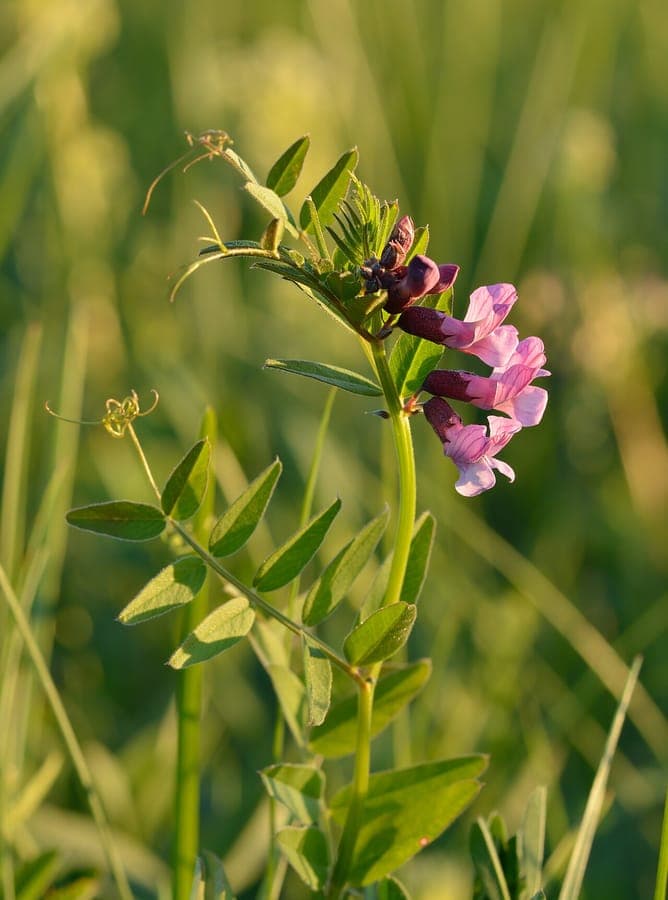
Hedge vetch characterizes itself through compound leaves with small oval leaflets, typical for the Vicia genus. The leaves are mid-green and provide attractive texture. The plant grows as a climber via spiral tendrils.
Flowers appear from April through September in purple to bluish-purple colors. These flowers are small to medium-sized and form compact inflorescences. Following flowering, small pod fruits develop that feel rough and contain self-dispersing seeds.
Ideal Location
Hedge vetch grows well in locations with abundant light but tolerates partial shade better than many other vetches. The plant requires at least four to six hours of direct sunlight daily. In natural environments, this plant is frequently found in semi-shaded locations.
The plant proves ideal for hedgerows, against fences, or on pergolas. In mixed borders, hedge vetch adds vertical dimension.
Soil
Hedge vetch remains flexible regarding soil requirements and grows well in moderate to nutrient-rich soils. The plant tolerates both acidic and alkaline soils and flourishes at pH 7.0 to 7.5. Well-draining soil is preferred.
Planting in nutrient-rich compost or with applied organic matter promotes growth. The plant forms nitrogen-fixing symbiosis and gradually improves soil quality.
Diseño gratis
¿Quieres ver Hedge vetch: complete guide en tu jardín? Crea un diseño gratis ahora.
Watering
Hedge vetch requires regular moisture during growth and flowering periods. Once established, the plant tolerates drought reasonably well. For optimal flowering, consistently moist but not waterlogged soil proves ideal.
Regularly check soil moisture several centimeters deep. In autumn and winter, watering can be moderated.
Pruning
Hedge vetch can be regularly pruned to maintain desired shape. In early spring, overgrown tendrils can be shortened. This also encourages more compact growth.
The plant tolerates aggressive pruning well and will regenerate quickly. Dead or diseased portions can be removed throughout the season.
Maintenance Calendar
Winter: Plant enters dormancy; minimal moisture needed. Early Spring: Check plant structure and prune if necessary. Spring: Full growth and early flowering; water regularly. Summer: Peak flowering; maintain consistently moist soil. Autumn: Growth slows; moderate watering.
Winter Hardiness
Hedge vetch is extremely winter-hardy and ranks among the hardiest Vicia species. The plant survives severe winters without special protection in most temperate climate zones. Even if above-ground portions freeze, the plant will regenerate from its root system.
In very severe climates, mulching around the plant base in late autumn proves beneficial.
Companion Plants
Hedge vetch works excellently with other hedgerow plants such as privet and hornbeam. In mixed borders it can be planted with other climbers such as ivy or clematis.
The plant attracts numerous insects and birds, making it valuable in biodiversity-focused gardens.
Final Thoughts
Hedge vetch likely ranks among the hardiest and most durable Vicia species for temperate climate zones. Its winter hardiness, soil flexibility, beautiful purple flowers, and value for insects and birds make it a true asset for sustainable, natural gardens. Whether cultivating this plant for hedgerows, borders, or purely for wildlife benefit, it consistently proves a reliable and valuable performer.
Note: Find this plant at garden centers and nurseries throughout Europe.
¿Quieres ver Hedge vetch: complete guide en tu jardín? Crea un diseño gratis ahora.
Sube una foto, elige un estilo y obtén un diseño fotorrealista con lista de plantas en menos de un minuto.
Más de 10.000 jardines diseñados
Sin tarjeta de crédito


Plantas similares
Tall Silky Lupine: complete guide
Lupinus elatus
Tall silky lupine is a fast-growing Californian perennial with silvery foliage and blue-purple flower spikes, ideal for a prairie-style garden.
Garfield Lupine: complete guide
Lupinus garfieldensis
The Garfield lupine is a rare, fast-growing American perennial for alkaline, dry grassland gardens, with striking blue flower spikes.
Lupinus elegans: complete guide
Lupinus elegans
Lupinus elegans, the elegant lupine, is a spectacular blooming plant from Mexico with blue flower spikes. Care, cultivation and garden use.