
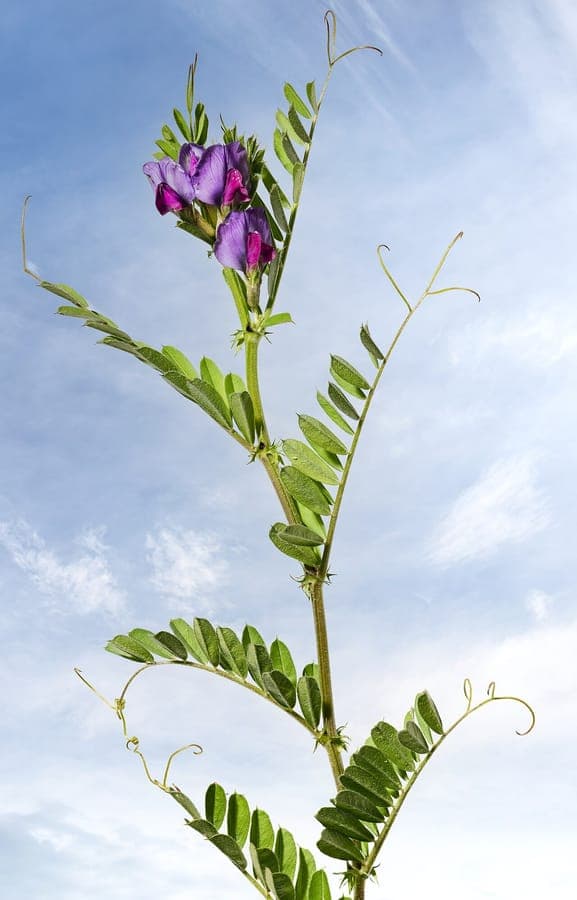
Didier Descouens / CC BY-SA 4.0, via Wikimedia Commons
Common vetch: complete guide
Vicia sativa
¿Quieres ver Common vetch: complete guide en tu jardín?
1 minuto, sin tarjeta de crédito
Overview
Common vetch, scientifically known as Vicia sativa, is arguably the most practical and widespread of all Vicia species. This plant belongs to the Fabaceae family and occurs naturally from North Africa to East Africa and is distributed through temperate Eurasia to the Arabian Peninsula. With its purple to pink flowers and robust growth habit, common vetch proves useful in both ornamental and functional garden situations.
Common vetch, thanks to its hardiness, rapid growth, and nitrogen-fixing ability, remains highly popular in organic agriculture and sustainable gardening practices. This makes it not merely a useful plant, but truly a valuable addition to any garden.
Appearance and Bloom
Common vetch characterizes itself through compound leaves with small oval leaflets arranged alternately along the leaf stem. The leaf stems terminate in spiral tendrils that readily cling to nearby plants.
The flowers are striking and appear in purple, pink, or sometimes nearly white colors. These flowers are conspicuous and highly attractive to insects. Following flowering, characteristic pod fruits develop that feel rough and release seeds when mature.
Ideal Location
Common vetch grows practically anywhere sunlight is available. The plant requires at least six hours of direct sunlight daily and thrives best in full sun. However, the plant's tolerance is high and grows well in partially shaded environments, though with slightly reduced floral abundance.
The plant can grow upright with support or climbing against structures. In green manure applications, common vetch is seeded directly into soil.
Soil
Common vetch grows well on diverse soil types. The plant thrives in moderate to nutrient-rich soils and tolerates both acidic and alkaline conditions. pH between 6.0 and 8.0 proves suitable.
The plant forms nitrogen-fixing symbiosis with soil organisms and thereby contributes to soil fertility. Well-draining soil is preferred, but the plant tolerates wet conditions reasonably well.
Diseño gratis
¿Quieres ver Common vetch: complete guide en tu jardín? Crea un diseño gratis ahora.
Watering
Common vetch requires regular moisture during active growth. Once established, the plant tolerates drought reasonably well. For optimal growth and flowering, consistently moist but not waterlogged soil proves ideal.
During rainy periods, natural precipitation usually suffices. Regularly check soil moisture several centimeters deep.
Pruning
Common vetch requires minimal pruning. If the plant grows excessively, vines can be shortened. Some gardeners stop growth back when the plant reaches certain height to encourage branching.
Dead or damaged portions can be removed throughout the season. In late season, entire plants can be worked into soil as green manure.
Maintenance Calendar
Spring: Sow when frost passes; prepare soil and seed directly into beds. Early Summer: Expect rapid growth; regular watering supports establishment. Summer: Flowering and seed setting; consistent moisture for best results. Autumn: Plant begins decline; seed setting concludes. Winter: Dormant season; remains can be worked in.
Winter Hardiness
Common vetch functions as an annual or very short-lived plant in most climates. It blooms quickly and sets seed, after which the plant dies. In milder climates, seed can overwinter and self-regenerate.
In very mild zones, volunteer plants from previous year's seed germinate in spring, providing early blooms.
Companion Plants
Common vetch works excellently with grain crops and other cereals in crop rotation. In ornamental gardens it can be planted with adapted grass species and other Fabaceae members.
The plant attracts hoverflies and other beneficial insects, making it valuable in biodiversity-focused garden design.
Final Thoughts
Common vetch represents a pragmatic plant choice for sustainable gardening practices. Its robustness, rapid growth, nitrogen-fixing ability, insect attraction, and usefulness as green manure make it a true asset for garden and field. Whether cultivating this vetch for fodder, green manure, or purely ornamental reasons, it consistently proves a reliable performer.
Note: Find this plant at garden centers and nurseries throughout Europe.
¿Quieres ver Common vetch: complete guide en tu jardín? Crea un diseño gratis ahora.
Sube una foto, elige un estilo y obtén un diseño fotorrealista con lista de plantas en menos de un minuto.
Más de 10.000 jardines diseñados
Sin tarjeta de crédito


Plantas similares
Tall Silky Lupine: complete guide
Lupinus elatus
Tall silky lupine is a fast-growing Californian perennial with silvery foliage and blue-purple flower spikes, ideal for a prairie-style garden.
Garfield Lupine: complete guide
Lupinus garfieldensis
The Garfield lupine is a rare, fast-growing American perennial for alkaline, dry grassland gardens, with striking blue flower spikes.
Lupinus elegans: complete guide
Lupinus elegans
Lupinus elegans, the elegant lupine, is a spectacular blooming plant from Mexico with blue flower spikes. Care, cultivation and garden use.