
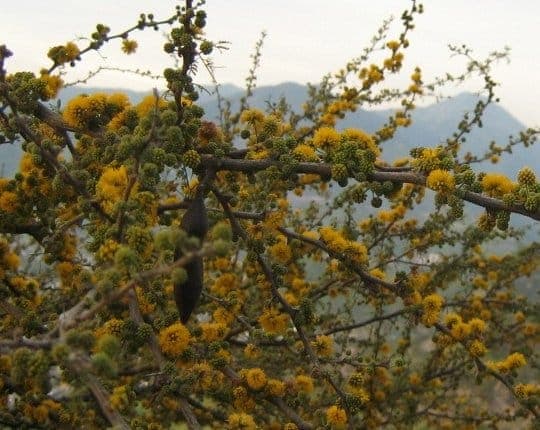
Cropped version of picture from Penarc / Public domain, via Wikimedia Commons
Roman cassie: complete guide
Vachellia caven
¿Quieres ver Roman cassie: complete guide en tu jardín?
1 minuto, sin tarjeta de crédito
Overview
Vachellia caven, commonly known as Roman cassie or espino caván, is a shrub to small tree belonging to the Fabaceae family. This South American species occurs naturally from Bolivia to Uruguay and is well adapted to arid, nutrient-poor climates. The plant forms dense hedges and can grow as a solitary tree to 6 meters height.
Vachellia caven distinguishes itself through delicate, doubly compound pinnate foliage and sharp thorns. The plant produces bright yellow flower clusters and bears thick, slowly dehiscing pods. For arid gardens and Mediterranean-climate gardening, this tree offers a robust, interesting option.
Appearance and Bloom
The foliage of Vachellia caven is doubly compound and imparts an airy, silken appearance. Leaves measure approximately 2 to 4 centimeters long and consist of numerous tiny leaflets. During the growth period, the foliage creates a light, rounded silhouette against the sky.
Flowers are produced in bright yellow, spherical pompoms highly fragrant to many observers. The blooming period typically runs from July through September in the southern hemisphere, though timing may be reversed in the northern hemisphere depending on planting location. Following bloom, the plant produces long pods to 10 centimeters that provide food for wildlife.
Ideal Location
Vachellia caven thrives in full sun (requiring at least six to eight hours of direct sunlight). In shaded locations, the plant grows slower and produces fewer flowers. Position this tree at a location with good drainage and provide wind protection when young.
This plant tolerates arid conditions exceptionally well, making it ideal for gardens in arid climates. Avoid placement in lowlying wetland areas where water tends to accumulate. The plant works well in coastal areas where salt spray resistance is necessary.
Soil
Vachellia caven grows in virtually all soil types, including poor, sandy, and rocky soils. The plant demonstrates remarkable tolerance for low fertility and can grow in locations where other plants fail. Soils with pH values from 5.0 to 8.0 are accepted.
While tolerant of poor conditions, the plant grows faster in well-drained, fertile soils. When growing in poor soil, feeding with slow-release fertilizer can promote stronger growth. The tree has nitrogen-fixing capabilities through associations with Rhizobium bacteria, which can improve soil fertility over time.
Diseño gratis
¿Quieres ver Roman cassie: complete guide en tu jardín? Crea un diseño gratis ahora.
Watering
Once established, Vachellia caven tolerates extended drought very well. Young trees require regular water (once weekly) during the first growing season to encourage deep rooting. After establishment (typically six months to one year), watering can be substantially reduced.
In very arid climates, supplemental water during the hottest months may promote growth. In rainfall-abundant regions, supplemental water is typically unnecessary. The tree survives on as little as 200-300 mm of annual precipitation.
Pruning
Vachellia caven responds well to pruning and can be shaped into hedge structures or tree forms. Pruning is best performed after flowering. This tree tolerates firm pruning without serious consequences.
Early formative pruning helps develop strong tree architecture. Mature trees can be trained to high-stem forms by removing lower branches as desired. Severe pruning may be necessary to rejuvenate old specimens.
Maintenance Calendar
In regions with distinct seasons: Spring (September through November in southern hemisphere) - active growth, regular watering, no pruning until after bloom. Summer - full growth, apply fertilizer once if desired. Autumn - slowing growth, reduce watering. Winter - dormancy, minimal care.
Annual inspection for pest problems, particularly spider mites in hot, dry conditions.
Winter Hardiness
Vachellia caven tolerates frost periods to approximately -10 degrees Celsius, though leaves and young twigs show damage. In areas with severe frost (below -10 degrees), this tree grows better as a container specimen that can be moved indoors.
In tropical regions without frost, the plant thrives and reaches maximum size. The tree is not suitable for cold climates but performs excellently in Mediterranean and warm-temperate zones.
Community Support
Connect with local growers in arid climates for region-specific cultivation tips. Acacias and related genera often have specific site and care requirements particular to each region.
Closing Thoughts
Vachellia caven offers a strong, drought-tolerant choice for gardens in warm, arid climates. With minimal care, this tree provides years of visual interest and wildlife benefits. For Mediterranean and semi-arid gardens, Roman cassie represents a robust, low-maintenance tree option.
Explore more drought-tolerant trees at gardenworld.app. For warm climate gardens, gardenworld.app helps you find strong, sustainable choices.
¿Quieres ver Roman cassie: complete guide en tu jardín? Crea un diseño gratis ahora.
Sube una foto, elige un estilo y obtén un diseño fotorrealista con lista de plantas en menos de un minuto.
Más de 10.000 jardines diseñados
Sin tarjeta de crédito


Plantas similares
Tall Silky Lupine: complete guide
Lupinus elatus
Tall silky lupine is a fast-growing Californian perennial with silvery foliage and blue-purple flower spikes, ideal for a prairie-style garden.
Garfield Lupine: complete guide
Lupinus garfieldensis
The Garfield lupine is a rare, fast-growing American perennial for alkaline, dry grassland gardens, with striking blue flower spikes.
Lupinus elegans: complete guide
Lupinus elegans
Lupinus elegans, the elegant lupine, is a spectacular blooming plant from Mexico with blue flower spikes. Care, cultivation and garden use.