
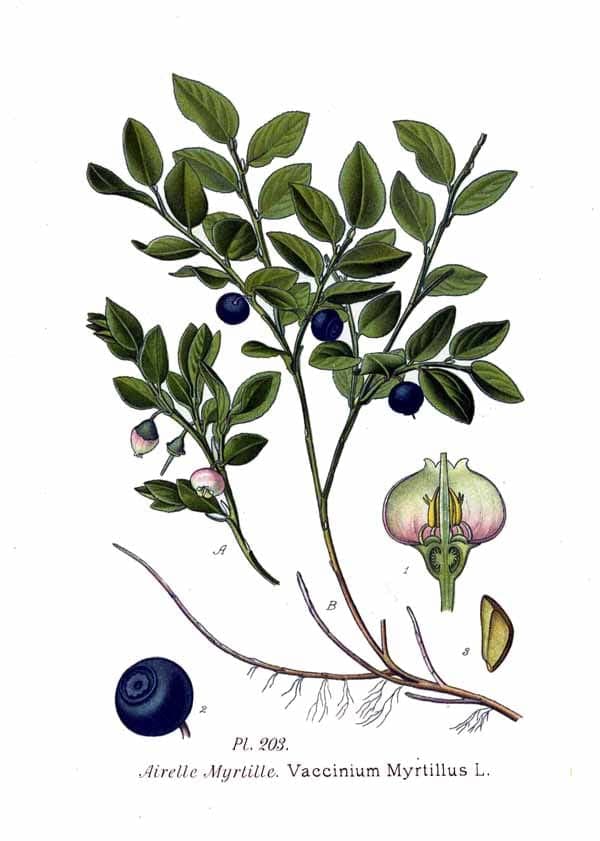
Amédée Masclef / Public domain, via Wikimedia Commons
Bilberry: complete guide
Vaccinium myrtillus
¿Quieres ver Bilberry: complete guide en tu jardín?
1 minuto, sin tarjeta de crédito
Overview
The bilberry or European blueberry (Vaccinium myrtillus), also called whortleberry or whinberry, is a compact shrub native across temperate and boreal Europe. This wild ancestor of cultivated blueberries grows only 0.3-0.8 meters tall and spreads via underground rhizomes, creating attractive ground cover. Despite its small stature, it produces intensely sweet, dark berries highly valued for jams and liqueurs.
Bilberries are ecologically invaluable, providing food for wildlife while requiring minimal maintenance once established. A mature colony yields several kilograms annually, sufficient for household preserving.
Appearance and bloom
Bilberry forms a low, dense shrub with wiry stems and small, ovate, deciduous leaves. Summer foliage is bright green; autumn brings striking red-purple tones. Flowers appear May-June as small, bell-shaped blooms in rosy-red or pale pink, subtly attractive.
Berries ripen to glossy blue-black, 0.5-1 cm diameter, intensely sweet with no tartness. Fruit attracts birds and small mammals voraciously. The leaves were traditionally steeped for medicinal tea.
Ideal location
Bilberries thrive in semi-shade to dappled light, naturally growing beneath thin tree canopy in upland forests. Provide 3-6 hours of sun daily; eastern aspects with morning sun suit moist climates. In dryer regions, afternoon shade becomes essential to prevent stress.
Plant in groups or clusters for authentic woodland aesthetic. Border plantings along shade-edge transitions work beautifully, echoing natural distribution patterns.
Soil
Bilberries are edaphic specialists, demanding strongly acidic soil (pH 3.5-4.5) rich in organic matter. In nature, they colonize peaty humus layers and sandy soils. Replicate this with 50% peat moss/composted pine bark and 50% coarse sand.
Incorporate abundant organic matter-leaf mold, wood chips, or composted conifer needles. Heavy clay soils need serious amendment; bilberries rarely thrive in compacted, poorly-drained conditions.
Diseño gratis
¿Quieres ver Bilberry: complete guide en tu jardín? Crea un diseño gratis ahora.
Watering
Bilberries tolerate drier conditions than most berries, yet benefit from consistent moisture during growing season. Avoid waterlogging; good drainage is essential. In dry summers, supplement rainfall. Apply leaf litter mulch annually to retain moisture and feed acidic humus layer.
Once established in suitable soil, additional watering is rarely necessary except during exceptional drought.
Pruning
Bilberries require minimal intervention. Light pruning in late winter removes dead or diseased wood. The natural compact form is usually perfect; avoid heavy cutting, which severely reduces fruiting for following years.
If spreading becomes excessive, gentle removal of peripheral branches controls size without stress. Annual removal of debris maintains aesthetic appeal.
Maintenance calendar
March: Light pruning; inspect for damage. April-May: Monitor soil moisture; growth begins. June-July: Flowers set fruit; minimal intervention. August-September: Harvest ripe berries; observe color change. October-February: Dormancy; colony expansion via rhizomes.
Winter hardiness
Bilberry is exceptionally hardy to -40C, thriving across Nordic regions, Scotland, and subarctic Asia. This plant needs no winter protection in any temperate European climate. Snow cover provides minor benefit in harsh conditions.
Companion plants
Bilberries combine beautifully with other ericaceous plants: lingonberry (Vaccinium vitis-idaea), cranberry, crowberry, and moss. In forest-garden contexts, they carpet ground beneath deciduous or light-canopy evergreen trees.
Understory plants such as wood anemone, wild strawberry, and ferns enhance diversity without competing. Leave sufficient spacing for rhizome expansion.
Closing
Bilberry is an exceptional choice for shade gardening, woodland creation, and natural ground-cover implementation. Extremely hardy, low-maintenance, and ecologically vital, it delivers fresh wild fruit while supporting bird and insect populations. Sourcing from specialist native-plant nurseries ensures genetic diversity.
Design comprehensive forest-garden systems integrating bilberries via gardenworld.app's composition tools. Consult gardenworld.app for seasonal maintenance schedules and wildlife-integration strategies.
¿Quieres ver Bilberry: complete guide en tu jardín? Crea un diseño gratis ahora.
Sube una foto, elige un estilo y obtén un diseño fotorrealista con lista de plantas en menos de un minuto.
Más de 10.000 jardines diseñados
Sin tarjeta de crédito


Plantas similares
Zenobia pulverulenta: complete guide
Zenobia pulverulenta
Everything about Zenobia pulverulenta (honeycup): siting, acid soil, pruning and the fragrant white bells, in this complete care guide.
Dwarf huckleberry: complete guide
Gaylussacia dumosa
Everything about dwarf huckleberry (Gaylussacia dumosa): acidic soil, partial shade, pruning and care for this compact North American berry shrub.
Drooping leucothoe: complete guide
Leucothoe fontanesiana
Everything about drooping leucothoe (Leucothoe fontanesiana): shade tolerance, soil, watering, pruning, hardiness and companion plants.