
Wikimedia Commons / Public domain, via Wikimedia Commons
Zenobia pulverulenta: complete guide
Zenobia pulverulenta
¿Quieres ver Zenobia pulverulenta: complete guide en tu jardín?
1 minuto, sin tarjeta de crédito
Overview
Zenobia pulverulenta, commonly called honeycup or dusty zenobia, is an underused deciduous to semi-evergreen shrub in the heath family (Ericaceae). The species is native to the south-eastern coastal plains of the United States, where it grows in moist, acidic peaty ground. In gardens it earns its place through two features: strikingly blue-grey, dusted foliage and dangling, pure white bells that carry a sweet aniseed scent. Anyone who already grows Pieris or blueberries will feel instantly at home with this plant, because the requirements and the mood are closely related.
Given the right corner, Zenobia develops into a loose, graceful shrub roughly one metre tall and wide. It is rare in mainstream garden centres, but specialist nurseries dealing in acid-loving plants usually stock it. On gardenworld.app you can preview how this refined shrub sits among your existing border planting before you buy.
Appearance and bloom
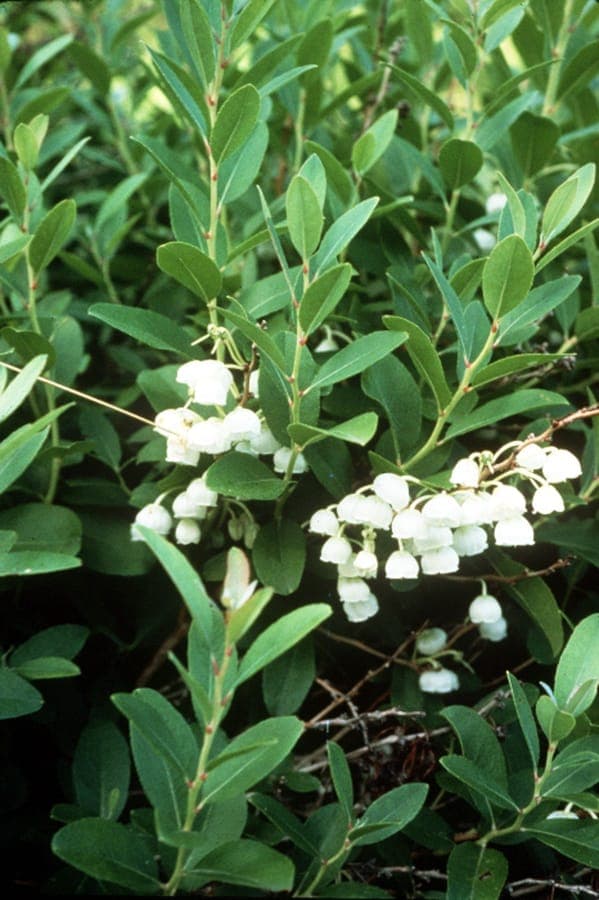
The chief ornamental value lies in the contrast between leaf and flower. Young shoots and leaves are coated in a whitish, waxy bloom that gives the foliage a cool blue-green, almost silvery cast. The leaves are oval to oblong, 3 to 6 cm long, and turn warm bronze-red in autumn before a portion falls.
Flowering follows in May and June. On the previous year's wood appear clusters of hanging, globe-shaped bells about 1 cm across, snow white and filled with a sweet, aniseed fragrance that draws bees and bumblebees. The blooms strongly resemble those of lily-of-the-valley, but on a woody shrub. After flowering, small dry seed capsules form that you can leave in place without concern.
Ideal location
Zenobia performs best in part shade, or in sun provided the soil stays reliably moist. A spot beneath light tree canopy, at the edge of a woodland border or beside a pond is ideal. Full, hot afternoon sun on dry ground is the one situation to avoid, because the fine foliage scorches and growth stalls under those conditions.
The shrub combines beautifully with other acid lovers. Think rhododendron, azalea, Pieris japonica, gaultheria and Japanese maple. Together they form a cohesive, woodland-edge tableau that offers something from spring through autumn. Allow roughly a metre of clear space all round so the naturally arching, slightly informal habit can show itself.
Soil
Here lies the heart of successful cultivation: Zenobia demands acidic soil with a pH between 4.5 and 5.5, just like rhododendron. On chalky or neutral ground the plant develops chlorosis, recognisable as yellow leaves with green veins, and slowly declines.
When planting, work in generous amounts of un-limed peat substitute, composted conifer needles or proprietary ericaceous compost. The earth must be both moisture-retentive and free-draining; improve heavy, wet clay with coarse organic matter. A mulch of needle litter or fine bark keeps the ground cool, damp and acidic. Avoid hard, limey tap water when watering in hard-water regions; collected rainwater is far preferable for keeping the root zone correctly acidic.
Watering
Consistent, even moisture matters more for Zenobia than for most shrubs. The shallow, fine roots dry out quickly, and the plant responds by shedding leaves and buds at once. Water regularly in the first and second years in particular, and never let the ground dry out completely during dry summer spells.
At the same time, the plant will not tolerate permanently saturated soil around the crown. Aim for the moisture of a well-wrung sponge. A thick mulch layer is your best tool: it limits evaporation and keeps the root zone cool. Use captured rainwater wherever possible, because prolonged irrigation with hard, lime-rich water raises the pH and undermines the long-term health of the shrub.
Diseño gratis
¿Quieres ver Zenobia pulverulenta: complete guide en tu jardín? Crea un diseño gratis ahora.
Pruning
Zenobia needs little pruning and naturally adopts an attractive, slightly open shape. Prune immediately after flowering in June, because next year's flower buds form on the new shoots of the current season. Anyone who cuts later in the year removes the coming display.
Limit yourself to taking out dead or damaged wood and the occasional over-long stem that breaks the outline. Older shrubs that grow bare at the base can be rejuvenated over several years by removing one third of the oldest stems close to the ground each time. That keeps the plant compact and free-flowering without the shock of a single hard cut-back.
Maintenance calendar
In early spring (March) top up the mulch with acidic compost or needle litter and, if you wish, apply a feed formulated for ericaceous plants. April and May are months of bud formation; keep the ground evenly moist then. During the bloom in May and June you mainly enjoy the show and water in dry spells.
Prune lightly straight after flowering in June. Through the hot summer months of July and August, regular watering is the key task, especially for young plants. In autumn the foliage colours up, and you can leave fallen leaves as a natural mulch. In winter the shrub is virtually maintenance-free; only protect newly planted specimens in hard frost with a layer of litter.
Winter hardiness
Zenobia pulverulenta is reliably hardy to about minus 25 degrees Celsius, corresponding to USDA zone 5. Across the Netherlands, Belgium and Germany the shrub overwinters outdoors without protection. Late spring frosts can occasionally damage young shoots or open flowers, but the plant recovers from that quickly.
Only freshly planted specimens in their first winter benefit from an extra layer of mulch around the base to shield the fine roots against drying frost winds and freeze-thaw cycles. Once established, the species is remarkably tough for such an elegant appearance.
Companion plants
Zenobia is happiest in the company of other acid-loving woodland plants. Combine it with rhododendron and azalea for spring colour, with Pieris japonica for evergreen foliage and hanging flower trusses, and with Japanese maple for autumn colour and structure. Low ground covers such as gaultheria, wintergreen and blueberry fill the base nicely.
For a natural woodland picture, ferns, hostas and Tiarella also sit well in the part shade beneath. By combining plants with staggered flowering times you create a border that offers something from March to November. On gardenworld.app you can assemble such a coherent planting in advance and see at once how Zenobia's blue-grey tones play against its neighbours.
Closing
Zenobia pulverulenta is a refined, fragrant shrub unfairly overshadowed by better-known ericaceous plants. Anyone who can offer acidic, moisture-retentive soil and a part-shade position is rewarded with blue-grey foliage, aniseed-scented white bells and warm autumn colour, all at minimal upkeep. Look for the plant at specialist growers of rhododendrons and acid-loving shrubs, since the standard garden centre rarely carries it. If you want to test in advance whether this shrub suits your garden's mood, design your border on gardenworld.app and see the result in a realistic image of your own garden.
¿Quieres ver Zenobia pulverulenta: complete guide en tu jardín? Crea un diseño gratis ahora.
Sube una foto, elige un estilo y obtén un diseño fotorrealista con lista de plantas en menos de un minuto.
Más de 10.000 jardines diseñados
Sin tarjeta de crédito


Plantas similares
Dwarf huckleberry: complete guide
Gaylussacia dumosa
Everything about dwarf huckleberry (Gaylussacia dumosa): acidic soil, partial shade, pruning and care for this compact North American berry shrub.
Drooping leucothoe: complete guide
Leucothoe fontanesiana
Everything about drooping leucothoe (Leucothoe fontanesiana): shade tolerance, soil, watering, pruning, hardiness and companion plants.
Fetterbush lyonia: complete guide
Lyonia lucida
Everything about Fetterbush lyonia (Lyonia lucida): location, soil, bloom cycle, pruning and ideal companion plants for this reliable evergreen shrub.